
2,400-Year-Old Iron Age Structure Found Beneath German Riverbank Stuns Archaeologists

2,400-Year-Old Iron Age Structure Found Beneath German Riverbank Stuns Archaeologists

An Iron Age structure in Aschaffenburg has emerged from beneath the bank of the Main River, and its age has surprised even the archaeologists called in to examine it.

The discovery was made during construction work for a rain overflow basin north of the Willigis Bridge. At first, the wooden remains seemed too well preserved to be truly ancient. Massive oak beams, still clearly visible deep below the modern surface, looked as if they might belong to a much later riverside installation.

But the timber told another story.

Scientific dating has now shown that the oak used in the structure was felled and built into place in the 4th century BC. That places the remains around 2,400 years ago, in the Iron Age, during the early La Tène period. For Aschaffenburg, a city already known to have traces of Iron Age activity, the find may be a rare architectural clue to a settlement whose importance has long been suspected but never fully understood.

A discovery made eight meters below the city

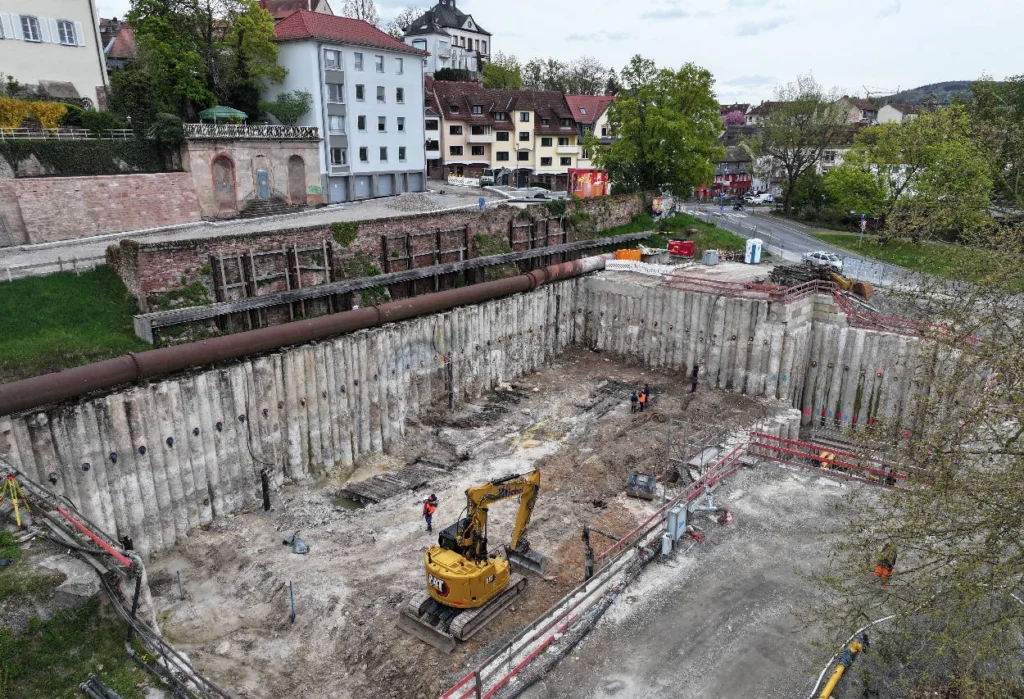
The wooden remains were encountered about eight meters below the surface during construction work near the Main River. The area had not previously been recorded as an archaeological monument, so the discovery came unexpectedly in an active building site.

After the find was reported to the Bavarian State Office for Monument Protection, known as the BLfD, archaeologists began documenting and recovering the remains under difficult conditions. The structure lay inside a deep construction pit, where every step had to be coordinated with safety requirements, engineering work, and the ongoing construction project.

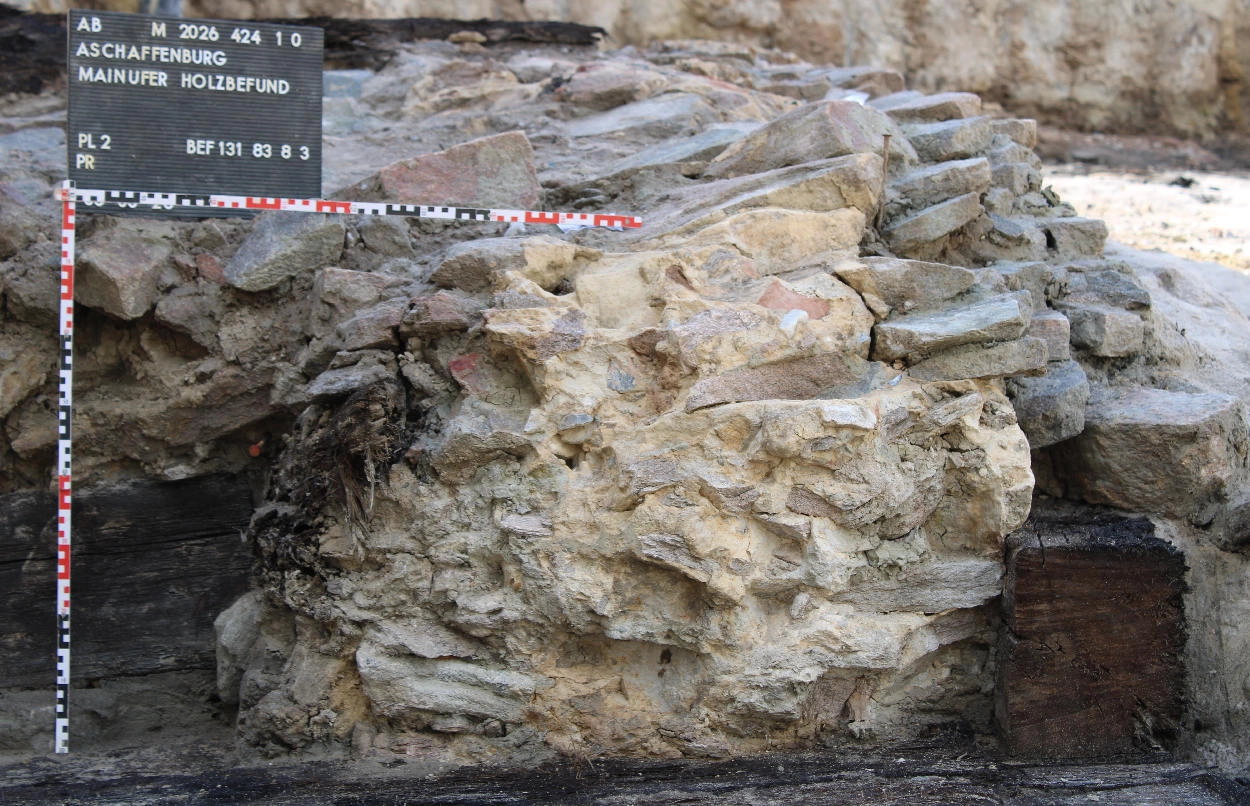
What appeared in the pit was not a small or ordinary feature. Archaeologists documented a large number of heavy oak beams arranged in what appears to have been a technically demanding construction. On the side facing the Main River, the installation ended in a dry-stone wall.

That detail makes the find especially unusual. Stone architecture from the Iron Age is rarely documented in this region. When stone elements do appear, they are often associated with important or fortified sites, including defensive constructions such as post-slot walls.
An Iron Age structure in Aschaffenburg has emerged from beneath the bank of the Main River, and its age has surprised even the archaeologists called in to examine it.

The discovery was made during construction work for a rain overflow basin north of the Willigis Bridge. At first, the wooden remains seemed too well preserved to be truly ancient. Massive oak beams, still clearly visible deep below the modern surface, looked as if they might belong to a much later riverside installation.

But the timber told another story.

Scientific dating has now shown that the oak used in the structure was felled and built into place in the 4th century BC. That places the remains around 2,400 years ago, in the Iron Age, during the early La Tène period. For Aschaffenburg, a city already known to have traces of Iron Age activity, the find may be a rare architectural clue to a settlement whose importance has long been suspected but never fully understood.

A discovery made eight meters below the city

The wooden remains were encountered about eight meters below the surface during construction work near the Main River. The area had not previously been recorded as an archaeological monument, so the discovery came unexpectedly in an active building site.

After the find was reported to the Bavarian State Office for Monument Protection, known as the BLfD, archaeologists began documenting and recovering the remains under difficult conditions. The structure lay inside a deep construction pit, where every step had to be coordinated with safety requirements, engineering work, and the ongoing construction project.

What appeared in the pit was not a small or ordinary feature. Archaeologists documented a large number of heavy oak beams arranged in what appears to have been a technically demanding construction. On the side facing the Main River, the installation ended in a dry-stone wall.

That detail makes the find especially unusual. Stone architecture from the Iron Age is rarely documented in this region. When stone elements do appear, they are often associated with important or fortified sites, including defensive constructions such as post-slot walls.

Tree rings changed the story

Several oak beams were sent to the BLfD dendrochronology laboratory in Thierhaupten. Dendrochronology dates wood by studying tree-ring patterns and comparing them with established regional chronologies.

The result changed the interpretation of the site completely.

The beams were not medieval, early modern, or modern. They came from trees cut in the 4th century BC. The structure was therefore part of the Iron Age landscape of Aschaffenburg, not a later riverside feature.

For archaeologists, that date is significant because well-preserved timber architecture from this period rarely survives in such condition. Wood normally decays unless it is sealed in wet or oxygen-poor conditions. Here, the Main River environment appears to have helped preserve part of a structure that would otherwise have vanished long ago.

Dr. Stefanie Berg, head of archaeological monument preservation at the BLfD, has described the discovery as exceptional because of its riverside location, its preservation, its unusual combination of wood and stone, and its Iron Age date.

Massive oak beams and rare Iron Age stonework

The exact function of the structure remains unknown. It may have been connected to the riverbank, perhaps as part of a larger settlement zone, a riverside installation, or a more substantial architectural complex.

Yet archaeologists do not appear to view it as a simple utilitarian feature.

The scale of the oak beams, the quality of the construction, and the presence of a dry-stone wall suggest a building or installation made with considerable planning. Researchers have raised the possibility that it belonged to a large, perhaps even representative structure.
That possibility matters because Aschaffenburg has already produced evidence of early La Tène-period activity. Finds from the area of the modern old town include settlement traces, a gold finger ring, and a fibula decorated with an animal head. Such objects have led scholars to suspect that an important Iron Age central place may once have existed here.

Until now, however, the evidence was scattered. Individual objects could point to status, craft, trade, or settlement, but they did not show much about the physical form of the community itself.

The newly discovered riverside structure gives archaeologists something more substantial. It is architecture, preserved in wood and stone, and fixed to a clear Iron Age date.

A rare clue to Iron Age Aschaffenburg

In the Iron Age, the Main River would have been more than scenery. It offered movement, contact, and access to the surrounding landscape. A settlement placed near its bank could benefit from communication routes, river resources, and control of local movement.

If the Aschaffenburg structure was part of a larger settlement, it may suggest that the area was more organized and socially complex than previously documented. Its location near the river is especially important, because rivers often shaped where communities grew, traded, and projected authority.

For now, the structure’s purpose remains open. Was it part of a riverside building? A fortified element? A representative structure connected to a local elite? Or something that does not fit neatly into known categories?

Further excavation, documentation, and scientific analysis will be needed before archaeologists can answer those questions with confidence.

Even so, the discovery has already changed the archaeological picture of Aschaffenburg. Beneath the modern city, close to the Main River, a rare Iron Age structure has survived with massive oak beams and stonework still in place. After 2,400 years underground, it has reopened a question that archaeologists have been circling for years: how important was ancient Aschaffenburg in the world of the early La Tène period?
Excavation pit with the discovery. The remains of the Iron Age structure are visible in front of the pile wall. Credit: Bayerisches Landesamt für Denkmalpflege (BLfD)

Tree rings changed the story

Several oak beams were sent to the BLfD dendrochronology laboratory in Thierhaupten. Dendrochronology dates wood by studying tree-ring patterns and comparing them with established regional chronologies.

The result changed the interpretation of the site completely.

The beams were not medieval, early modern, or modern. They came from trees cut in the 4th century BC. The structure was therefore part of the Iron Age landscape of Aschaffenburg, not a later riverside feature.

For archaeologists, that date is significant because well-preserved timber architecture from this period rarely survives in such condition. Wood normally decays unless it is sealed in wet or oxygen-poor conditions. Here, the Main River environment appears to have helped preserve part of a structure that would otherwise have vanished long ago.

Dr. Stefanie Berg, head of archaeological monument preservation at the BLfD, has described the discovery as exceptional because of its riverside location, its preservation, its unusual combination of wood and stone, and its Iron Age date.

Massive oak beams and rare Iron Age stonework

The exact function of the structure remains unknown. It may have been connected to the riverbank, perhaps as part of a larger settlement zone, a riverside installation, or a more substantial architectural complex.

Yet archaeologists do not appear to view it as a simple utilitarian feature.

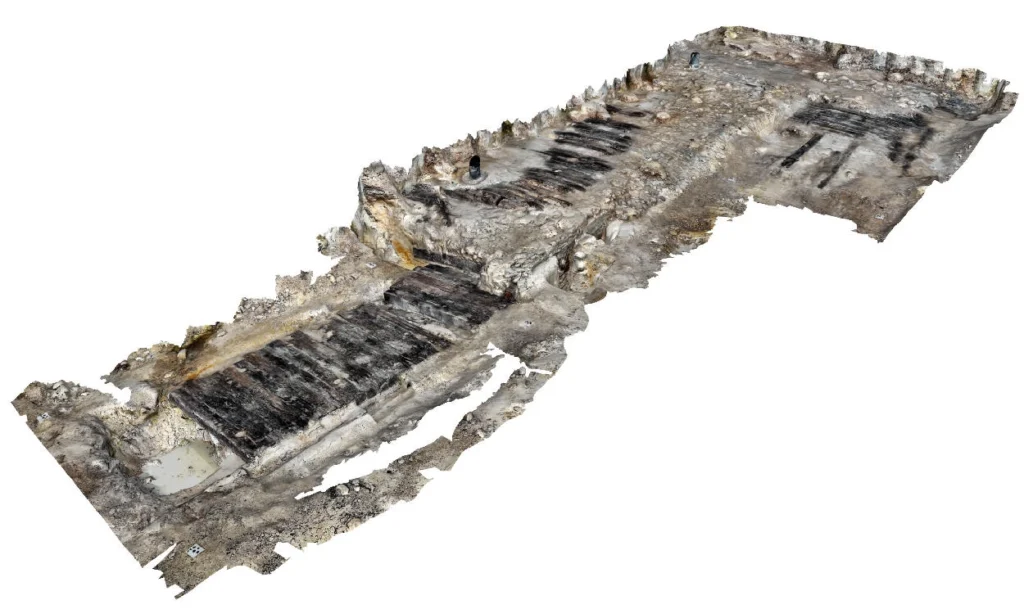
The scale of the oak beams, the quality of the construction, and the presence of a dry-stone wall suggest a building or installation made with considerable planning. Researchers have raised the possibility that it belonged to a large, perhaps even representative structure.

3D model showing the full extent of the Iron Age structure discovered in Aschaffenburg. Credit: Bayerisches Landesamt für Denkmalpflege (BLfD)

That possibility matters because Aschaffenburg has already produced evidence of early La Tène-period activity. Finds from the area of the modern old town include settlement traces, a gold finger ring, and a fibula decorated with an animal head. Such objects have led scholars to suspect that an important Iron Age central place may once have existed here.

Until now, however, the evidence was scattered. Individual objects could point to status, craft, trade, or settlement, but they did not show much about the physical form of the community itself.

The newly discovered riverside structure gives archaeologists something more substantial. It is architecture, preserved in wood and stone, and fixed to a clear Iron Age date.

A rare clue to Iron Age Aschaffenburg

In the Iron Age, the Main River would have been more than scenery. It offered movement, contact, and access to the surrounding landscape. A settlement placed near its bank could benefit from communication routes, river resources, and control of local movement.

If the Aschaffenburg structure was part of a larger settlement, it may suggest that the area was more organized and socially complex than previously documented. Its location near the river is especially important, because rivers often shaped where communities grew, traded, and projected authority.

For now, the structure’s purpose remains open. Was it part of a riverside building? A fortified element? A representative structure connected to a local elite? Or something that does not fit neatly into known categories?

Further excavation, documentation, and scientific analysis will be needed before archaeologists can answer those questions with confidence.

Even so, the discovery has already changed the archaeological picture of Aschaffenburg. Beneath the modern city, close to the Main River, a rare Iron Age structure has survived with massive oak beams and stonework still in place. After 2,400 years underground, it has reopened a question that archaeologists have been circling for years: how important was ancient Aschaffenburg in the world of the early La Tène period?

Cover Image Credit: Bayerisches Landesamt für Denkmalpflege (BLfD)