
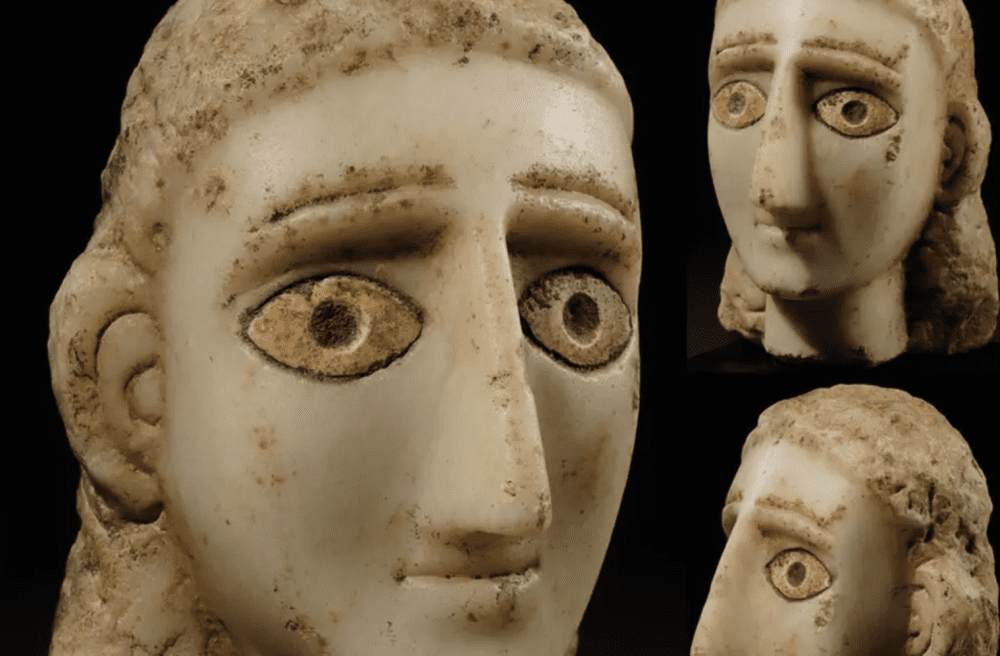
A rare alabaster sculpture believed to portray a princess from the ancient Kingdom of Saba is set to go under the hammer in Vienna next month, reigniting debate over the global trade in looted antiquities and renewed demands for Yemen’s cultural repatriation.
The piece, dated to the first century BCE, will headline the Antiquities and Ancient Arts Auction on November 21, 2025, according to documentation reviewed by Yemeni antiquities specialist Abdullah Mohsen. It is one of three Yemeni artifacts listed for sale and is currently held by Joseph Ozan, owner of the Samarkand Gallery in Paris. Auction records claim the sculpture was previously part of a Swiss family collection since before 1971—a claim Yemeni experts have strongly questioned.
Carved from translucent alabaster, the finely modeled head bears elongated eyes, a narrow straight nose, and a sharply pointed chin—features typical of Sabaean funerary portraiture once found in the necropolises of Marib and Timnaʿ. Scholars suggest it may have represented a royal or elite woman, reflecting the artistic refinement of southern Arabia’s early kingdoms.
“This is not just art—it’s a fragment of our identity, taken in times of chaos,” Mohsen wrote on X (formerly Twitter), calling on UNESCO and European authorities to stop the sale.
Yemen’s Ancient Legacy Under Threat
The auction has sparked condemnation among Yemeni academics and activists, who warn that the piece was likely smuggled during decades of conflict and state collapse.
Since the civil war escalated in 2015, thousands of Yemeni artifacts—ranging from funerary stelae to inscribed bronzes—have surfaced in Western auction houses and private collections. Researchers estimate that over 23,000 antiquities from Yemen remain outside the country’s control.
According to Independent Arabia, the same Vienna sale includes an alabaster bull protome and a bronze plaque inscribed in the ancient South Arabian Musnad script, both believed to have originated from Marib and Beihan, regions once under the dominion of Saba and Qataban.
Echoes of the Incense Kingdom
The Kingdom of Saba, known to the Greeks and Romans as Sheba, was one of the most prosperous civilizations of ancient Arabia.
Flourishing between the 10th century BCE and the 3rd century CE, it controlled the incense routes that carried frankincense and myrrh from southern Arabia to the Mediterranean. The kingdom’s monumental temples, hydraulic dams, and refined stone sculptures reveal a culture of extraordinary wealth and artistry—one now endangered by modern looting.
As Yemen continues to grapple with humanitarian crises, the repatriation of its cultural heritage has largely depended on diplomatic initiatives and individual campaigns led by archaeologists like Mohsen.
Yet, without international enforcement, many fear that Yemen’s lost treasures may soon become permanent exiles in private European collections.
Neither UNESCO nor the Yemeni government has yet issued a formal statement regarding the upcoming Vienna auction, but heritage advocates are urging swift diplomatic action before the artifacts disappear once again into the private art market.