

A new study of Ardipithecus ramidus — the 4.4-million-year-old hominin known as “Ardi” — has reignited the debate over how the first humans began to walk upright. Researchers from Washington University in St. Louis, together with colleagues from Canada and the United States, have analyzed Ardi’s ankle joint in remarkable detail, revealing a rare combination of traits for both climbing and early bipedalism. Their findings, published in Communications Biology, strengthen the hypothesis that humans evolved from an African ape-like ancestor rather than from a more generalized primate.
Discovered in 1994 in Ethiopia’s Afar region, Ardipithecus ramidus predates the famous Australopithecus afarensis specimen “Lucy” by nearly one million years, representing an even earlier chapter in the story of human evolution. Ardi could walk upright, yet retained an opposable big toe for gripping — a combination that puzzled scientists for decades. Early interpretations suggested that Ardipithecus moved in a unique, generalized way, not directly comparable to the locomotion of modern African apes.

The new research, led by biological anthropologist Dr. Thomas (Cody) Prang, challenges that assumption. His team focused on the talus — the ankle bone that links the leg to the heel — and compared Ardi’s specimen with a broad range of chimpanzees, gorillas, monkeys, and early humans. The results were striking: Ardi’s ankle shares key structural similarities with those of African apes, particularly features linked to vertical climbing and plantigrade walking (placing the full foot on the ground).
According to Prang, these findings indicate that Ardipithecus combined tree-climbing agility with partial terrestrial locomotion, functioning as a true transitional form. “The talus acts like a black box of locomotor evolution,” he explains. “In Ardi, we can see the blueprint of the shift from arboreal to terrestrial life.”
Yet the fossil also reveals something more — derived traits in the ankle that suggest a more efficient propulsion mechanism, marking the first steps toward the fully upright gait that would later define our genus.
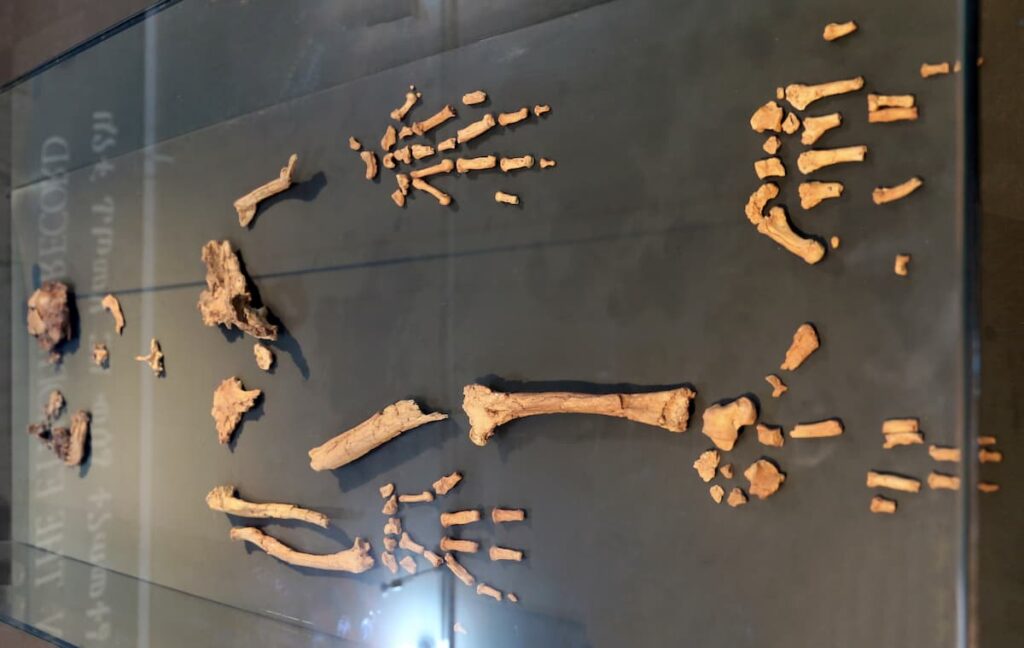
For paleoanthropologists, this discovery recalibrates the evolutionary map. Rather than portraying chimpanzees and gorillas as evolutionary “dead ends,” Ardipithecus ramidus highlights a shared ancestry rooted in African ape-like locomotion. It shows that the foundations of human bipedalism were already emerging millions of years before Australopithecus took its first confident steps across the African savannah.
Cover Image: Replica of an Ardipithecus ramidus skull displayed at the Jeongok Prehistory Museum, illustrating the anatomy of one of humanity’s earliest known ancestors. Credit: Aspere / Wikimedia Commons