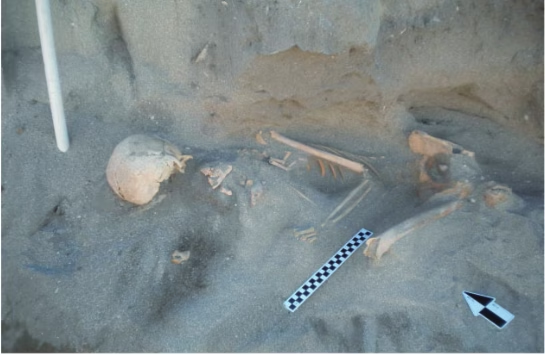
A 2,300-year-old skeleton discovered on South Africa’s west coast has provided one of the earliest genetic links to humanity’s common ancestor — a woman known as “Mitochondrial Eve.” The study, published in Genome Biology and Evolution, offers a rare glimpse into a population that diverged at the dawn of modern human evolution.
Unearthing a Genetic Time Capsule
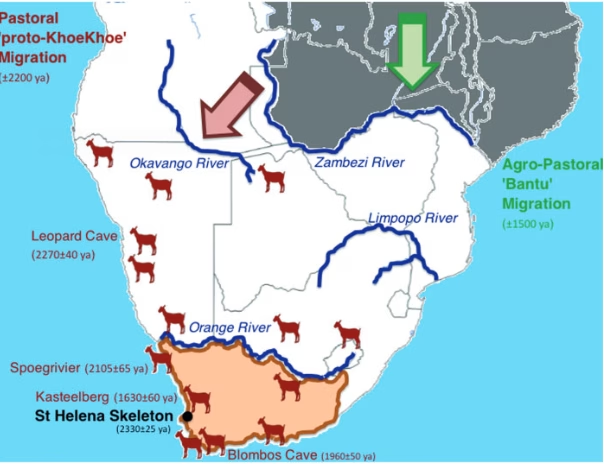
In 2010, archaeologist Prof. Andrew Smith from the University of Cape Town uncovered a remarkably preserved skeleton at St. Helena Bay, near the site where 117,000-year-old human footprints — often called Eve’s Footprints — had previously been found. The skeleton belonged to a short, middle-aged man who lived roughly 2,330 years ago, during a period before pastoral migrations reached the Cape.
Biological anthropologist Prof. Alan Morris determined that the man was a marine forager, regularly diving in the cold Atlantic waters for shellfish. His worn teeth, arthritic bones, and “surfer’s ear” growths painted a vivid portrait of a seasoned coastal hunter-gatherer.
Ancient DNA from the Edge of Africa
Recovering DNA from skeletons in the acidic soils of southern Africa is notoriously difficult. To overcome this, Smith collaborated with Prof. Vanessa Hayes, a genomic medicine expert then at the J. Craig Venter Institute and now at Sydney’s Garvan Institute. The DNA was extracted from a tooth and a rib in the laboratory of Prof. Svante Pääbo at the Max Planck Institute — the same researcher who sequenced the Neanderthal genome.
The result was a complete mitochondrial genome that revealed the man’s maternal lineage as one of the earliest-diverging ever identified in modern humans. His DNA carried a unique variant unseen in any known population, suggesting a now-extinct branch that once thrived along Africa’s southern shores.
A Lost Lineage Close to Mitochondrial Eve
The study shows that this coastal forager’s maternal line was genetically closer to Mitochondrial Eve than to the pastoralist groups who migrated into the region 2,000 years later. According to Hayes, this makes him part of a lineage that split early from the rest of humanity and remained isolated for millennia.
“We believe this individual represents a genetic snapshot from a time before later admixture events blurred the picture of human origins,” said Prof. Hayes. “His genome provides a critical baseline for comparing ancient and modern African populations.”
Rewriting the Genetic Reference for Humanity
Hayes emphasized that most modern human genomes are still mapped against a European-biased reference, which fails to represent indigenous populations worldwide.
“If we want a true global reference, we must go back to the roots — to Africa itself,” she said.
Her team argues that early, unadmixed genomes like this one could refine how we interpret genetic data in both evolutionary biology and medical research.
More information: Paper – gbe.oxfordjournals.org/content … /gbe.evu202.full.pdf
Cover Image: Burial site and skeletal remains of the St. Helena marine forager carbon dated to 2,330 ± 25 years before present. (A) The complete skeleton exposed during the June 2010 excavation revealed that this 1.5-m-tall male marine hunter was at least 50 years old at time of death. Source: Garvan Institute of Medical Research