
Scientists have discovered a 1,200-year-old island in Fiji built almost entirely from shellfish remains, revealing how repeated human activity over centuries can physically reshape coastal landscapes.
The island, located off the coast of Culasawani in the Fiji archipelago, covers approximately 3,000 square meters. Analysis shows that 70% to 90% of its material consists of edible shellfish, primarily clam species such as Anadara, along with fragments of pottery linked to human use.
The findings, published in the peer-reviewed journal Geoarchaeology, are based on radiocarbon dating and geoarchaeological fieldwork that traces the formation of the island back to around 760 CE.
A Landscape Formed by Repetition
Rather than a natural landform, the island appears to have developed gradually as generations of coastal communities processed shellfish in the same location. Over time, discarded shells accumulated into dense layers, eventually rising above sea level.
Researchers classify the site as a midden island—a formation created through the long-term build-up of human refuse such as shells and domestic debris. These sites are particularly valuable because they preserve direct evidence of diet, subsistence strategies, and long-term human presence.
The absence of animal bones and stone tools suggests the island was not a permanent settlement. Instead, it likely served as a task-specific processing site, used by people traveling from nearby mainland areas.
Field Evidence Confirms Human Origin
The island was first identified in 2017, when burrowing crabs exposed deeper layers by bringing material from 30–50 centimeters below the surface. These exposed deposits revealed unusually dense concentrations of shell remains.
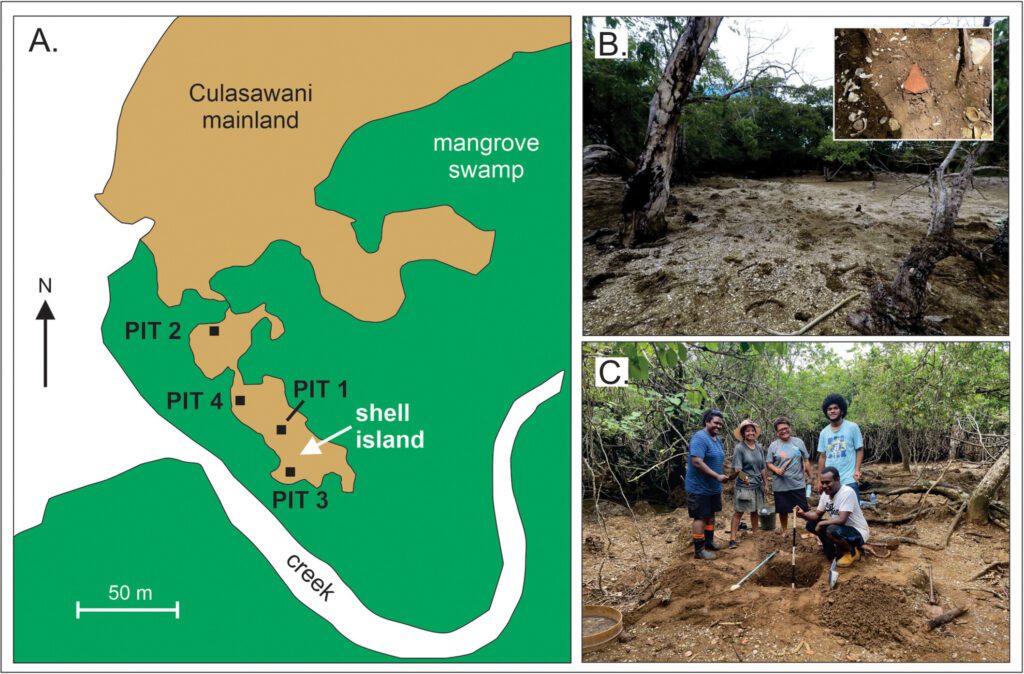
Follow-up investigations in 2024 confirmed that the formation is a distinct island, surrounded by mangroves and a creek, with an elevation of only 20 to 60 centimeters above high tide.
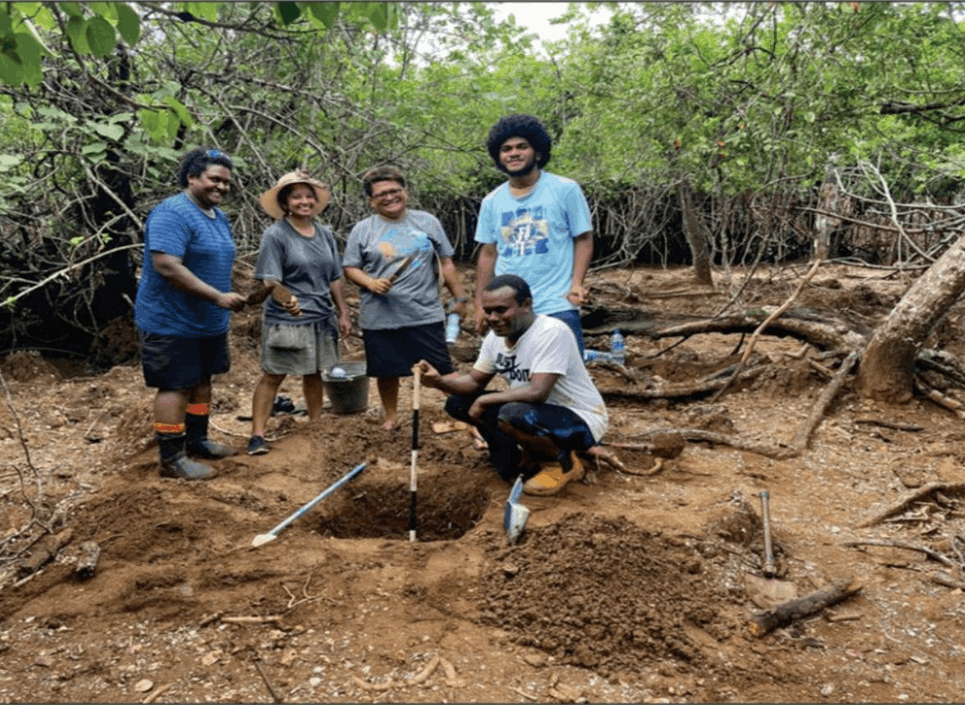
To test the internal structure, researchers extracted 20 sediment cores using hand augers and excavated four 1×1 meter test pits. Results showed that the shell-rich composition is consistent across the entire site, indicating it formed in place over time.
Radiocarbon dating focused on Anadara shells, which are known to provide reliable chronological data.
Not a Tsunami Deposit
Researchers also considered whether the island could have formed through a natural event such as a tsunami or storm surge. However, the evidence does not support this scenario.
All analyzed shells belonged to edible species, which strongly indicates human selection. Natural events typically produce mixed deposits containing a wide range of marine materials, not a concentrated accumulation of food remains.
This consistency points to intentional, repeated human activity, rather than a single catastrophic event.
A Rare Insight into Coastal Life
Shell middens across the Pacific provide key insights into how communities adapted to marine environments. In many regions, shellfish have been a primary food source for over 3,000 years, and in some modern communities they still account for a significant portion of daily consumption.
This discovery is particularly important for Vanua Levu, Fiji’s second-largest island, which has received relatively limited archaeological attention. The site offers a rare opportunity to reconstruct past coastal economies and human-environment interactions.
Next Steps
Researchers now plan to investigate nearby mainland areas around Culasawani to identify associated settlement sites. Establishing these connections could clarify how the island functioned within a broader system of resource use and food processing along Fiji’s ancient coastline.
Patrick D. Nunn et al, Shell‐Dense Island Off Culasawani, Vanua Levu Island, Fiji: Midden or Muddle?, Geoarchaeology (2026). DOI: 10.1002/gea.70052