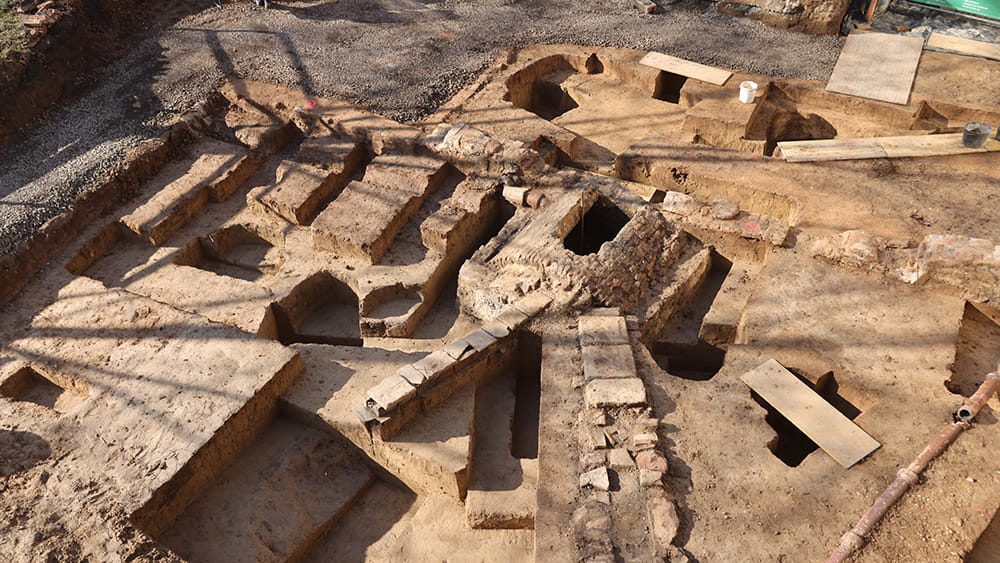
A quiet restoration project in Frankfurt’s Höchst district has led to something far more significant than expected. Beneath the gardens of the historic Bolongaropalast, archaeologists have uncovered what is now considered the earliest known Roman military camp in the city, dating to around the beginning of the first century AD.
It’s the kind of find that doesn’t announce itself loudly—but once you see the details, its weight becomes clear.
Not a Temporary Camp
At first glance, the discoveries might seem routine: a handful of coins, fragments of fine ceramics. But taken together, they tell a different story.
Coins traced to regions corresponding to modern-day France and Belgium, alongside South Gaulish tableware, point to something more structured. This was not a short-lived encampment. It functioned as a connected node within Rome’s wider logistical network.
In other words, soldiers weren’t just passing through. They were staying.
A Rare Case of Preservation
Early Roman camps are notoriously difficult to identify. Many were used briefly and left behind little more than soil discolorations or scattered debris.
Höchst breaks that pattern.
Archaeologists believe the site remained active for several years. That longer occupation allowed traces of everyday life—diet, local pottery, routine activity—to survive. It’s precisely the kind of evidence that is usually missing from this early phase of Roman expansion.
A Deliberate Location
The choice of location was strategic.
Positioned near the confluence of the Nidda and Main rivers, the camp offered access to waterways, visibility over the surrounding terrain, and links to emerging transport routes. These are not accidental advantages.
The site reads as a forward operational point, placed carefully as Rome pushed deeper into central Europe under Augustus.
More Than Just Soldiers
The composition of the camp also matters.
It likely housed both legionaries and auxiliary troops, meaning Roman citizens served alongside soldiers recruited from allied or non-citizen communities. That mix reflects how Rome actually operated on its frontiers—pragmatic, flexible, and culturally diverse.
A Different Kind of Encounter
Perhaps the most revealing detail is what isn’t there.
There is no evidence of destruction. No burn layers. No signs of violent confrontation.
Instead, archaeologists identified local ceramics and dietary remains alongside Roman material. The implication is difficult to ignore: early contact here may have involved interaction rather than immediate conflict.
That doesn’t erase later tensions—but it complicates the opening chapter.
Frankfurt, Before Frankfurt
Frankfurt is rarely discussed in a Roman context. Its identity is usually tied to the medieval and modern city.
But this site adds another layer.
The Höchst camp suggests that Roman presence extended further into this region—and perhaps more steadily—than previously assumed. Not as a fleeting incursion, but as a measured foothold.
And like many discoveries of this kind, it wasn’t found in some remote landscape.
It was waiting beneath a garden.
Cover Image Credit: The excavation site at Bolongaropalast. City of Frankfurt am Main, Maik Reuß