
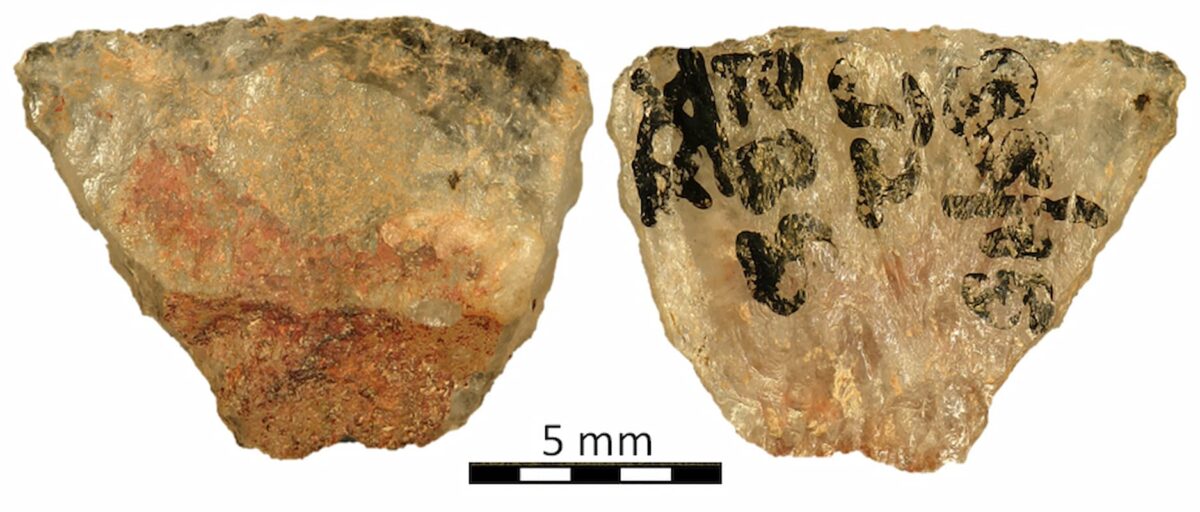
A set of quartz arrowheads from southern Africa has quietly rewritten the deep history of human technology. Chemical residues preserved on these small stone points reveal that early Homo sapiens were coating their weapons with plant-based poison around 60,000 years ago—tens of millennia earlier than any previously documented, direct evidence for such a practice.
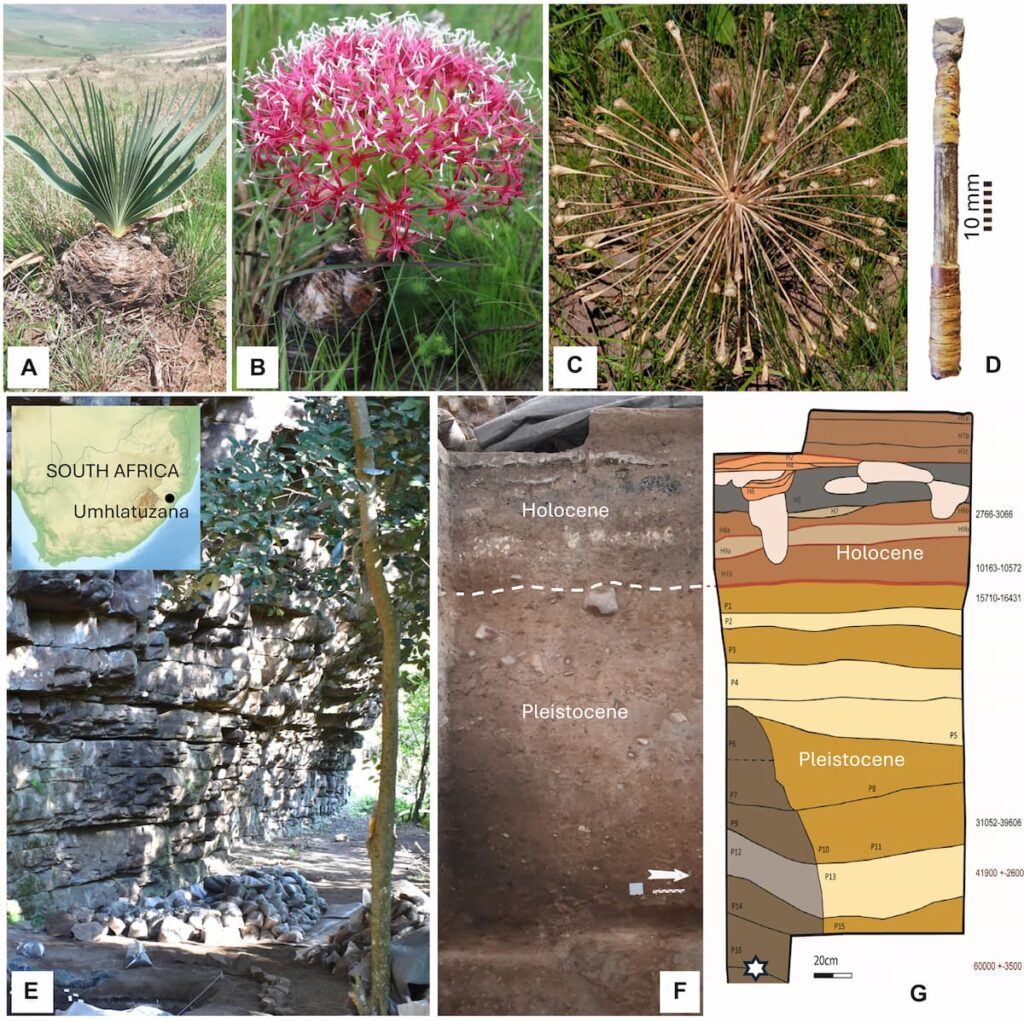
The finding comes from Umhlatuzana Rock Shelter in KwaZulu-Natal, South Africa, and was reported in Science Advances. Rather than relying on analogy or iconography, the study identifies unmistakable molecular signatures of a toxic plant compound on the weapons themselves, offering the earliest material proof of poisoned projectiles anywhere in the world.
A molecular signature from the deep past
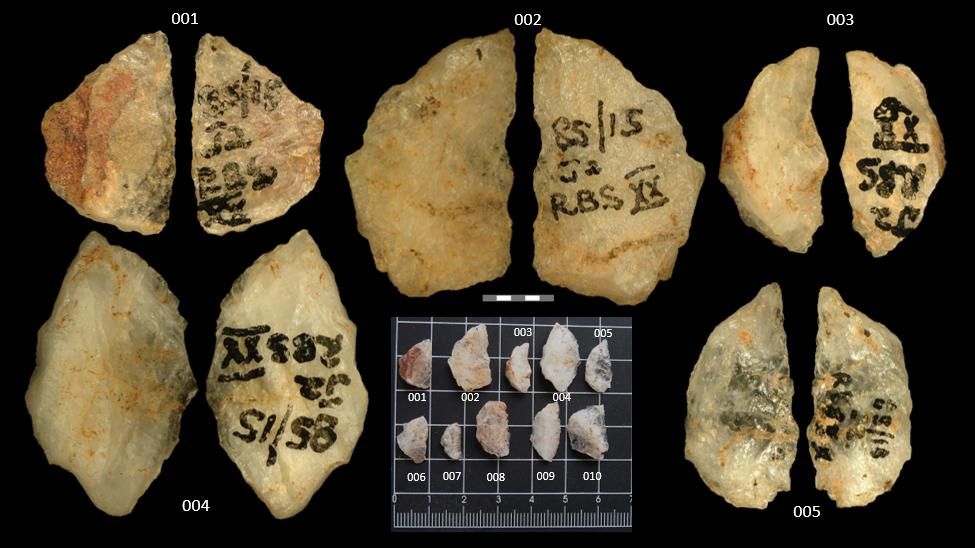
The arrowheads were recovered from securely dated Middle Stone Age layers at Umhlatuzana Rock Shelter, a site long recognized for its importance in African prehistory. Using advanced organic residue analysis, researchers detected two alkaloids—bufanidrine and epibufogenin—that act as a chemical fingerprint for Boophone disticha, a highly poisonous bulb known locally as gifbol, or “poison onion.”
These compounds are neurotoxic and capable of paralyzing or killing prey even when wounds are not immediately fatal. Their presence on quartz arrow points demonstrates that the poison was deliberately processed and applied, not accidentally introduced through environmental contamination.
Knowledge beyond stone tools
The implications extend far beyond weaponry. According to Professor Marlize Lombard of the Palaeo-Research Institute, the evidence confirms that southern African hunter-gatherers had already mastered both archery and a sophisticated botanical pharmacopeia at a surprisingly early date. Preparing such poisons requires identifying the correct plant, isolating its most potent components, processing them safely, and integrating the substance into a broader hunting strategy.
This is not improvisation. It is applied chemical knowledge embedded in a technological system.
A tradition spanning tens of thousands of years
One of the study’s most striking results comes from a long-term comparison. The same alkaloids identified on the Pleistocene arrowheads also appear on poisoned arrows collected in southern Africa during the 18th century and now held in Swedish museum collections. Professor Sven Isaksson of the Stockholm University notes that this chemical continuity is unlikely to be coincidental. Instead, it points to an extraordinarily durable technological tradition, transmitted across hundreds—perhaps thousands—of generations.
The chemical stability of these alkaloids is what made this comparison possible. Their resistance to degradation allowed the research team to match molecular structures across a time span of roughly 60,000 years, reinforcing the authenticity of the ancient residues.
What poisoned arrows say about the human mind
Using delayed-action poison changes the very logic of hunting. As Professor Anders Högberg of Linnaeus University explains, such weapons demand patience, foresight, and trust in invisible processes. The hunter must anticipate how long the toxin will take to act, track injured prey over extended distances, and plan the hunt around effects that are not immediately observable.
These behaviors imply advanced causal reasoning, long-term planning, and abstract thinking—hallmarks of fully modern human cognition.
From inference to proof
Until now, claims about poisoned hunting weapons in deep prehistory rested on indirect indicators: ethnographic parallels, rock art, or tool morphology. The residues from Umhlatuzana provide something fundamentally different—direct, chemical evidence anchored in a well-dated archaeological context.
In doing so, they place complex hunting technologies, botanical chemistry, and cognitive sophistication firmly within the early chapters of modern human behavior in Africa. Sixty thousand years ago, a hunter at Umhlatuzana was not merely shaping stone. They were combining ecological knowledge, chemistry, and patience into a lethal system—one whose molecular traces have endured long enough to reach us today.
Sven Isaksson et al., Direct evidence for poison use on microlithic arrowheads in Southern Africa at 60,000 years ago. Sci. Adv. 12, eadz3281(2026). DOI:10.1126/sciadv.adz3281