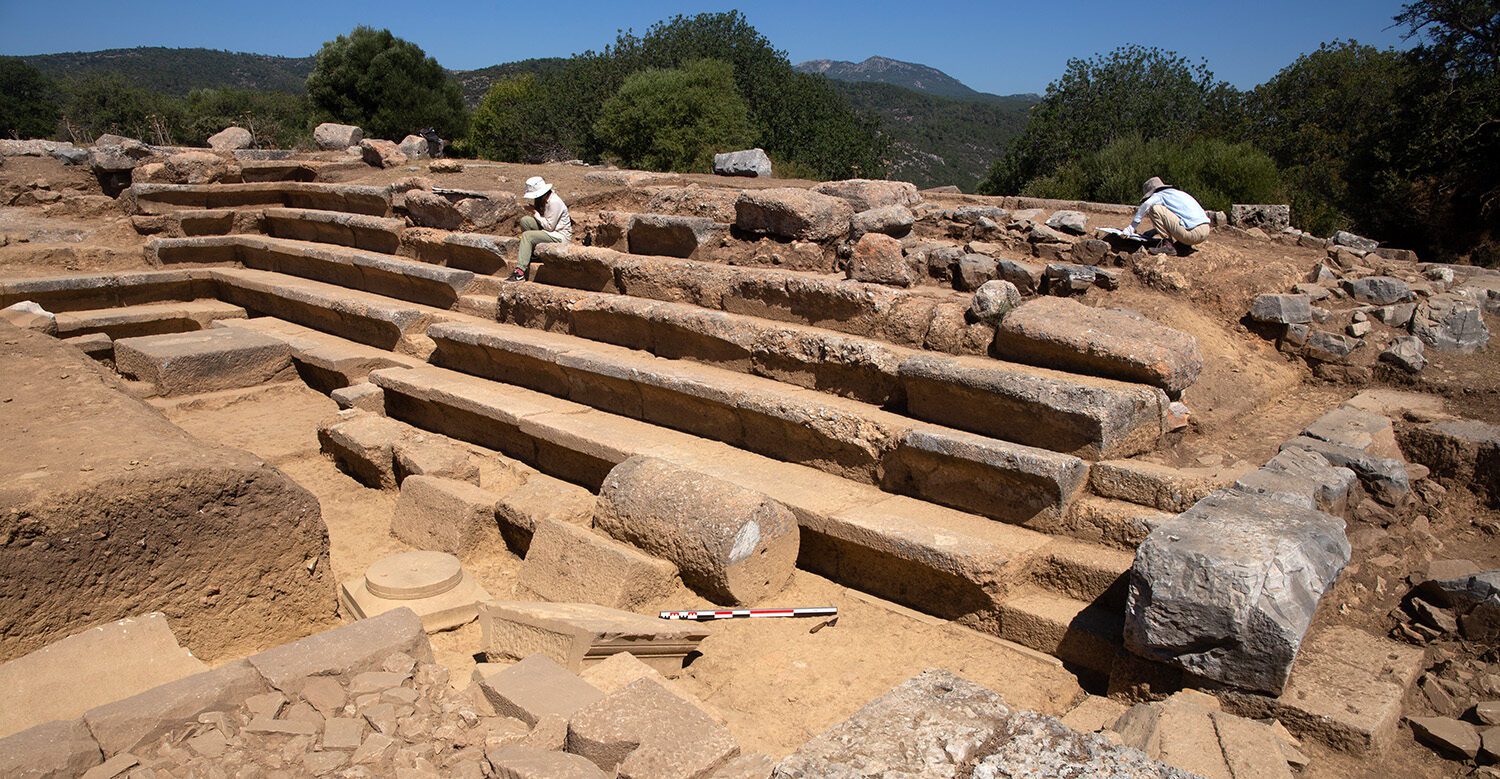
On the western edge of Anatolia, far from royal capitals and imperial courts, the Greek-founded harbor city of Notion once found itself entangled in the financial machinery of one of antiquity’s greatest empires. The evidence did not come in the form of inscriptions or monumental architecture—but from a modest ceramic pot buried beneath the floor of a house.
At the ancient harbor city of Notion, archaeologists uncovered a hoard of gold coins that offers a rare, material glimpse into how the Persian Empire projected power along the Aegean coast—not only through armies and governors, but through gold.
A hoard beneath the floor

The coins were discovered during ongoing excavations led by Prof. Dr. Christopher John Ratté, who has directed fieldwork at Notion since 2022. Hidden inside a ceramic vessel placed in a room beneath a domestic structure, the hoard appears to have been deliberately concealed rather than ritually deposited.
Such a context immediately raises questions. Why would someone hide a substantial quantity of gold under a private residence? And why in Notion—a city that never ranked among the great powers of the ancient Greek world?
Gold that speaks Persian
The answer begins with the coins themselves. Each piece bears the unmistakable image of a kneeling archer, the defining icon of the Persian gold daric. These coins were not generic currency. They were an imperial instrument, closely associated with state finance, military payments, and centralized control.
Darics circulated widely in moments of conflict. Ancient sources and archaeological parallels suggest they were commonly used to pay mercenaries, secure loyalties, and fund rapid military operations. Their presence in a Greek-speaking port city is therefore anything but incidental.
From Sardes to the Aegean
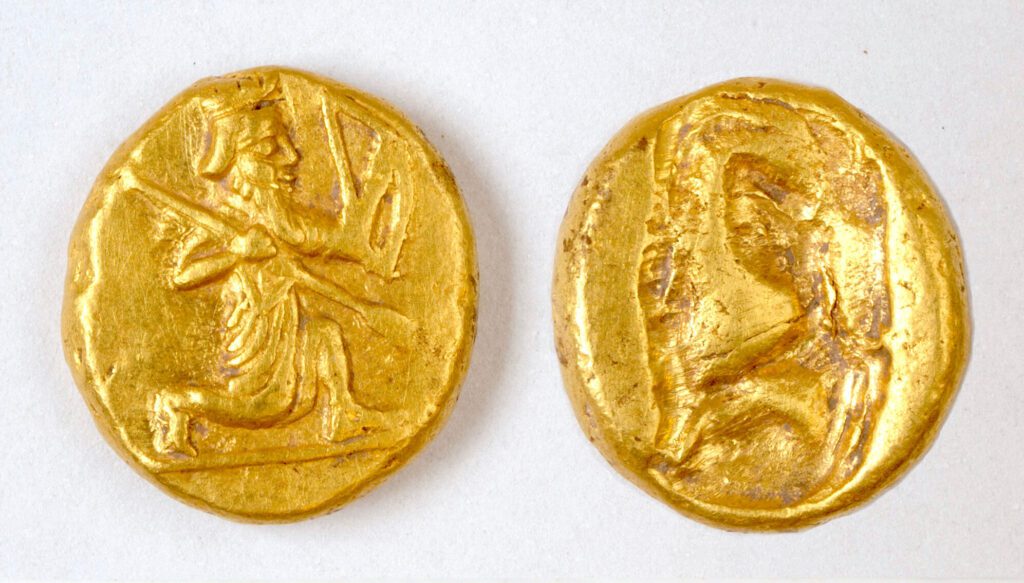
Numismatic analysis suggests that the coins were likely minted at Sardes, the principal administrative and monetary hub of Persian-controlled western Anatolia. In effect, Sardes functioned as the empire’s western financial engine—a place where imperial silver and gold were transformed into political leverage.
That gold made its way to Notion indicates that the city was plugged directly into this imperial network. Rather than a peripheral settlement, Notion emerges as a node—a point where Persian resources, local actors, and regional tensions converged.
A city at the crossroads
Geography helps explain why. Notion lay within striking distance of Klaros, Kolophon, Metropolis, and Ephesos, a dense landscape of sanctuaries, trade routes, and competing political interests. Control of such a zone did not require constant military occupation; it required liquidity.
Gold could move faster than armies.
In this light, the hoard may represent emergency funds, a stalled payment, or wealth concealed during a moment of instability. Whatever the precise scenario, the act of hiding the coins suggests urgency—and fear.
An exceptional archaeological context
According to a statement by the University of Michigan, discoveries of Persian gold hoards within controlled archaeological excavations are exceptionally rare. Most known examples come from chance finds or illicit contexts, stripped of the information that allows historians to reconstruct behavior and intent.
Here, context is everything. The domestic setting, the sealed container, and the precise stratigraphy allow researchers to move beyond the fact of discovery toward interpretation.
Rethinking Persian power in the Aegean
The significance of the Notion hoard lies not in its gold content alone, but in what it reveals about imperial strategy. This was not power imposed solely by force. It was power administered through payments, incentives, and financial pressure, woven quietly into the fabric of local communities.
Seen from this perspective, Notion’s buried gold becomes a historical document—one that records a moment when imperial ambition, local uncertainty, and personal risk intersected beneath the floor of an ordinary house.
Cover Image Credit: Notion Archaeological Project, University of Michigan