For decades, the search for humanity’s deepest origins revolved around a familiar map: East Africa as the unquestioned cradle, Europe as the stage for later divergence, and the Sahara as a vast biological wall in between. New fossil evidence from Morocco now forces a fundamental reassessment of that narrative.
At a quarry on the Atlantic edge of Casablanca, hominin remains dated with unprecedented precision to around 773,000 years ago point to a population that may sit close to the last common ancestor of Homo sapiens, Neandertals, and Denisovans. The findings, published in Nature, suggest that Northwest Africa was not a peripheral zone in human evolution, but a central arena where key lineages were already taking shape.
Why 773,000 Years Matters More Than the Fossils Themselves
Early human fossils are notoriously difficult to place on an absolute timeline. What sets the Moroccan discoveries apart is not only their anatomical significance, but the geological clock that anchors them.
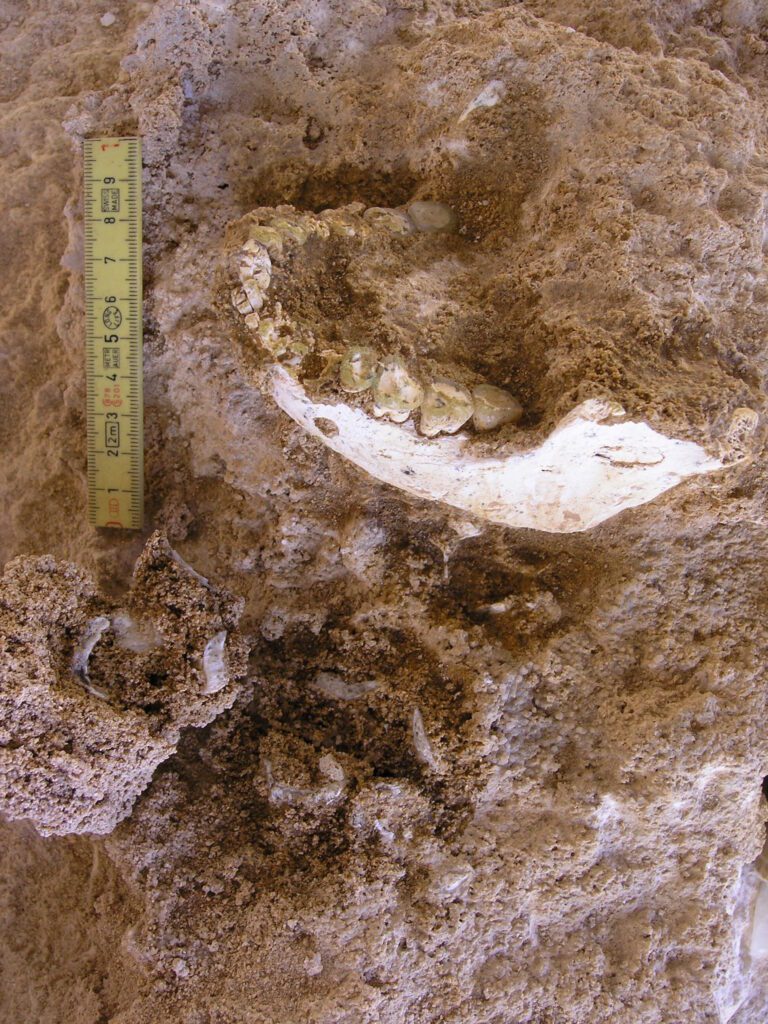
The fossils come from Thomas Quarry I, within a cave system known as the Grotte à Hominidés. Here, sediments recorded the Matuyama–Brunhes geomagnetic reversal, a globally synchronous flip in Earth’s magnetic field that occurred about 773,000 years ago. Because this signal is captured directly in the layers containing the hominin remains, the age of the fossils is not inferred—it is fixed.
According to Serena Perini, the level of resolution achieved through magnetostratigraphy at this site is unparalleled for an African hominin locality of this age. In effect, the fossils are pinned to a geological timestamp with an accuracy rarely possible in deep prehistory.
An African Population at the Base of Multiple Lineages
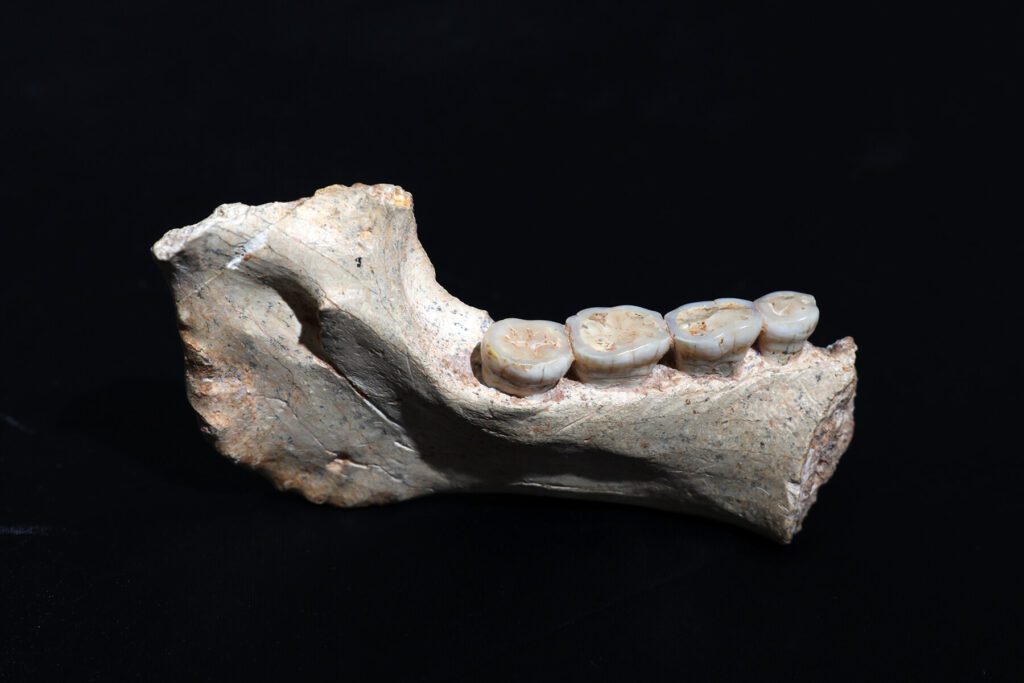
The hominin assemblage includes adult and child mandibles, vertebrae, and isolated teeth—some bearing marks of carnivore gnawing, suggesting the cave once functioned as a den rather than a dwelling. What makes these remains exceptional lies in their morphology.
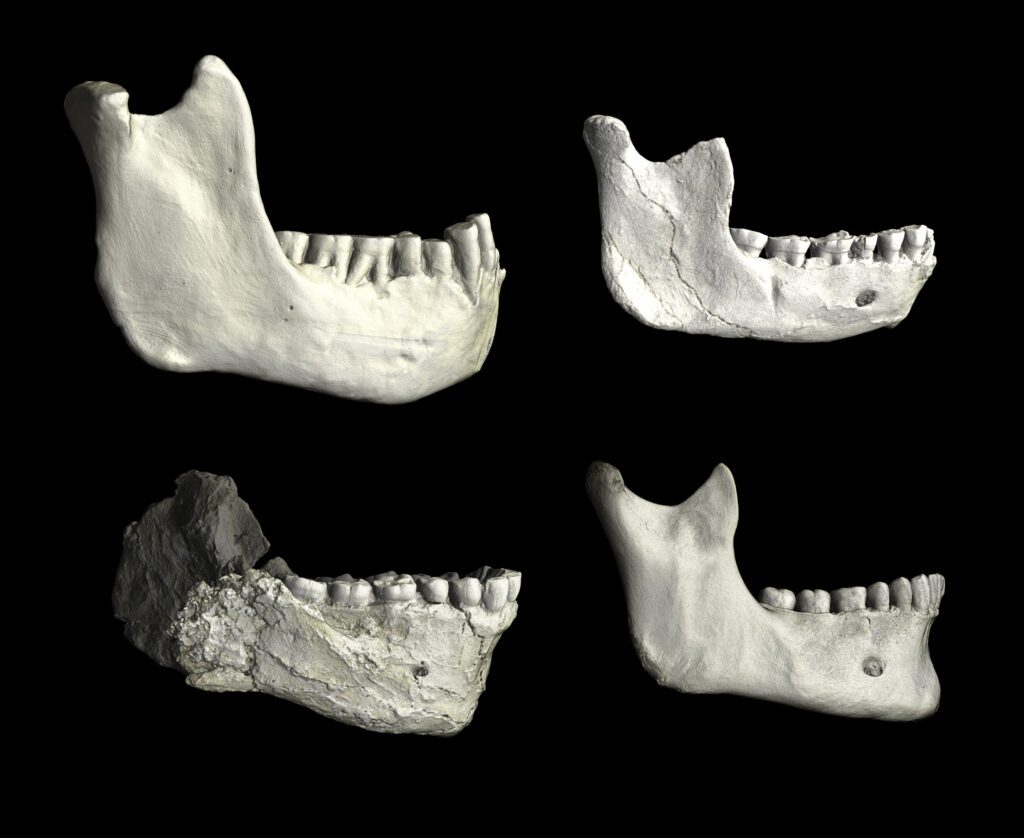
High-resolution micro-CT scans and geometric morphometric analyses reveal a mosaic of traits. Some features recall early European hominins such as those from Gran Dolina in Atapuerca, while others remain deeply archaic and African. Crucially, the fossils are distinct from Homo erectus and Homo antecessor, yet do not show the derived traits associated with Neandertals.
As explained by Matthew Skinner, the internal structure of the teeth—particularly the enamel-dentine junction—places these hominins outside known Eurasian lineages. Instead, they appear consistent with populations basal to both later African Homo sapiens and archaic Eurasian groups.
Northwest Africa, Not the Margins but the Crossroads
This interpretation challenges a long-standing assumption: that the Sahara functioned as a permanent barrier separating North Africa from sub-Saharan evolutionary processes. Paleontological and geological evidence from the Middle Pleistocene suggests otherwise.
Repeated climatic oscillations periodically transformed the Sahara into a mosaic of grasslands and corridors, enabling movements of animals—and hominins—between regions. As Denis Geraads notes, Northwest Africa was repeatedly connected to eastern and southern African ecosystems, making sustained population interaction not only possible but likely.
Within this context, the Moroccan hominins represent more than a local population. They document a wider African evolutionary network, operating hundreds of thousands of years before Homo sapiens appears in the fossil record.
Older Than Jebel Irhoud, Closer to the Ancestral Core
The significance becomes clearer when placed in temporal perspective. The Moroccan fossils predate the earliest Homo sapiens remains from Jebel Irhoud by roughly half a million years. They are also older than Middle Pleistocene fossils associated with the Neandertal–Denisovan lineage in Eurasia.
Genetic studies estimate that the last common ancestor of modern humans, Neandertals, and Denisovans lived between 765,000 and 550,000 years ago. The Grotte à Hominidés fossils align closely with the older end of this window, making them some of the strongest physical candidates yet identified for populations near this ancestral node.
A Shift in the Geography of Human Origins
For Jean-Jacques Hublin, the implications are clear. The Moroccan fossils reinforce a deep African origin for humanity, but not one confined to a single region. Instead, they point to multiple interconnected African populations, some of which—like those in Northwest Africa—have been underestimated in their evolutionary importance.
Rather than asking when Homo sapiens emerged, the discovery reframes the question: what did humanity look like before it became Homo sapiens? The answer, increasingly, seems to lie not at the margins of Africa, but along its ancient Atlantic coast.
Jean-Jacques Hublin, Early hominins from Morocco basal to the Homo sapiens lineage, Nature (2026). DOI: 10.1038/s41586-025-09914-y. www.nature.com/articles/s41586-025-09914-y
Cover image: This illustration was generated using artificial intelligence for visual storytelling purposes.