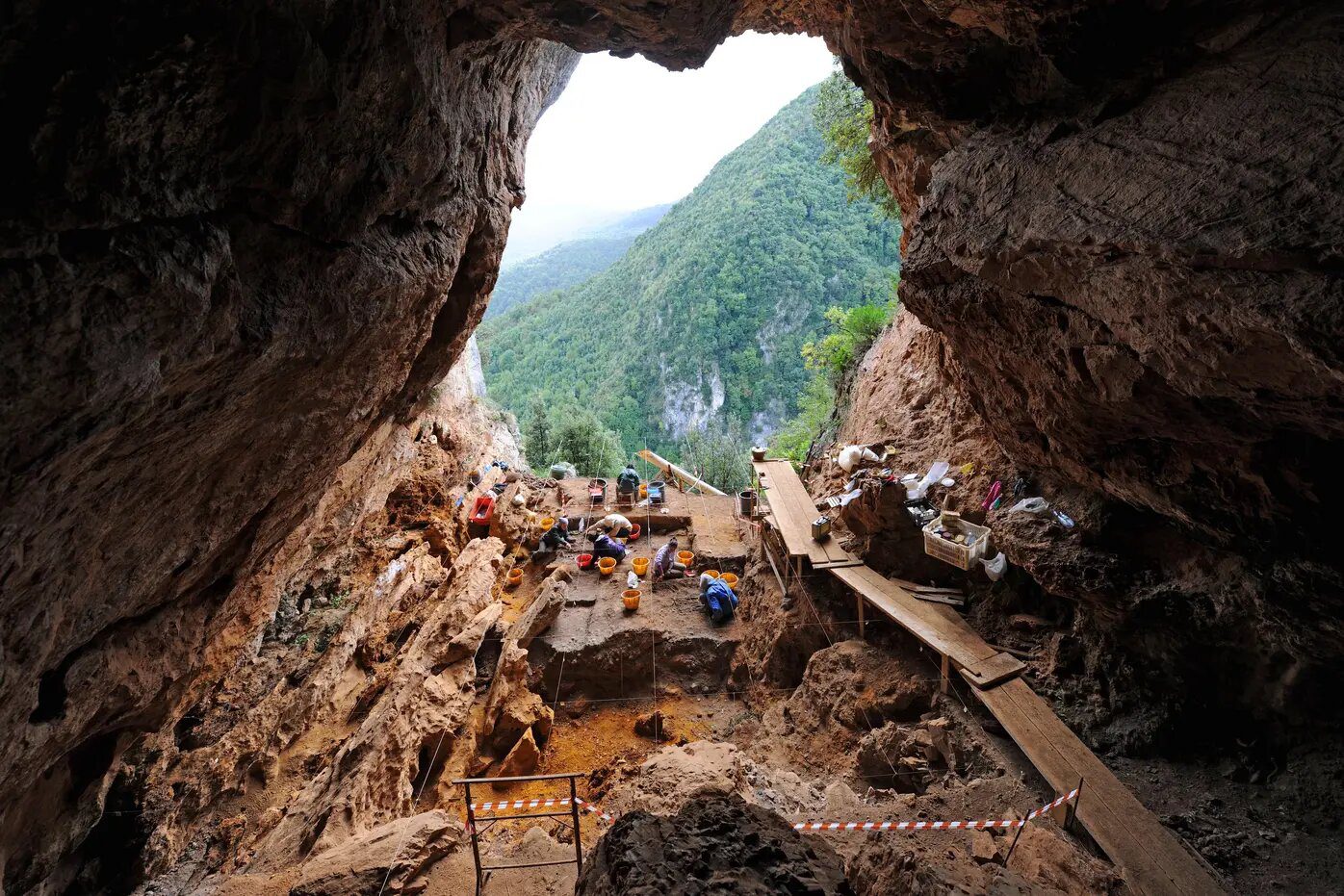
Deep in the rugged mountains of southern Italy, a prehistoric cave has quietly preserved the genetic memory of a forgotten Bronze Age community. Now, for the first time, scientists have reconstructed the biological and social fabric of this small society—revealing how people lived, moved, ate, and even organized family life in Calabria some 3,500 years ago.
The study, led by researchers from the Max Planck Harvard Research Center for the Ancient Mediterranean in Leipzig and the University of Bologna, was published in Communications Biology. It focuses on human remains recovered from Grotta della Monaca, a cave site in northwestern Calabria linked to the Protoapennine cultural horizon of the Middle Bronze Age.
Southern Italy: A Cave That Preserves More Than Bones
Grotta della Monaca lies high in the Pollino massif, near today’s Sant’Agata di Esaro. Archaeologists have long known the site for its early evidence of copper and iron ore exploitation, as well as its later use as a burial space. What remained unknown—until now—was who these people were, where they came from, and how their community functioned.
By extracting and analyzing ancient DNA from individuals dated between 1780 and 1380 BCE, the research team placed this mountain population within the wider genetic landscape of Bronze Age Mediterranean societies. The results show a community that was locally rooted yet far from isolated.
Genetically, the Grotta della Monaca individuals were most closely related to Early Bronze Age populations from Sicily, suggesting sustained interaction across the Strait of Messina. However, unlike their Sicilian counterparts, they lacked genetic signals associated with eastern Mediterranean migrations, indicating that Tyrrhenian Calabria followed a distinct demographic path.
“This tells us that contact does not necessarily mean assimilation,” explains Francesco Fontani, first author of the study. “These communities were connected, but they were shaping their own cultural and biological identities.”
Unexpected mobility in a mountain world
Despite living in a seemingly remote environment, the population shows clear evidence of long-distance movement. Two individuals carried genetic ancestry linked to northeastern Italy, pointing to mobility across the Italian peninsula during the Bronze Age.
At the same time, their genomes reflect a familiar European mixture: ancestry from Anatolian Neolithic farmers, Western hunter-gatherers, and Steppe pastoralists. What makes Grotta della Monaca distinctive is how these components combine into a localized genetic signature—one shaped by geography, tradition, and selective interaction rather than large-scale migration.
Family, burial, and a rare genetic signal
The cave also offers insight into social organization. Genetic and anthropological data reveal structured burial practices, suggesting that individuals were interred according to sex and kinship ties, rather than randomly.
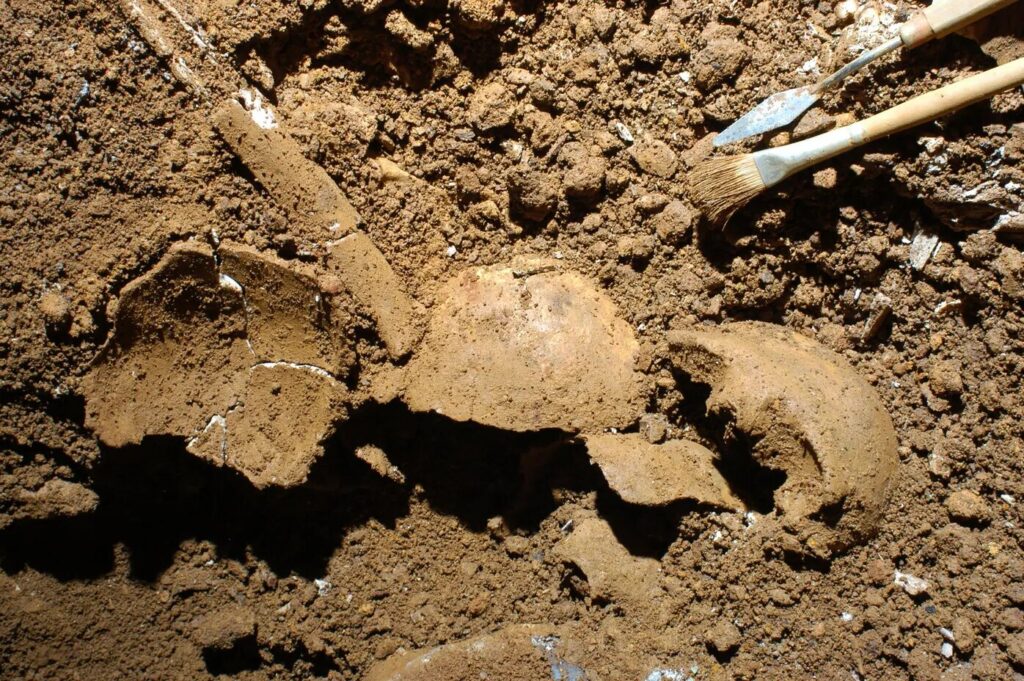
Among the most striking findings is the identification of a parent–offspring union, representing the first unambiguous genetic evidence of such a relationship ever documented in prehistoric Europe.
“This is a biological fact, not a cultural explanation,” cautions Alissa Mittnik of the Max Planck Institute for Evolutionary Anthropology. “While the genetic signal is clear, its social meaning remains open. It may reflect exceptional circumstances rather than a normative practice.”
The discovery underscores how ancient DNA can reveal intimate aspects of past lives—while also reminding researchers of the limits of interpretation.
Living with milk, without lactose
Isotopic analysis paints a vivid picture of daily life. The Grotta della Monaca community practiced pastoralism, relying heavily on milk and dairy products. Yet genetically, these individuals lacked the mutations associated with adult lactose tolerance.
This apparent contradiction highlights a crucial point in human evolution. “Cultural adaptation often comes before genetic change,” explains Donata Luiselli, co-senior author of the study. “These people developed ways to process and consume dairy that allowed them to benefit nutritionally, even without genetic lactose tolerance.”
Such strategies may have included fermentation or other methods that reduced lactose content—an example of innovation driven by environmental necessity rather than biology alone.
Rethinking caves in Bronze Age society
Beyond genetics, the study reshapes how archaeologists understand caves in Protoapennine culture. Rather than marginal or symbolic spaces, Grotta della Monaca appears to have functioned as a central communal burial site, reinforcing shared identity and lineage within a small population.
Situated more than 600 meters above sea level, the cave anchored social memory in a challenging landscape—binding families together across generations.
As Felice Larocca, director of research at the site, notes, Grotta della Monaca continues to illuminate the origins of complex societies in southern Italy. More broadly, it demonstrates how even small, seemingly isolated communities contributed to the deep mosaic of human biological and cultural diversity.
Cover Image: The wide entrance of Grotta della Monaca observed from the inside during field activities. Credit: Felice Larocca, CRS Enzo dei Medici
Francesco Fontani et al, Archaeogenetics reconstructs demography and extreme parental consanguinity in a Bronze Age community from Southern Italy, Communications Biology (2025). DOI: 10.1038/s42003-025-09194-2