
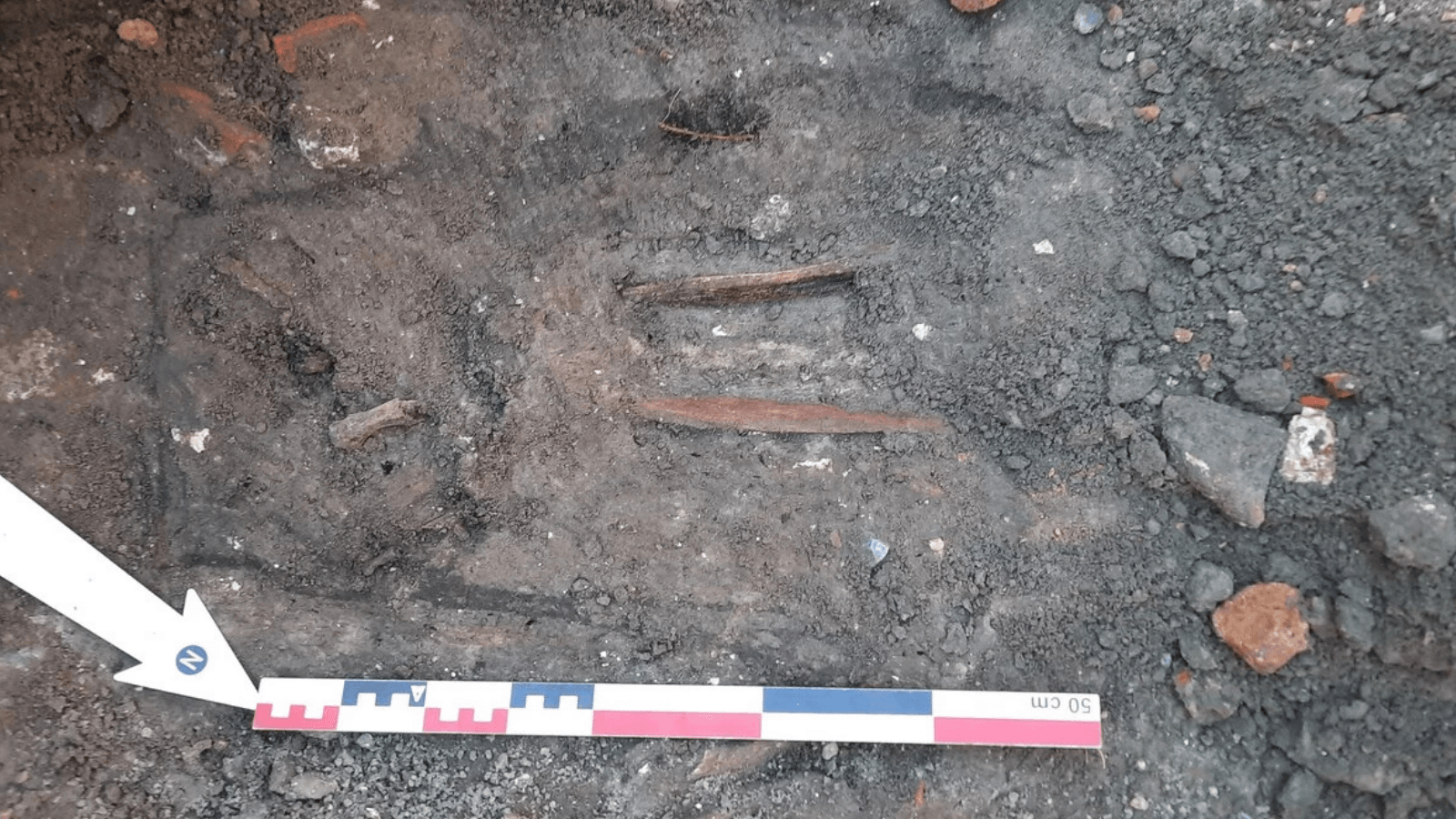
A two-square-metre test pit opened beside St James’ Church in Ghent has exposed four well-preserved burials at a depth of 1.3 metres. Further investigation indicates that five burial levels lie beneath this small section of the Vlasmarkt, where archaeologists estimate the remains of at least 240 people may survive within an area of just 23 square metres.
Archaeologists from BAAC Vlaanderen carried out the investigation ahead of planned landscaping work in the historic Belgian city. The test pit was positioned where Ghent authorities intended to plant a tree.
Human remains were expected in the general area because a cemetery surrounded St James’ Church, locally known as Sint-Jacobskerk, from the 11th until the 18th century. What remained uncertain was the depth of the graves, their density and their condition beneath the modern square.
Five burial levels beneath the Vlasmarkt
At approximately 1.3 metres below the present surface, archaeologists uncovered four burials in a good state of preservation. A borehole survey showed that the exposed graves were part of a deeper sequence, with around five burial levels lying above one another.
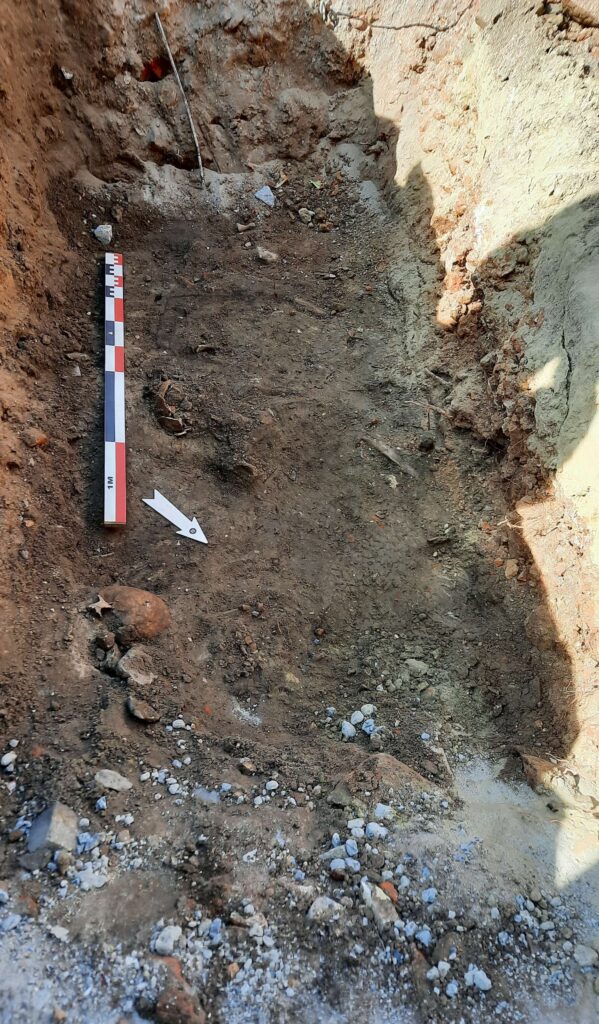
Based on the density recorded in the test pit, the archaeologists estimate that this two-square-metre space alone may contain approximately 20 individuals. When the calculation is extended across the full 23-square-metre area affected by the planned work, the estimated number rises to at least 240.
This does not mean that archaeologists have excavated 240 skeletons. Only four burials were exposed, while the larger figure is a projection based on the density of the graves and the five levels detected beneath the ground.
The successive layers suggest that the same limited area around the church was used repeatedly during the cemetery’s long history. Although the site is broadly described as medieval, burial continued there into the early modern period, and no precise dates have yet been announced for the four exposed individuals.
Burials beside one of Ghent’s oldest churches
The cemetery developed around a religious site whose history reaches back to medieval Ghent. According to the Ghent’s city’s tourism service, a wooden church dedicated to St James stood here during the 11th century and was replaced by a Romanesque stone church in the following century.
The building was later damaged, enlarged and altered several times. Parts of its Romanesque and later medieval fabric remain incorporated into the present church, while the former cemetery gradually disappeared beneath the streets and public spaces around the Vlasmarkt. The discovery follows other urban excavations in Belgium, including a medieval village and around 40 human skeletons uncovered beneath a town centre
The new investigation does not reveal a previously unknown cemetery. Instead, it establishes how densely people were buried, how far the graves extend below the square and how well some of the remains have survived.
Five superimposed levels within such a restricted area point to intensive use over several centuries. They also explain why even a relatively small intervention—such as digging a planting pit—could disturb numerous graves.
Ghent will leave the cemetery in place
The City of Ghent has decided not to excavate the estimated 240 individuals. The ground will remain undisturbed, preserving the burials where they lie.
As a result, the tree originally planned for this location will be moved elsewhere. Digging its planting pit and allowing roots to develop above the cemetery could have damaged graves at several depths.
Information from the test investigation will now be taken into account in any future redevelopment of the area. Archaeologists have established the depth, density and preservation of the burial sequence without undertaking a larger excavation.
The four exposed burials will remain beneath the Vlasmarkt along with the deeper graves. The planned tree will be relocated, leaving the five detected burial levels undisturbed.
Cover Image: Human remains uncovered in a small archaeological test pit at the Vlasmarkt in Ghent, where investigators detected five successive burial levels. Credit: City of Ghent / BAAC Vlaanderen