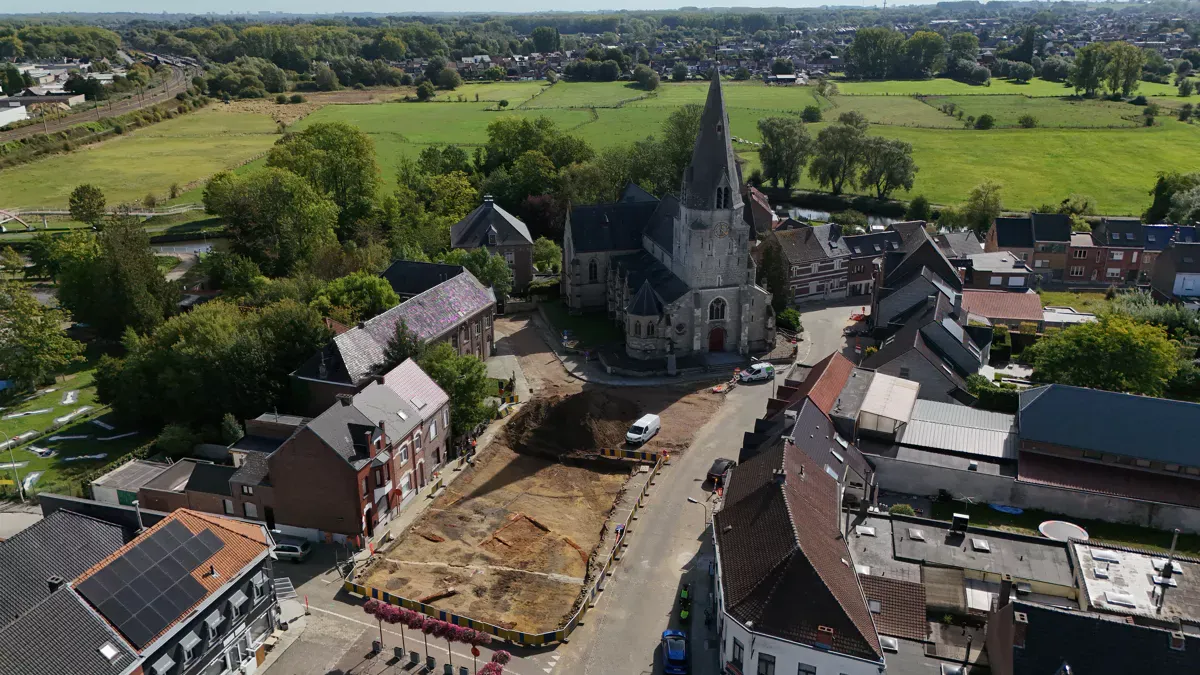
A medieval village plan has been found beneath the modern center of Denderleeuw in East Flanders, revealing how a moated residential compound shaped the Belgian town’s layout for nearly 1,000 years.
The discovery was made during archaeological excavations near the local church, where researchers uncovered traces of a 10th-century settlement surrounded by a moat. The site included several wooden buildings, whose postholes were still visible in the soil. For archaeologists, that survival is striking. In places that remained inhabited for centuries, early traces are often destroyed by later construction. In Denderleeuw, they endured.
What emerged from the excavation is not just the outline of a medieval household or a few isolated structures. It is the deep footprint of a village center that continued to influence streets, plots and movement through the town until the 19th century.
A medieval settlement under a modern square
The excavations took place around the square in front of the church and in nearby streets, an area now marked by modern buildings, roads and public space. Beneath that familiar surface, archaeologists found the remains of a much older settlement.
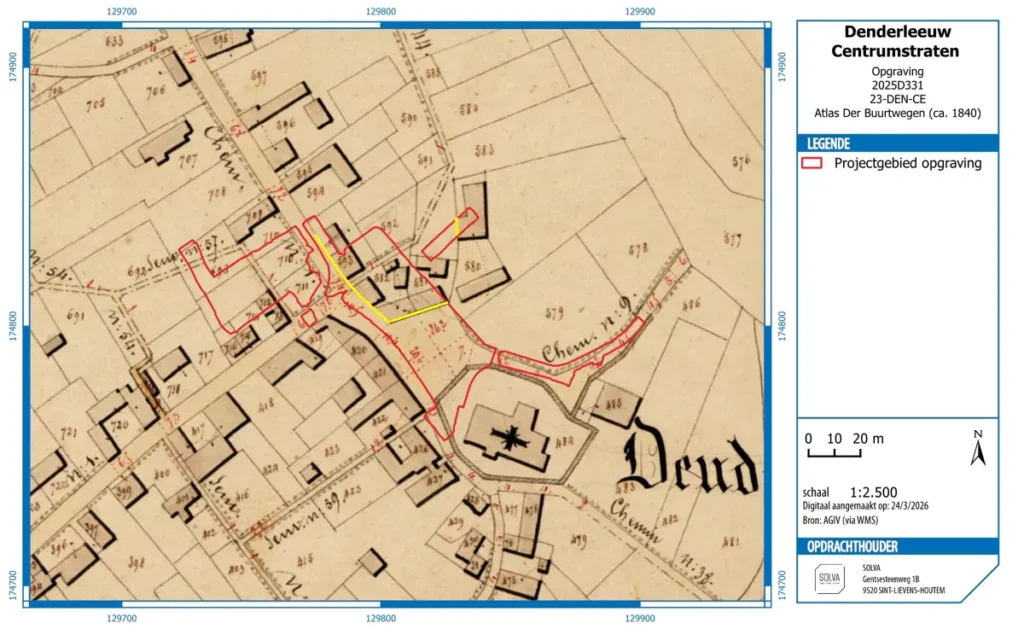
According to Wouter De Maeyer, project leader at SOLVA Archaeologists, a residential compound was built close to the church in the 10th century. It was enclosed by a moat and contained several wooden houses. The wooden structures themselves have long vanished, but the posts that once supported them left clear marks in the ground.
Those marks are small details, but they carry unusual weight. They show where houses stood, how the compound was organized and how early medieval inhabitants used the land around what later became the heart of Denderleeuw.
The find challenges the easy assumption that medieval villages looked much like the compact villages of today. In southern East Flanders, early villages may have been more clustered and discontinuous, made up of enclosed residential areas rather than continuous built-up streets.
The village plan that refused to disappear
The most important result of the excavation is continuity.
The moated settlement did not vanish from Denderleeuw’s story after the Middle Ages. Its layout appears to have remained embedded in the town’s development for centuries. Although wooden houses were eventually replaced by stone buildings, the basic organization of the area survived.
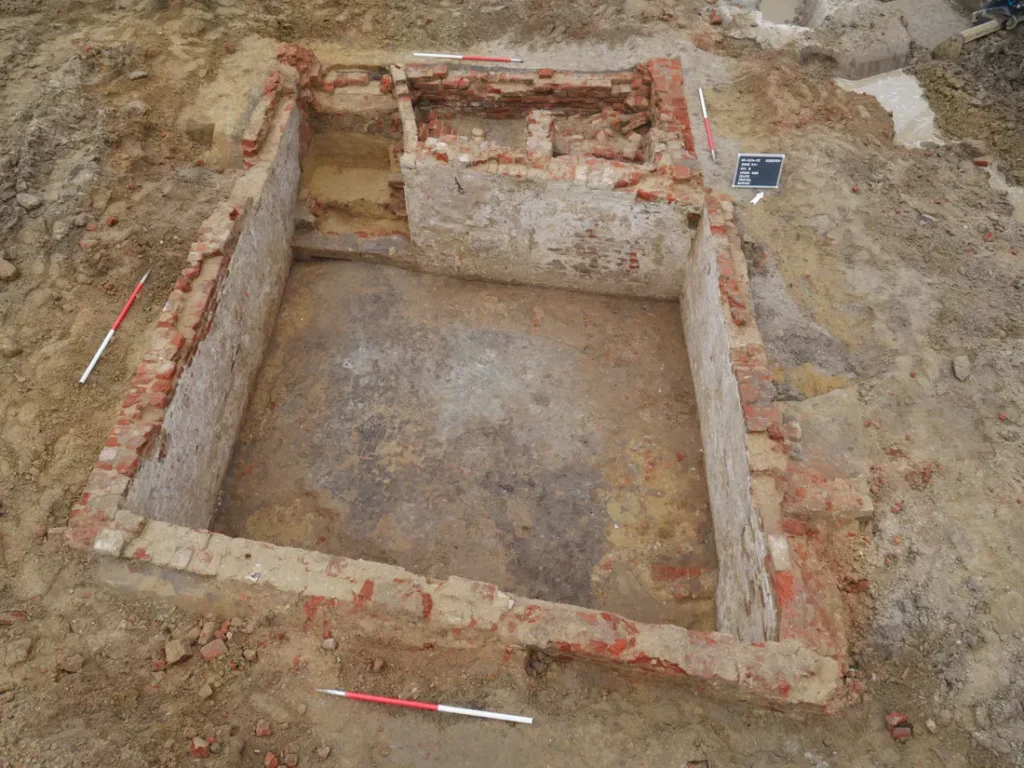
By the 19th century, the old structure could still be recognized in historic Belgian mapping, including the Roads Atlas, which recorded roads and paths across the country. This means that a settlement first laid out around 1,000 years earlier continued to shape how people moved through and built within the center of Denderleeuw.
That is what makes the discovery more than a local excavation. It shows how medieval decisions could remain active in the landscape long after the original buildings disappeared. A moat dug in the 10th century, a property boundary maintained by later generations, a road kept in use because it still made sense. Over time, these choices became the town itself.
What Denderleeuw reveals about medieval villages
The excavation also offers a wider view of village formation in western Europe.
Researchers had already suspected that settlements in the southern part of East Flanders were not always continuous villages in the modern sense. Other excavations in the region pointed in that direction. Denderleeuw now gives archaeologists a larger area to examine, making the evidence stronger and more useful.
Similar patterns have been observed in parts of France and the United Kingdom, where excavations have also suggested that medieval villages developed through clusters, enclosures and gradual expansion rather than through a single fixed plan.
Further research will be needed before archaeologists can say whether this was a common model across western Europe. Still, the Denderleeuw excavation adds an important case study. It shows that village formation was not a simple process. It was slow, layered and deeply shaped by local choices.
Forty skeletons near the church
The excavation also uncovered around 40 human skeletons.
Most were found near the church and cemetery area, which was expected. Churches often stood at the center of medieval and later village life, and burial grounds commonly developed around them. But a few bodies were discovered outside the known cemetery zone, raising questions that remain unanswered.
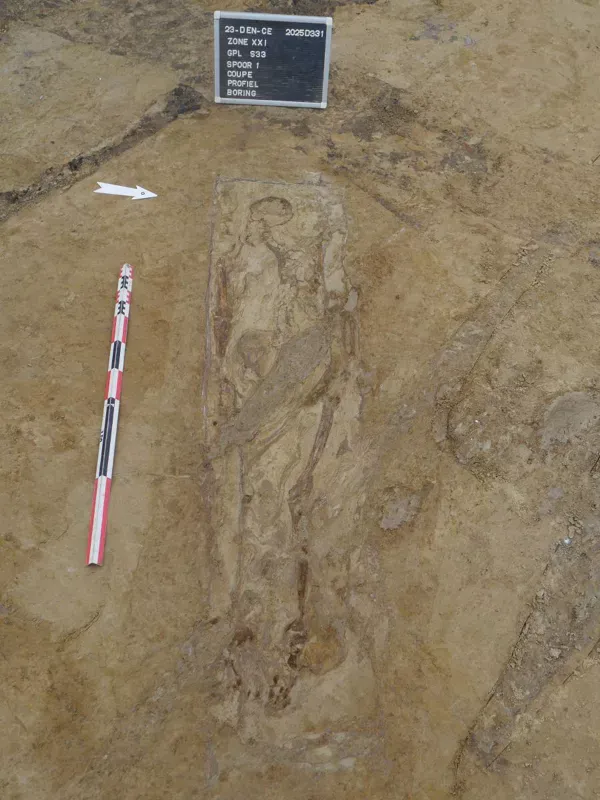
Their position may point to an earlier burial area, a different boundary of the churchyard or another phase of religious and community use. Further analysis of the remains and their archaeological setting will be needed to understand why they were buried beyond the expected cemetery limits.
The human remains add another layer to the story. Denderleeuw was not only a settlement of houses, ditches and roads. It was a lived landscape, where generations built homes, buried their dead and reshaped the same ground over centuries.
A rare window into a changing town
The excavation was commissioned before the local council’s plan to transform the square in front of the church into a greener public meeting place. Such archaeological surveys are often required before redevelopment work begins. In this case, the investigation revealed something unusually deep: a medieval structure that quietly guided the town’s growth for almost a millennium.
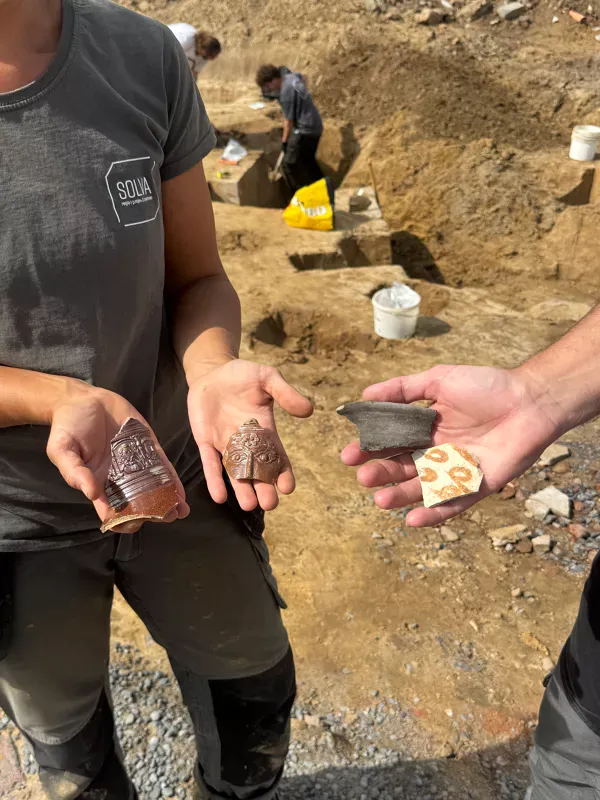
The future square will become a new public space, but the land beneath it has already served that purpose in different forms for centuries. It was a place of homes, paths, burials and memory.
Denderleeuw’s discovery is a reminder that old villages do not always disappear. Sometimes they remain underfoot, not as ruins standing above ground, but as patterns in streets, property lines and the shape of everyday life.
Cover Image: Aerial view of the excavation area near Sint-Amandus Church in Denderleeuw, Belgium, where archaeologists uncovered traces of a medieval moated residential compound that shaped the town center for nearly 1,000 years. Credit: SOLVA