
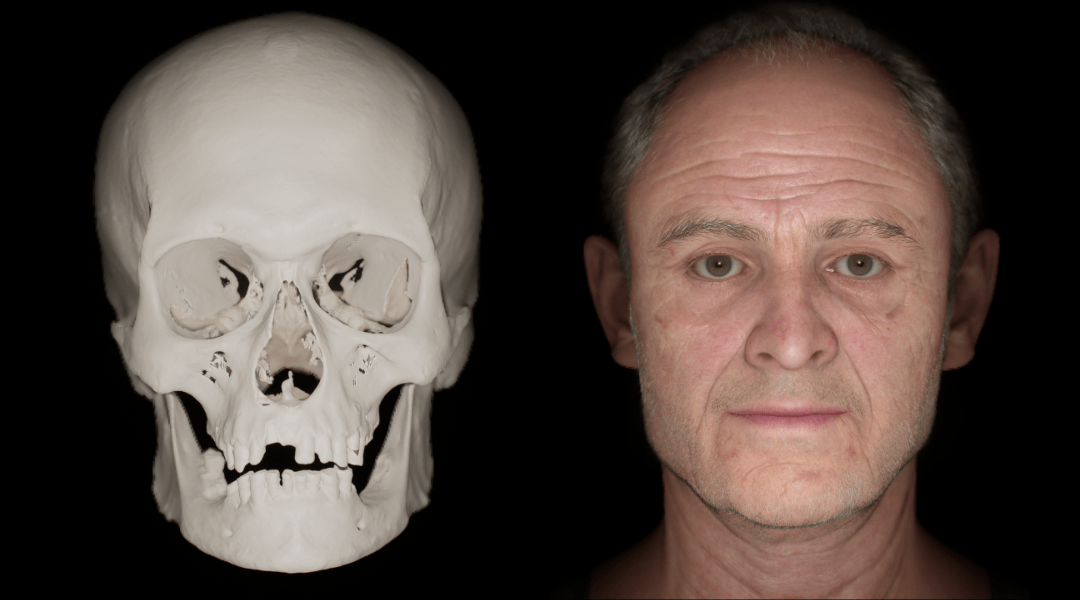
The face of “Conquest Man,” an individual buried in England shortly after the Norman Conquest, has been digitally reconstructed from his 1,000-year-old skull. His burial combined a Christian setting with Scandinavian-influenced grave goods, while scientific tests indicate substantial continental European ancestry.
His skeleton was excavated at St Peter’s Church in Barton-upon-Humber, North Lincolnshire. He was laid inside an oak coffin made from timber felled around 1079, placing his burial in the generation immediately following William the Conqueror’s invasion of England in 1066.
The skeleton, known as “Conquest Man,” was excavated at St Peter’s Church in Barton-upon-Humber, North Lincolnshire. He was laid inside an oak coffin made from timber felled around 1079, placing his burial in the generation immediately following William the Conqueror’s invasion of England in 1066.
Researchers used osteological examination, ancient DNA analysis and isotope testing before specialists at Face Lab at Liverpool John Moores University reconstructed his appearance. The project brought together English Heritage, Historic England, the Francis Crick Institute, the British Geological Survey, the University of Southampton, muVIS and Face Lab.
According to English Heritage, the results indicate that the man had substantial continental European ancestry. Tests conducted on one of his teeth provide further clues about where he may have lived during different stages of his life.
Oxygen isotope values are consistent with time spent in a colder climate during adolescence. His strontium isotope values, however, are more compatible with the region around Barton-upon-Humber.
The evidence does not establish exactly where he was born. He may have moved to Barton during his lifetime, or he may have grown up in a community whose population already reflected long-established movement across the North Sea.
A carefully arranged medieval burial
Conquest Man died between the ages of 50 and 60. He stood just over five feet tall and had a stocky, muscular build. His skeleton also carried several healed fractures, showing that he had survived multiple injuries.
The body had been placed in the coffin with its arms folded. A grass pillow supported the head, while two pieces of local chalk prevented it from falling sideways.
Three applewood staffs lay beside him. English Heritage describes these objects as grave goods belonging to a Scandinavian tradition.
Their presence does not by itself prove that the man was Scandinavian. Burial customs can travel between communities and remain in use long after people settle in a new region. In this case, the staffs show that Scandinavian-influenced practices were still understood at Barton during the late 11th century.
The location of the grave is equally significant. St Peter’s was established before the Norman Conquest but came under Norman ownership afterward. Conquest Man was therefore buried in a church connected to the new political order while receiving a funeral that retained older northern European elements.
Barton was connected to the North Sea world
Barton-upon-Humber stood within the area once governed under the Danelaw, where Scandinavian settlement had left a lasting mark on language, trade and social life. Its position near the Humber provided access to maritime routes linking eastern England with northern Europe.
These connections continued before and after 1066. The population encountered by the Normans was not culturally uniform, and the Norman ruling class itself had more distant Scandinavian origins.
Kevin Booth, English Heritage’s head curator of collections, said the burial complicates the familiar picture of the conquest as a confrontation between two clearly separated peoples.
“The classic way of understanding the Battle of Hastings is binary; ‘them and us,’” Booth said. “But what Conquest Man illustrates is so much richer than that.”
“We don’t know if he was ‘Saxon’ or ‘Norman.’ He may have been neither—a man of continental, Scandinavian influences.”
There is no evidence that Conquest Man fought at Hastings or arrived in England with William’s army. The archaeological evidence shows only that he lived through the conquest and received a respected burial during the period that followed.
What the reconstruction can—and cannot—show
Face Lab created the digital depiction by studying the surviving skull. Its shape can inform the proportions of the jaw, nose, cheeks and other anatomical features, allowing specialists to produce a scientifically guided approximation.
Other details are less certain. Hairstyle, facial hair and some aspects of complexion cannot normally be recovered from the skull alone unless supported by genetic or additional evidence. These parts of the finished image should therefore be understood as interpretive choices rather than an exact portrait.
The reconstruction depicts an older man with a broad face, receding grey hair and short stubble. It offers a plausible impression of his appearance, not a photograph-like identification.
One life within an exceptional burial archive
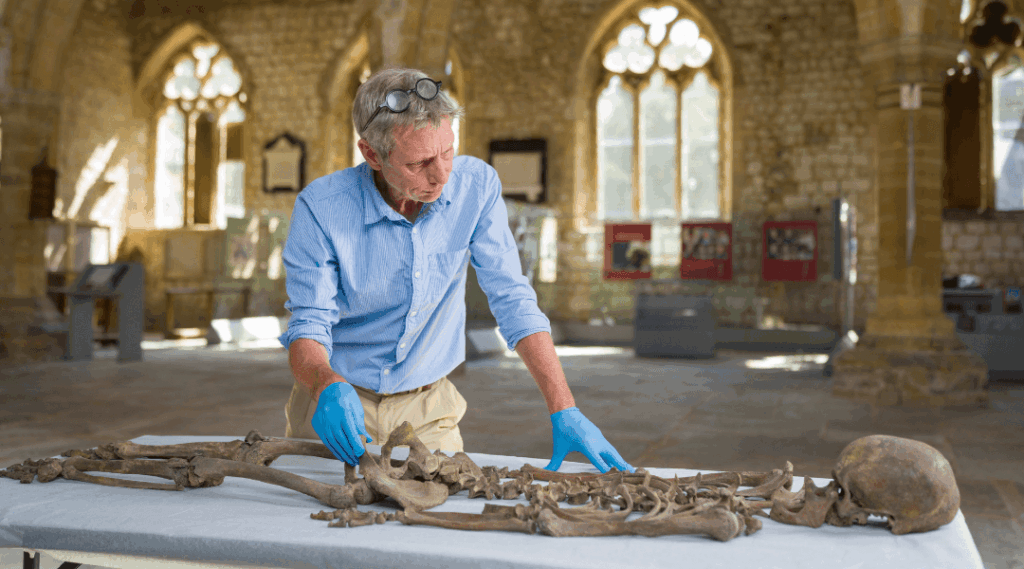
Archaeologists excavated St Peter’s Church and its cemetery between 1978 and 1984 after the building was declared redundant. They recovered the remains of nearly 3,000 people buried over approximately 900 years, from the Anglo-Saxon period to Victorian times.
Waterlogged conditions also preserved medieval wooden coffins that would ordinarily have disappeared. The resulting collection provides an unusually long record of one community and allows researchers to examine changes in health, disease, diet and burial practice.
Conquest Man demonstrates what newer scientific methods may add to that archive. His skeleton cannot reveal which side he supported in 1066, but it does show that identity in conquest-era England was more complicated than the labels “Saxon” and “Norman” suggest.
English Heritage announced the results on August 31, 2026. Its statement does not cite a peer-reviewed paper presenting the complete DNA, isotope and facial reconstruction data.
Cover Image: The skull of “Conquest Man” alongside the digital facial reconstruction created by Face Lab at Liverpool John Moores University. Credit: Face Lab, Liverpool John Moores University / English Heritage