
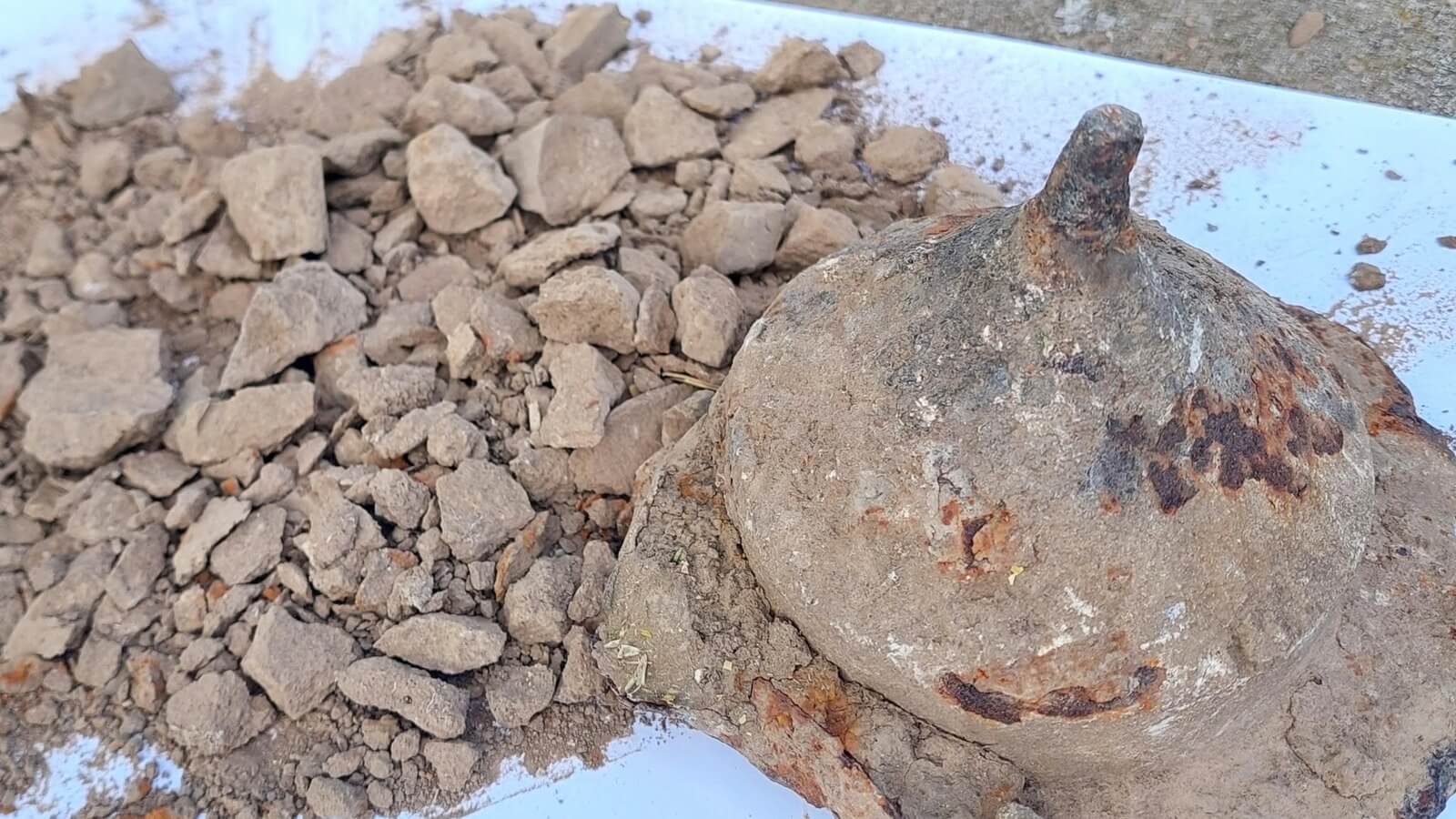
An iron shield fitting rescued from a scrapyard in eastern Poland has been identified as a 1,800-year-old archaeological artifact. Inside it, museum specialists found something even more revealing: soil containing burned human bones, apparently preserved from a cremation grave whose location remains unknown.
Włodzimierz Starykiewicz discovered the object at a scrapyard in Hrubieszów, close to Poland’s border with Ukraine. He had gone there looking for parts for old motorcycles and cars, but among the workshop tools, bolts and discarded iron he noticed a shape he recognized from archaeological publications.
Still uncertain about what he had found, Starykiewicz photographed the object and contacted the Stanisław Staszic Museum in Hrubieszów. Museum director Bartłomiej Bartecki received the image while Starykiewicz was still at the scrapyard, and the artifact was brought to the museum shortly afterward.
Its recognition came just in time. Had it remained among the scrap metal, it would probably have been sent for smelting along with everything preserved inside it.
The discovery was not an entire shield
The object is an iron shield boss, commonly called an umbo, provisionally dated to the second century CE. It once occupied the center of a wooden shield, covering the opening behind which the owner held its grip.
The surrounding wooden structure has not survived, making some reports describing the find as a complete ancient shield misleading. What reached the museum was its central iron fitting, hammered from a single piece of metal and shaped to provide space for the hand.
The Hrubieszów example also carries a pronounced spike. Bartecki told Radio Lublin that the projection was more than a decorative feature: it could assist in deflecting blows and may also have allowed the shield to be used offensively at close range.
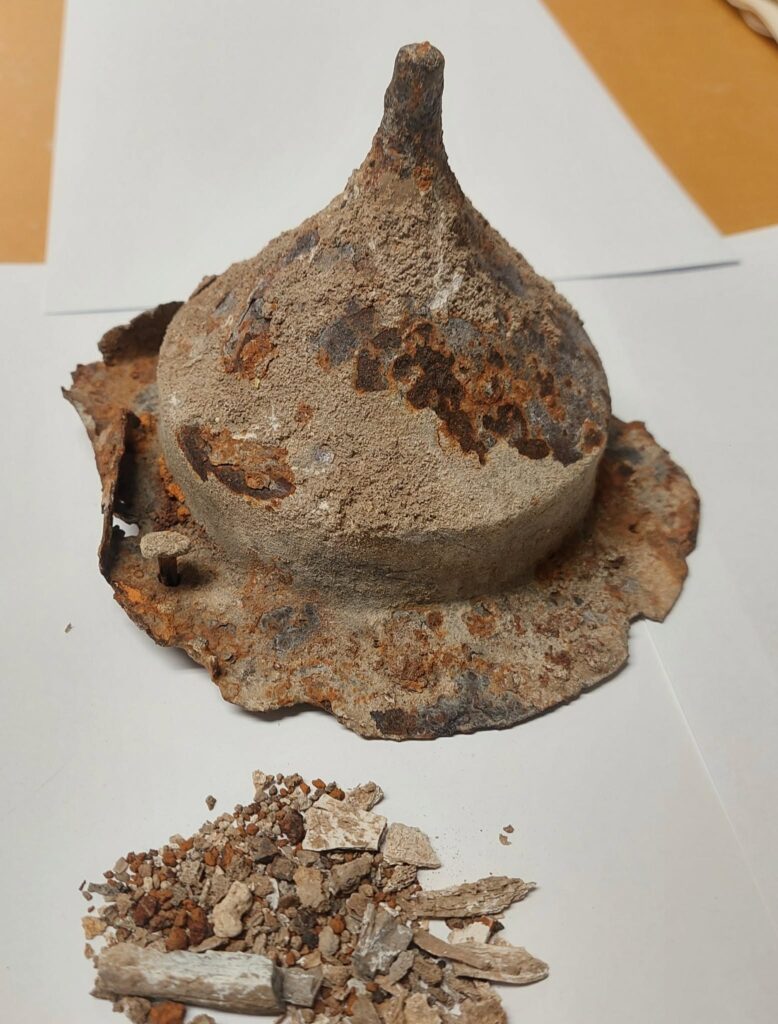
Shield bosses of this general type are known from Roman-period weapon graves in Central Europe. Most surviving examples have been separated from the wooden shields to which they originally belonged because iron is far more likely to endure in the ground than wood.
The soil inside changed the meaning of the find
A hardened mass of earth remained lodged in the hollow underside of the shield boss. Starykiewicz chose not to remove it, preserving evidence that might easily have been brushed away before archaeologists saw the object.
At the museum, Bartecki opened the compacted soil in the finder’s presence. Small pieces of burned human bone were discovered inside, while the iron itself showed a surface associated with exposure to high temperatures.
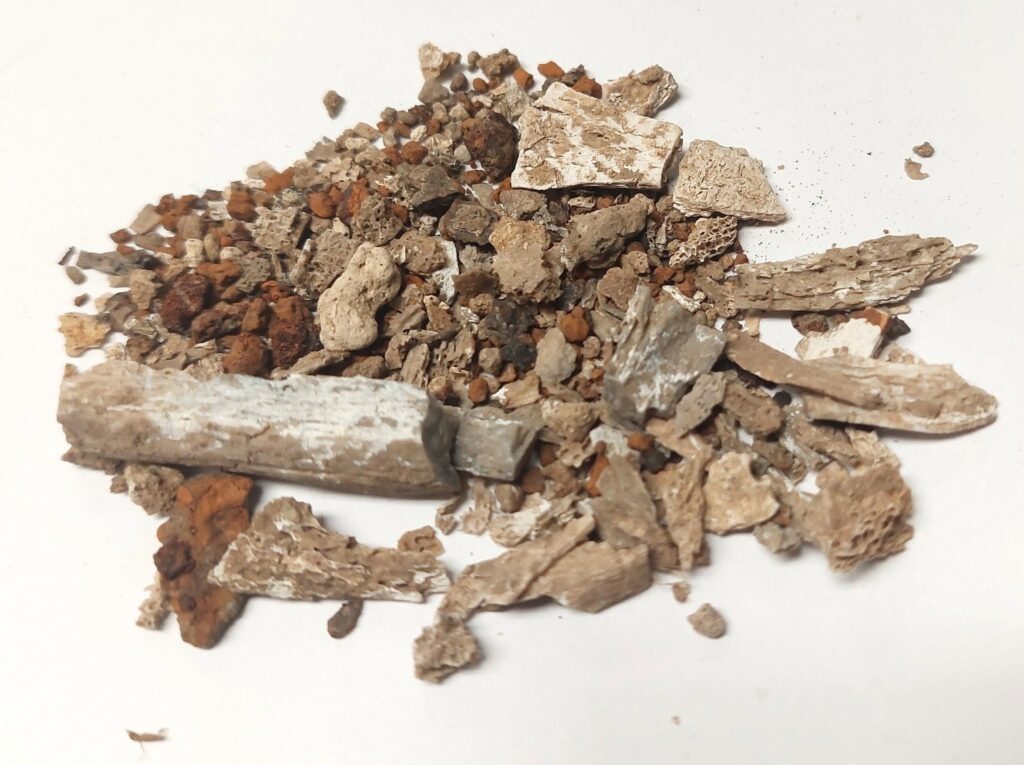
According to the museum, this combination points to a cremation burial. The shield boss had apparently been subjected to fire during funerary rites and was later placed in a grave with at least some of the deceased person’s cremated remains.
The available evidence does not establish whether the dead person was male or female. Museum representatives have therefore spoken cautiously of a warrior or possibly a female warrior, while the fragmented and burned condition of the bones may limit what further anthropological examination can determine.
The scrapyard was probably not where the artifact came from
The soil contained traces of stubble or other plant material, suggesting that the shield boss had previously been lying in cultivated ground. Museum staff suspect it may have been caught by a plough and removed from a field before someone, unaware of its age, discarded it as scrap metal.
This leaves archaeologists with a serious problem. They know where the artifact was recovered, but not where the burial was disturbed. A comparable loss of context surrounded a possible 3,000-year-old mace head found near Dukla, which could not be securely connected with a hoard, grave or wider archaeological deposit.
The umbo may have been positioned close to the upper part of the grave and pulled out by agricultural machinery while other objects remained below the plough zone. If so, weapons, pottery or personal items could still survive at the original location. There is also a chance that the damaged grave belongs to a larger, previously unrecorded cemetery.
For that reason, the museum has appealed to the person who originally brought the object to the scrapyard. Even an approximate field or farm location could allow archaeologists to inspect the area and search for the remaining grave assemblage.
What may still be beneath the field
Weapon burials from the period can contain swords, spearheads, javelin points and shield fittings, together with belt buckles or brooches used to fasten clothing. The presence of the umbo does not prove that all or any of these objects accompanied the Hrubieszów burial, but it raises the possibility that the scrapyard find represents only one displaced part of a larger deposit.
The location of every object within a grave can help reconstruct the burial rite. Researchers would want to know whether the weapons had been burned on the pyre, deliberately bent or broken, and whether the remains were placed directly into the grave or collected in a container.
That evidence cannot be recovered from the shield boss alone. Until its original location is identified, archaeologists have an artifact and part of a cremated individual, but not the complete archaeological context that once connected them.
Why the “Vandal warrior” identification requires care
The Hrubieszów museum has provisionally associated the burial with the Przeworsk culture, which was present across large areas of modern Poland during the late centuries BCE and the Roman period. Cremation was a common funerary practice in Przeworsk communities, and weapons were deposited in some graves.
Archaeologists and historians often connect parts of the Przeworsk cultural sphere with Germanic peoples identified in Roman written sources, including the Vandals. However, an archaeological culture is defined through recurring patterns in objects, settlements and burial customs. It does not automatically reveal the ethnic identity of an individual person.
Calling the deceased a “Vandal warrior” is therefore a useful historical shorthand rather than a confirmed personal identity. A more precise description would be an individual buried according to practices associated with the Przeworsk culture, in a region where communities linked with the Vandals are believed to have lived.
The Hrubieszów Basin was culturally important during the Roman period. Przeworsk sites are known from the area, while communities associated with the Wielbark culture—frequently linked with the Goths—later became increasingly visible in southeastern Poland.
Similar weapon graves have previously been found around Mołożów, Szychowice and Obrowiec, as well as in Hrubieszów itself. Bartecki noted that some archaeologists have interpreted late second-century warrior burials in the region against the background of possible conflict between groups traditionally identified as Vandals and Goths. Without its original location and complete contents, however, the newly recovered shield boss cannot yet be connected with any particular conflict.
A discovery that is still incomplete
The shield boss entered the Stanisław Staszic Museum’s collection on August 19 and is expected to undergo professional conservation. The treatment should stabilize the iron and may reveal construction details hidden beneath the corrosion, but it cannot restore the missing record of where the artifact was first unearthed.
The next development may depend on someone recognizing the object and remembering the field from which it came. Starykiewicz’s decision to stop, photograph the find and leave the soil untouched saved the surviving evidence from the furnace. Finding its original location could turn that rescue into the discovery of an unknown Roman-period burial ground.
Cover Image: An iron shield boss dating to the second century CE, recovered from a scrapyard in Hrubieszów, eastern Poland. Soil preserved inside the fitting contained fragments of burned human bone. Credit: Stanisław Staszic Museum in Hrubieszów