
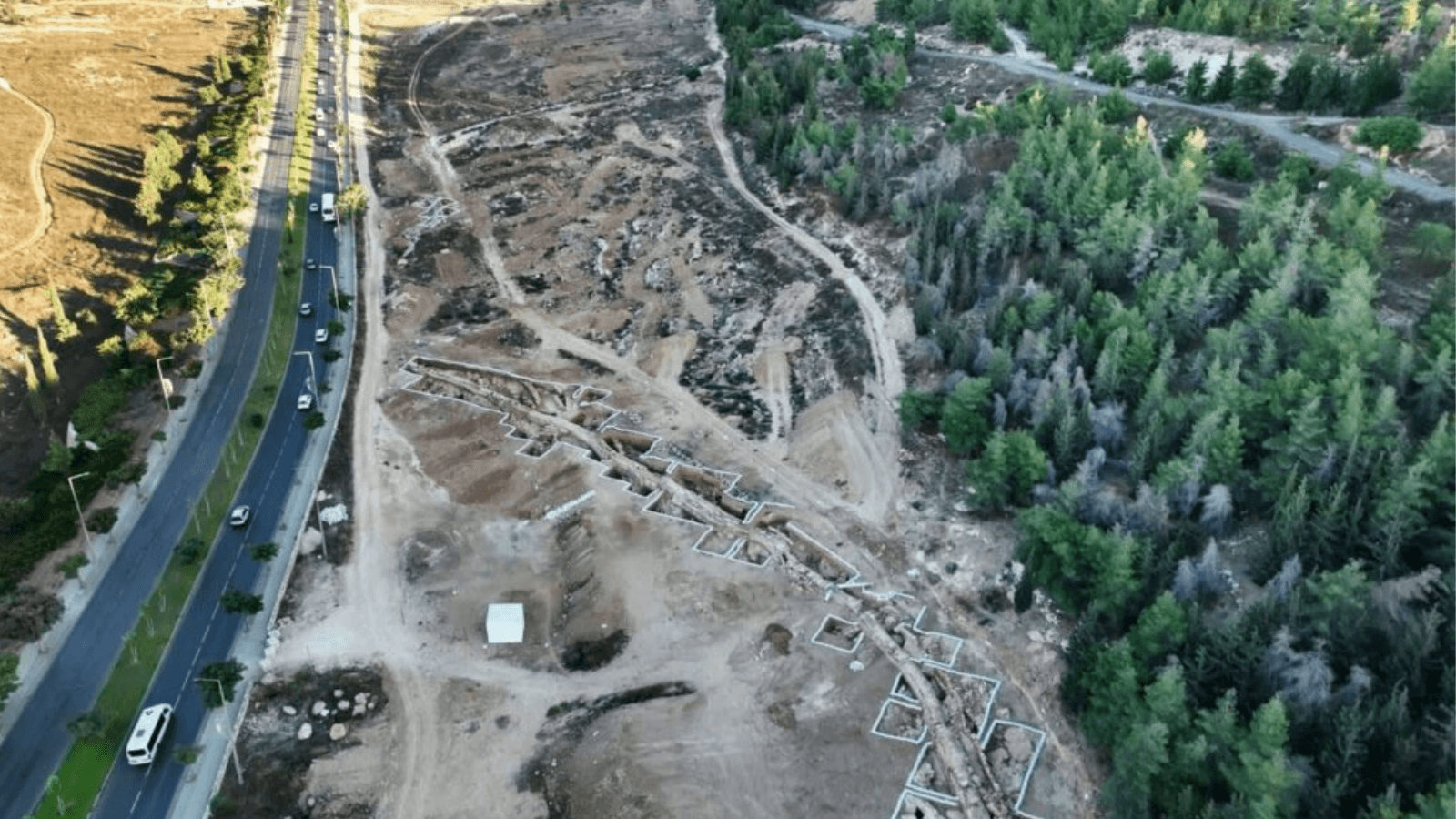
Archaeologists have uncovered a 300-meter-long section of an ancient aqueduct that delivered water to Jerusalem’s Temple Mount around 2,000 years ago. Constructed during the Hasmonean period, this hydraulic system spanned the hills south of the city and continued in operation—albeit with interruptions—until roughly a century past.
The Israel Antiquities Authority (IAA) identified the structure while excavating south of Kibbutz Ramat Rachel, an area designated for a new residential development. Funded by the Israel Land Authority, the dig revealed one of the longest surviving segments of Jerusalem’s Lower Aqueduct.
How Did the Hasmonean Kings Bring Water to Jerusalem?
The Lower Aqueduct conveyed spring water from the Gush Etzion region, passing through Solomon’s Pools south of Bethlehem, to Jerusalem’s Temple Mount. Spanning roughly 21 kilometers, its path traced the land’s natural contours, enabling gravity-fed flow without pumps or mechanical aids.
Excavation directors Dr. Benyamin Storchan, Gil Freid, and Rotem Cohen suggest the system likely dates to the Hasmonean period, when Judea was ruled by kings in the final centuries BCE. A primary engineering challenge was maintaining a precise slope. For much of its length, the channel descended only one meter per kilometer; a steeper gradient could have accelerated the water too quickly, while a shallower one risked stopping the flow entirely.
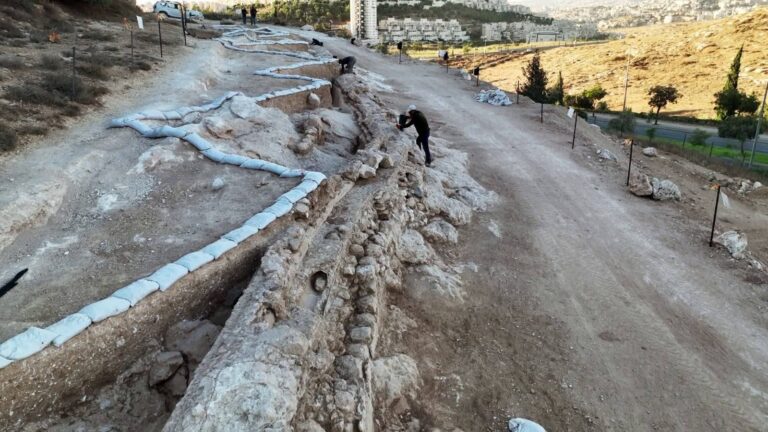
Builders adapted the aqueduct’s route to fit the surrounding hillsides and bedrock, installing access points for workers to clear sediment buildup and prevent blockages. Given Jerusalem’s growth, this infrastructure proved essential as the city required reliable water supplies for domestic use, public facilities, and religious observances, importing fresh spring water from beyond its immediate boundaries.
Repairs Carried Out During the Ottoman Period Shed Light on the Aqueduct’s Long History
Archaeological digs uncovered proof that the water system underwent changes spanning multiple centuries. The initial aqueduct featured a constructed channel lined with plaster to stop water from leaking through the walls.
Approximately five hundred years ago, under Ottoman rule, laborers fitted ceramic pipes within the older channel. They coated the exterior wall face in plaster and pressed small stones into the surface while it was still wet.
This unique finishing method can be followed along portions of the aqueduct’s path. The ceramic pipes and remaining plaster layers enable archaeologists to separate the original build from later alterations.
Instead of replacing the whole system, different generations adjusted parts of the existing structure. These fixes kept the aqueduct functional long after the leaders who ordered its construction had been gone.
The Ancient Aqueduct in Yeni Mahalle Will Be Preserved
A newly exposed section of the aqueduct near Ramat Rachel is being integrated into a planned residential neighborhood entrance. Under an agreement between the Israel Land Authority and the IAA, developers will preserve the remains and make them accessible to the public.
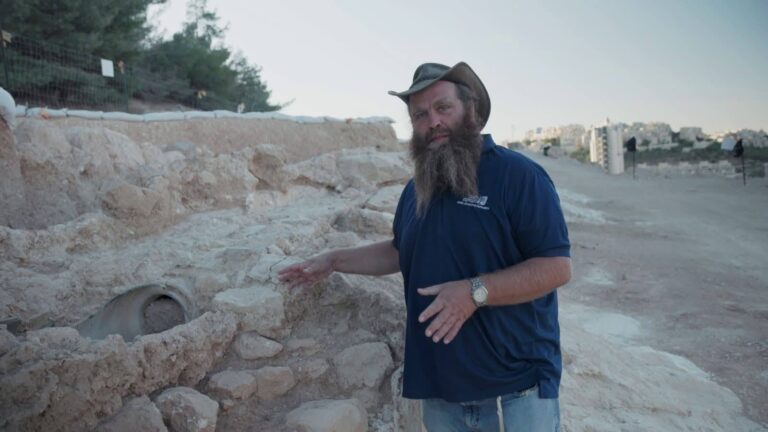
Dr. Amit Re’em, the IAA’s Jerusalem District Archaeologist, stated that the project required extraordinary planning to supply ancient Jerusalem with water. He also outlined plans for a continuous park that would let visitors follow the aqueduct from southern Jerusalem toward the Old City.
The IAA is collaborating with the Jerusalem Municipality and other partners to move forward with the proposal, though the wider park remains a future initiative.
Researchers will share their findings at the 19th New Studies in the Archaeology of Jerusalem and Its Region conference, organized by the Israel Antiquities Authority, Tel Aviv University, the Hebrew University, and Tagliyot – Israel Institute of Archaeology.
The 300-meter stretch near Ramat Rachel provides a detailed view of both the original Hasmonean construction and the later alterations that kept the aqueduct functioning. Preserving this section will allow visitors to examine part of the infrastructure that supplied Jerusalem with water for nearly two millennia.
Cover Image: Aerial view of the newly uncovered 300-meter section of Jerusalem’s 2,000-year-old Lower Aqueduct. Credit: Israel Antiquities Authority.