

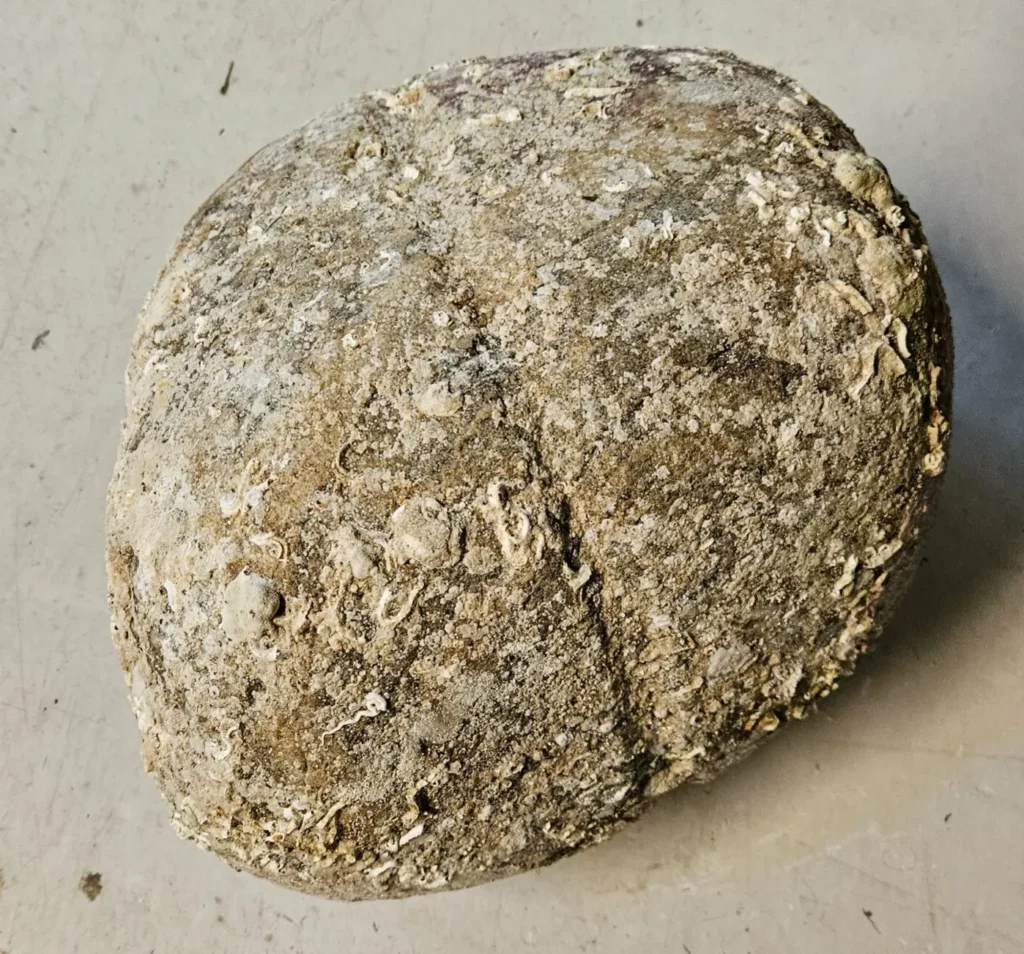
A stone weighing more than 30 kilograms and located 20 meters below the sea surface off Norway’s west coast may be the world’s oldest known anchor. The stone was discovered near a prehistoric quarry and may provide clues as to how Stone Age people secured their boats while transporting heavy boulders.
The stone was first spotted in 2025 near the small island of Hespriholmen off the coast of Bømlo and was recovered during underwater surveys in 2026. It features a distinct groove around its circumference, suggesting that a rope was once tied around it. Archaeologists believe the stone may have been used as an anchor.
A 30-Kilogram Stone and a Puzzling Groove
Leif Inge Åstveit from the University Museum of Bergen and Arild Skjæveland Vivås from the Stavanger Maritime Museum were surveying the waters around Hespriholmen. The stone was resting on a pile of quarry waste at a depth of about 20 meters.
Its unusual shape immediately caught their attention. The groove may have served to hold the rope in place; however, the stone’s considerable weight makes it illogical to use it as a fishing net sinker. Åstveit is convinced that it is an anchor, particularly given its location right next to an old quarry (a place where boats were necessary to transport stone).
Vivås also observed that the stone was well-balanced and could be lifted with a single rope. This practical detail supports the interpretation that the stone was designed to be suspended and lowered into the water.
Hein Bjerck, a retired professor from the Norwegian University of Science and Technology (NTNU), examined photographs of the find even though he did not participate in the research. He finds the anchor interpretation plausible and notes that while Stone Age people could normally pull their boats ashore, securing a boat on a rocky island exposed to strong currents and waves was a different matter.
An Island That Provided Axe Stone for Thousands of Years
Hespriholmen is located about five kilometers off the Norwegian coast. Despite its exposed location, people regularly traveled here between approximately 9,000 and 5,000 years ago to extract greenstone. This durable rock was primarily used for making axes.
Axes made from Hespriholmen greenstone have been found throughout much of western Norway. This indicates that the material extracted from this small island reached communities far beyond its borders.
Transporting the stone to the mainland required considerable effort. Quarry workers had to carry their tools across the water, extract the heavy blocks of greenstone, and load them onto boats for the return journey. Underwater surveys also revealed a large number of large hammer stones that had been brought from the mainland to the island—further evidence of the scale of quarrying operations.
An anchor was particularly useful, especially during loading. Keeping the boat steady near the rocky shore could make it easier to handle the heavy stone blocks—especially in bad weather.
Could It Be Older Than Bronze Age Anchors?
Some of the oldest stone anchors that archaeologists have reliably dated come from Bronze Age contexts in the Mediterranean. If the Hespriholmen find dates to the Stone Age period when the quarry was in operation, it could push the history of anchor use back by several thousand years.
However, the discovery has not yet been reliably dated. Its possible age is based on archaeological context rather than a direct date; the fact that the quarry was operated during the Stone Age does not prove that the stone was used during the same period. The research team has not yet published its findings in a peer-reviewed journal.