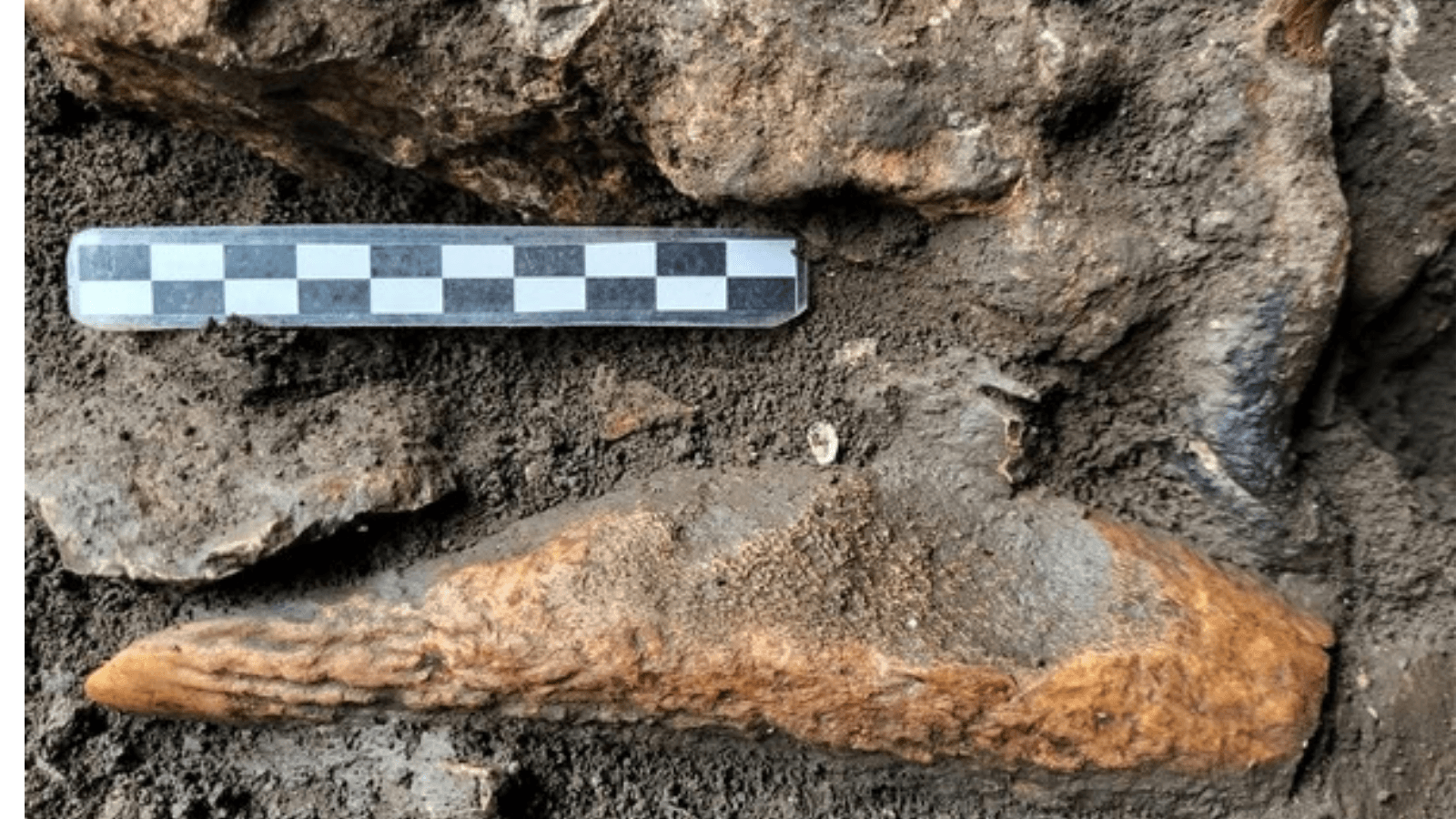
Archaeologists excavating a cave in northeastern Italy have uncovered a rare antler axe dating to around 8,000 years ago. The piece still shows traces of a hole that its prehistoric maker started but never finished. The find comes from a Mesolithic hunter-gatherer camp buried directly beneath the earliest farming layers in the region.
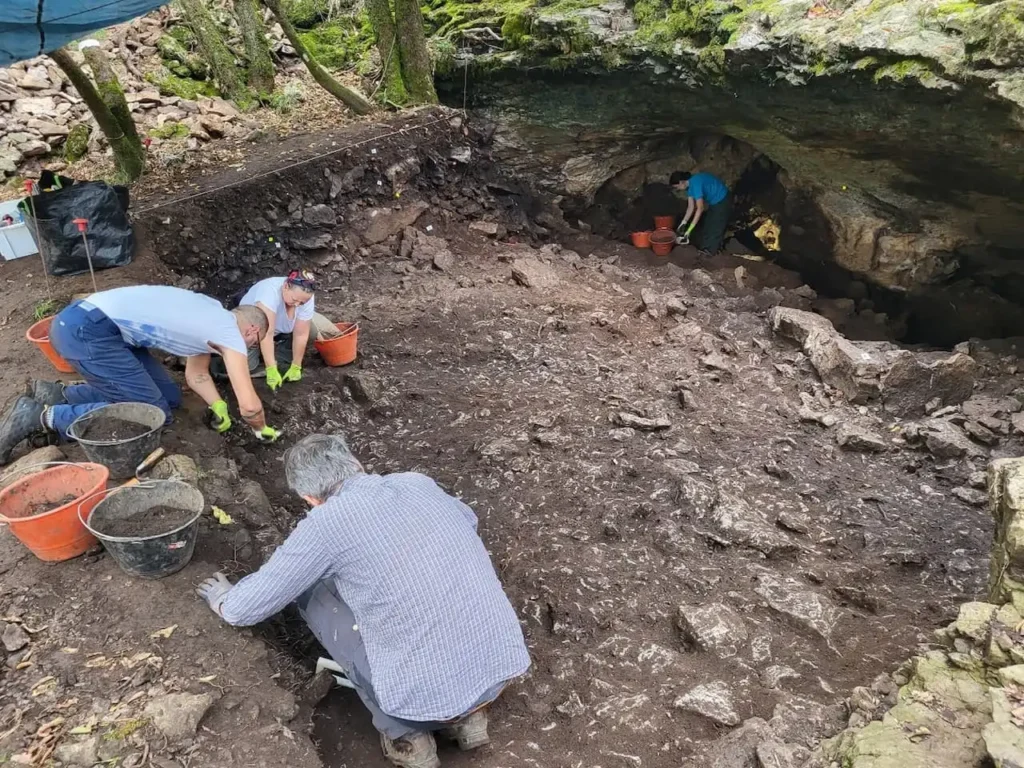
The discovery was made at Tina Jama Cave, near Trieste, by an Italian-Slovenian research team. Alongside the axe they found another unusual antler tool, hunting equipment, personal ornaments and clear traces of a campsite. The well-preserved sequence is helping researchers understand how people lived in the northern Adriatic just before agriculture arrived.
A Rare Axe with an Unfinished Hole
The large axe, made from deer antler, is one of the most striking finds from the excavation. Its surface preserves clear evidence of an unfinished perforation, giving a rare glimpse into how prehistoric craftspeople worked with animal materials.
Comparable antler axes are known from Central and Northern Europe, but they are exceptionally rare in Italy. According to Ca’ Foscari University of Venice, this piece adds an important example to the limited archaeological record of such objects on the Italian peninsula. While researchers have identified it as an axe, its precise function is still under investigation. They are studying it together with other antler objects from the cave to better understand the tools used by the region’s last Mesolithic hunter-gatherers.
Another Mysterious Tool Found Nearby
Not far from the axe, the team recovered an equally intriguing object: an approximately 11-centimetre-long section of deer antler with two deliberately formed openings. One hole runs across the antler and measures about one centimetre in diameter, while another extends lengthwise through its centre.
Researchers suspect the object may have been used to straighten wooden arrow shafts, though they have not yet confirmed this interpretation. The surrounding deposits support a strong focus on hunting. Archaeologists recovered small stone tools, trapezoidal arrowhead components, bone points and waste flakes produced during toolmaking. These finds suggest the cave’s occupants used the sheltered space for more than simple refuge. They manufactured and maintained equipment, prepared for hunting, and left behind objects that reveal aspects of their daily routines.

A Prehistoric Camp with a Hearth and Personal Ornaments
The excavation has revealed more than individual artefacts. Researchers identified traces of a Mesolithic campsite arranged around a hearth in one of the cave’s most protected areas. A structure of stones and larger blocks marked the entrance, showing that the occupants had organised their living space.
Among the smaller finds are pierced deer teeth that served as pendants and ornaments made from marine and freshwater shells. One deer tooth still bears traces of red ochre. Some flint tools retain traces of adhesive substances. The team also recovered a child’s tooth, which researchers hope will provide new information about the people who lived in the region during the Late Mesolithic. Animal remains are well preserved and will allow archaeozoologists to study hunting practices and how these communities obtained food from the surrounding Karst landscape.
What the Finds Reveal About the Arrival of Farming
The archaeological setting of the axe is as important as the object itself. The Mesolithic camp lies immediately beneath deposits left by the first Neolithic farming communities, who reached the region approximately 7,500 years ago.
Federico Bernardini of Ca’ Foscari University, who directs the excavation, explains that these early farmers travelled northward along the Dalmatian and Istrian coasts before arriving in the Karst area. Their arrival brought agriculture and animal husbandry into a region where earlier communities had relied on hunting and gathering.
Yet relatively little is known about the people who lived in the northern Adriatic immediately before this change. Many Mesolithic sites in the Karst and Istrian regions contain disturbed or incomplete deposits. Tina Jama is different. Its clear sequence allows researchers to examine evidence from the last Mesolithic communities alongside the traces of the farmers who followed them.
Elena Leghissa of the Slovenian Academy of Sciences and Arts, who coordinates the project with Bernardini, considers this sequence particularly valuable for studying the transition between the two periods. The team is now completing its fourth excavation campaign. Further analysis of the artefacts and animal remains is expected to clarify how people used the cave and what happened to the hunter-gatherer communities of the northern Adriatic when farming began to transform the world around them.
Cover Image: The rare deer-antler axe found at Tina Jama Cave, still in situ. Note the unfinished perforation near the base. Scale bar in centimetres. Credit: Università Ca’ Foscari Venezia