-

The Silk Road City Beneath the Water: A Medieval City Discovered in Lake Issyk-Kul
Archaeologists have confirmed the existence of a medieval Silk Road city lying beneath the waters of Lake Issyk-Kul—a discovery that reshapes historical understanding of Central Asia’s submerged past. The site, identified as the long-lost settlement of Toru-Aygyr, was revealed by researchers from the Russian Academy of Sciences and officially announced on November 18, 2025. Hidden…
-

Lost City of Almanzor May Have Been Found: LiDAR Data Points to Medina Alzahira
For more than a century, the exact location of Medina Alzahira, the vanished seat of power built by Almanzor at the height of Umayyad rule in al-Andalus, has remained one of medieval Iberia’s most persistent archaeological riddles. Dozens of hypotheses were proposed. None could be anchored to verifiable physical evidence. That may now have changed.…
-

Europe’s Lost Black Death Graves Found: Scientists Identify First Systematically Proven Plague Mass Burial
A long-missing chapter of medieval Europe’s deadliest pandemic is finally emerging from the ground An interdisciplinary research team has identified compelling evidence of a Black Death mass grave near the abandoned medieval village of Neuses, just outside Erfurt. The discovery represents the first systematically identified plague burial site in Europe, offering rare physical confirmation of…
-

5,000-Year-Old Rock Art Sites Discovered in Saudi Arabia’s Soudah Peaks
A rugged highland zone in southwestern Saudi Arabia has yielded one of the most extensive recent rock art discoveries in the region. The Saudi Arabia’s Heritage Commission, working in partnership with Soudah Development, has announced the identification of 20 previously undocumented rock art sites across the Soudah Peaks area. The newly recorded sites lie within…
-

A Late Roman Bone Box Unlike Any Other Emerges from a Grave in Roman Britain
For months, archaeologists working at Milestone Ground in Broadway kept one discovery out of the spotlight. Now revealed, the find stands out as one of the most unusual small objects recovered from Roman Britain in recent years: an intact, finely carved bone box with no known parallels. The artefact, dating to the late Roman period,…
-

A 3,300-Year-Old Face Emerges from a Dilmun Grave in Bahrain
In the packed earth of a Middle Bronze Age burial in southern Bahrain, archaeologists have come face to face with something rarely encountered in Gulf archaeology: a crafted faience head, placed beside the dead more than three millennia ago. Discovered at the Hilla (Al-Hillah) site, the object is as striking as it is enigmatic—and may…
-

An Exceptionally Heavy 1,800-Year-Old Gold Roman Fidelity Ring Discovered at Bononia
Nearly six meters beneath the streets of modern Vidin, archaeologists uncovered an exceptionally heavy gold Roman fidelity ring lost nearly 1,800 years ago—an object that speaks not of war or imperial power, but of marriage, status, and social identity in the Roman world. The discovery was made during the final days of the 2025 excavation…
-
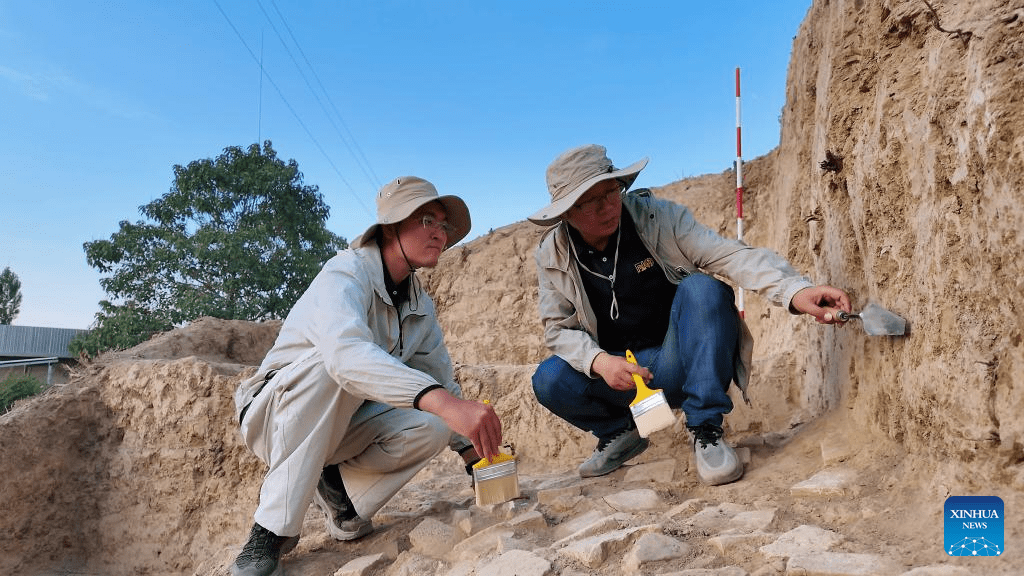
1,300-Year-Old Ancient City Walls Discovered in Kuva Along the Silk Road
Archaeologists working in eastern Uzbekistan have uncovered ancient city walls at Kuva that were built, altered, and reused over a period of nearly 1,300 years, revealing the long-term resilience of a key Silk Road settlement. Dating from the 3rd century BC to the 10th century AD, the fortifications provide rare physical evidence of continuous urban…
-

A Unique Bone Stylus from Ancient Gela Redefines Craft, Ritual, and Symbolism in Classical Greece
Archaeologists working in the ancient Greek city of Gela, on Sicily’s southern coast, have uncovered an object so unusual that specialists describe it as a true unicum—a discovery without known parallels in the archaeological record of Classical Greece. The find is a finely carved ceramist’s stylus made of bone, dated to the 5th century BCE,…