
A rugged highland zone in southwestern Saudi Arabia has yielded one of the most extensive recent rock art discoveries in the region. The Saudi Arabia’s Heritage Commission, working in partnership with Soudah Development, has announced the identification of 20 previously undocumented rock art sites across the Soudah Peaks area.
The newly recorded sites lie within a survey zone covering more than 636.5 square kilometers, extending across Soudah and parts of Rijal Almaa. Preliminary assessments indicate that many of the carvings and inscriptions date to between 4,000 and 5,000 years ago, pushing the region’s documented human activity deep into prehistory.
Images of Life Carved in Stone
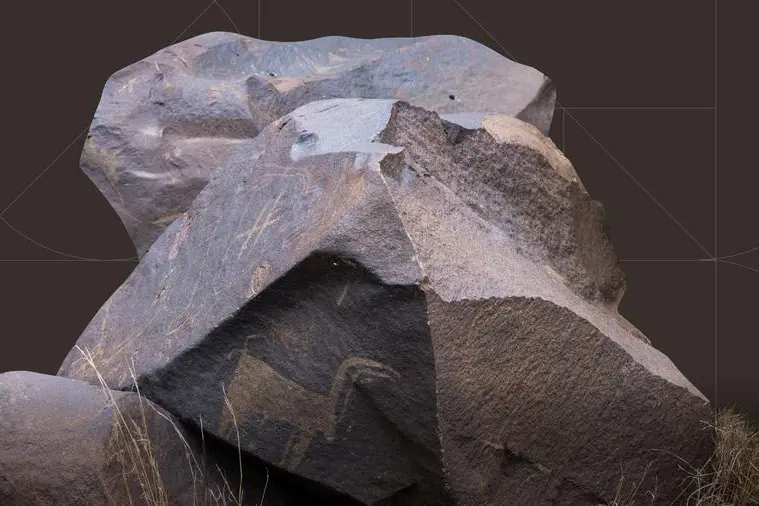
The rock art assemblage offers a vivid glimpse into the lifeways of ancient communities who once moved through these mountains. Among the most striking elements are Thamudic inscriptions, alongside finely rendered figures of ibex, hyenas, and ostriches. Human scenes are equally prominent, depicting hunters in motion, groups engaged in dance, palm trees, and weapons.
Taken together, these images suggest a landscape shaped not only by subsistence activities but also by ritual behavior, social expression, and symbolic communication. For researchers, the variety of motifs provides rare insight into how early populations perceived their environment and organized communal life in Arabia’s highlands.
A Four-Phase Scientific Survey
The discoveries form part of a structured archaeological program carried out under a formal cooperation agreement between the Heritage Commission and Soudah Development. The project unfolded in four scientific phases, beginning with data collection and spatial analysis, followed by detailed documentation, evaluation, and the classification of sites with high archaeological value.
This methodology was designed to ensure that cultural heritage considerations are fully integrated into future planning. Rather than isolated finds, the rock art panels are now recorded as elements of a wider cultural landscape, strengthening their protection and research potential.
Heritage at the Core of Development
Soudah Development has emphasized that safeguarding cultural heritage remains central to its long-term vision for the area. While the Soudah Peaks are being positioned as a high-end mountain destination, the company has committed to embedding archaeological preservation into its development strategy.
By presenting ancient rock art as a defining feature of the region, the project seeks to balance tourism, conservation, and scholarship—allowing visitors to encounter the deep history of Arabia without severing it from its original context.
What emerges from the mountains of Soudah is more than a collection of carvings. It is a stone archive, preserving voices from millennia ago and reshaping how the early cultural history of the Arabian Peninsula is understood.
Cover Image: Prehistoric rock art panel from Saudi Arabia’s Soudah Peaks, featuring carved animal figures and human motifs dated to approximately 4,000–5,000 years ago. Credit: SPA