
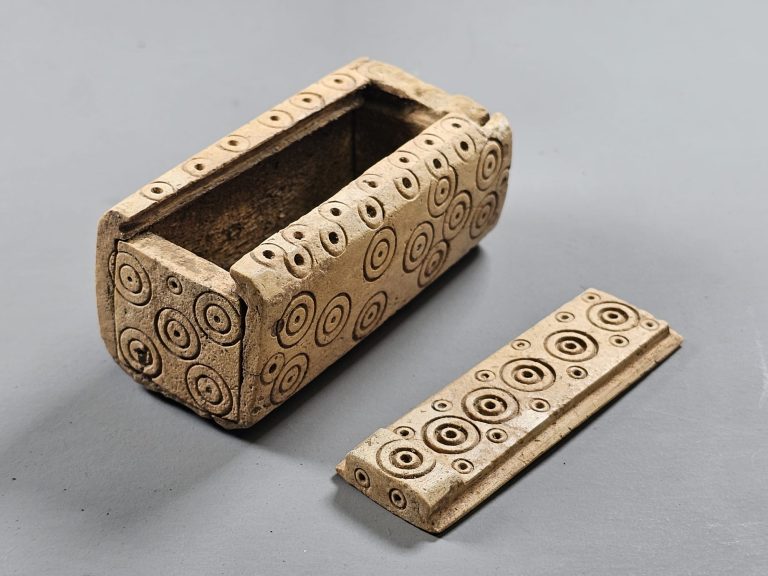
For months, archaeologists working at Milestone Ground in Broadway kept one discovery out of the spotlight. Now revealed, the find stands out as one of the most unusual small objects recovered from Roman Britain in recent years: an intact, finely carved bone box with no known parallels.
The artefact, dating to the late Roman period, will soon be introduced to a wider audience through Digging for Britain, but its archaeological significance extends well beyond television.

A Personal Object Placed with Care
The box was found inside the grave of a young woman, deliberately positioned rather than discarded or disturbed. Remarkably well preserved, it features a sliding lid and a decorative scheme known as ring-and-dot, a motif consistent with late Roman craftsmanship.
Radiocarbon dating of the burial confirms the proposed chronology. Measuring just 68 mm in length, the object is small, yet its condition and precision immediately drew attention during excavation.
Specialist analysis revealed that the box was made from roe deer bone, a material choice that adds another layer to its interpretation. Researchers suggest it may once have contained an ointment or cosmetic substance, hinting at aspects of daily life, care, or personal identity that rarely survive in the archaeological record.
“Something Truly Special”
Jamie Wilkins, who led the excavation, described the moment of discovery as exceptional. He emphasized not only the quality of the object itself, but what it reveals about the people who lived—and were buried—at the site.
Objects of this kind are rare in Roman Britain. An object with no known parallels is rarer still.
One Site, Thousands of Years of History
While the bone box has become the focal point, Milestone Ground tells a much broader story. Excavations uncovered evidence of continuous human activity spanning roughly 8,000 years, from the Mesolithic period through Roman occupation and into Saxon times.
Broadway’s location along a major routeway across the Cotswolds escarpment helps explain this long-term importance. Generation after generation, communities returned to the same landscape, leaving behind traces now pieced together through archaeology.
From Excavation to Museum
The excavation was commissioned and funded by Wychavon District Council as part of the planning process. Fieldwork has concluded, but specialist studies are ongoing. Once complete, all finds and records will be formally deposited with the county museum, ensuring long-term preservation and public access.