
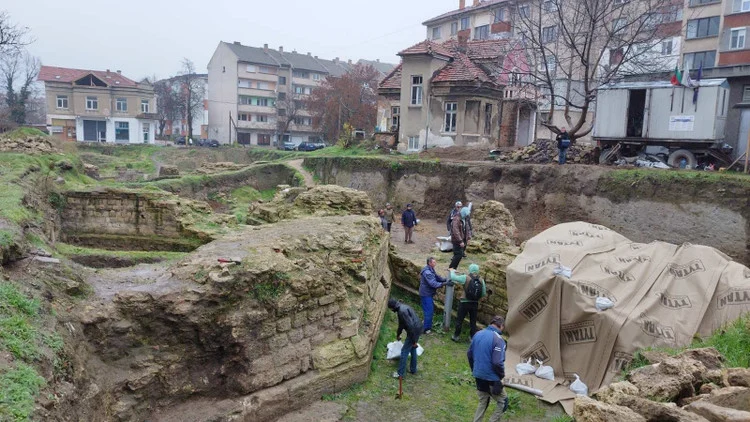
Nearly six meters beneath the streets of modern Vidin, archaeologists uncovered an exceptionally heavy gold Roman fidelity ring lost nearly 1,800 years ago—an object that speaks not of war or imperial power, but of marriage, status, and social identity in the Roman world. The discovery was made during the final days of the 2025 excavation season at Bononia, a key Roman center along the Danube frontier.
Weighing 23.63 grams and dating to the late second or early third century AD, the ring is already regarded as one of the most significant Roman-period finds unearthed in the region in recent years.
A Ring That Defined Marriage in Roman Society
According to excavation director Assoc. Prof. Dr. Zdravko Dimitrov, the object belongs to a rare category known as Roman marital fidelity rings. These rings were exchanged at the moment of legal marriage and functioned as visible markers of a woman’s marital status within Roman society.
Unlike plain bands, fidelity rings carried strong symbolic meaning. They represented lawful union, loyalty, and social legitimacy—concepts that were central to Roman family structure and civic life.
Symbolism Cast in Gold
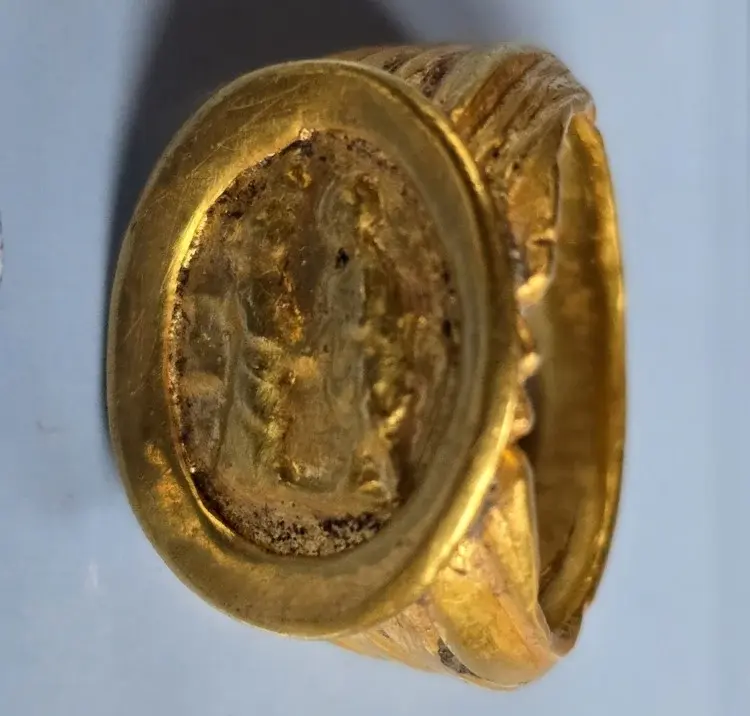
What sets the Bononia ring apart is its refined iconography. Its oval gold bezel is engraved with a married couple facing one another, a visual formula commonly associated with harmony, permanence, and mutual obligation. The bezel is carefully soldered onto the hoop, whose shoulders are decorated with parallel cannelures—a decorative technique characteristic of high-quality Roman goldwork.
Such craftsmanship suggests deliberate commission rather than mass production, reinforcing the object’s elite status.
Local Craftsmanship Along the Danube
Specialists believe the ring was produced locally, most likely in the goldsmith workshops of Ratiaria, a major urban and artisanal center on the Danube. During the second century AD, both Bononia and Ratiaria transitioned from military outposts into prosperous civilian cities, sustained by trade routes and river-based commerce.
Roman fidelity rings were typically worn by women and could also function as personal seals, pressed into wax to authenticate documents—giving them both emotional and administrative significance in daily life.
Bononia and the Roman Danube Frontier
Founded initially as a Roman fort, Bononia later developed into a flourishing city within the province of Moesia Superior. Its position along the Danube Limes made it a strategic hub for trade, communication, and military logistics.
The substantial weight and purity of the gold ring indicate ownership by a wealthy local family during the city’s economic peak.
A Layered Landscape of Power and Movement
The excavation area has revealed evidence of long-term and continuous use. Approximately two meters above the Roman layers, archaeologists recovered a lead seal belonging to Basil, the Byzantine strategos of Bdin, dated to 1003 AD—during the reconquest of the region under Emperor Basil II.
The repeated loss of valuable objects near Tower No. 10, just inside the fortress entrance, suggests this zone functioned as a heavily trafficked gateway across centuries.
Conservation and Future Research
With the 2025 excavation season concluded, conservation work is underway to protect the site through winter. Bulgarian authorities have confirmed continued funding for future archaeological research at Bononia and the nearby Baba Vida fortress moat.
This single gold ring, preserved beneath layers of Roman and Byzantine history, offers a rare and personal insight into how marriage, legality, and status were understood in the Roman world—quietly reinforcing Bononia’s role as a cultural crossroads along the ancient Danube.
Cover Image Credit: National Museum of Bulgaria.