
Skip to content
Ancientist

Exploration goes beyond the pursuit of knowledge

Social links will appear here soon.

  • Home
  • Anatolian Archaeology
  • Anthropology
  • Archaeology News
  • Biblical Archaeology
  • Classical Archaeology
  • Egypt
Friday, November 6
  1. Home
  2. Archaeology News
  3. 11,000-Year-Old Feast Reveals Wild Boars Were Transported 70 KM in Prehistoric Iran
Archaeology News

11,000-Year-Old Feast Reveals Wild Boars Were Transported 70 KM in Prehistoric Iran

By Zack RafielJul 15, 2025
11,000-Year-Old Feast Reveals Wild Boars Were Transported 70 KM in Prehistoric Iran

A stunning discovery in the Zagros Mountains rewrites our understanding of prehistoric social life and long-distance gift exchange

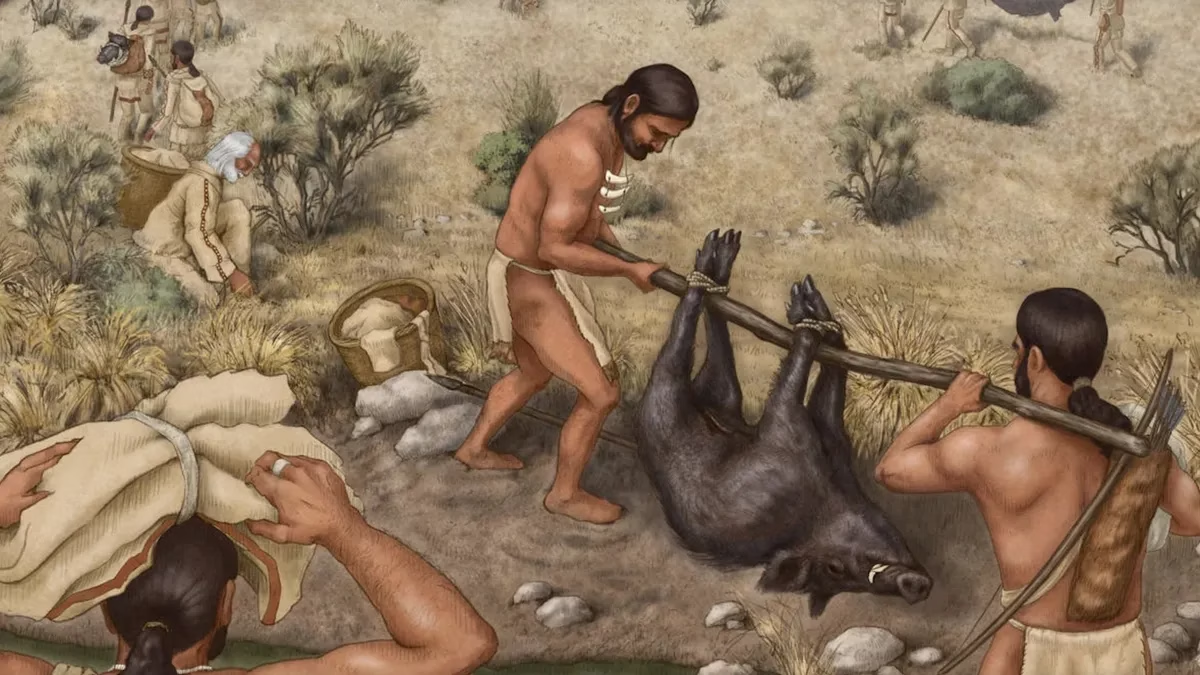
A groundbreaking archaeological discovery in western Iran’s Zagros Mountains has revealed that prehistoric communities held elaborate communal feasts over 11,000 years ago—and even transported wild boars over 70 kilometers across rugged terrain to attend them.

Feasting Before Farming: A New Perspective on Prehistoric Societies

Until recently, large-scale feasting was believed to be exclusive to agricultural societies. However, new research from the Asiab site challenges this idea. Archaeologists uncovered the skulls of 19 wild boars buried together in a pit, bearing signs of butchery consistent with a communal event.

Led by Dr. Petra Vaiglova, a team of researchers used isotopic analysis of tooth enamel to determine that several of these animals were not local. Instead, they were brought from distant regions—demonstrating not only mobility but also symbolic gift-giving long before the rise of farming.

Tooth Enamel Tells a Story of Travel

Just like counting tree rings, the scientists analyzed microscopic growth layers in the boars’ teeth to track environmental exposure over time. The variations confirmed that the animals originated from diverse ecological zones and were intentionally brought to Asiab—likely as meaningful contributions to the feast.

“Much like bringing a regional wine to a dinner party today, these animals were probably gifted to mark social ties and celebrate shared identity,” explained Vaiglova.

Gift-Giving and Social Bonds in the Stone Age

This behavior suggests that reciprocity and social cohesion were already essential parts of human interaction during the pre-agricultural period. Sharing food from distant places could have been a powerful gesture, reinforcing alliances and cultural identity.

Summary of the analyses carried out in this study. Credit: Nature Communications Earth & Environment

Though similar feasting behavior has been seen at Stonehenge—where pigs were brought from across Britain—the Asiab site predates it and is the first known example of long-distance food transport in a pre-farming society in the Near East.

Asiab Discovery Redefines Ancient Community Life

The findings show that ancient humans were capable of organizing complex social events, including symbolic exchanges and coordinated logistics, much earlier than previously thought. These gatherings likely played a crucial role in shaping the foundations of community, ritual, and eventually, agriculture.

From Boar to Brie: Food as a Cultural Connector

Whether it’s crocodile jerky in Australia or French cheese at a celebration, food remains a universal expression of culture and connection. And now, thanks to the wild boars of prehistoric Iran, we know this tradition stretches far deeper into human history than we imagined.


Vaiglova, P., Kierdorf, H., Witzel, C. et al. Transport of animals underpinned ritual feasting at the onset of the Neolithic in southwestern Asia. Commun Earth Environ 6, 519 (2025). https://doi.org/10.1038/s43247-025-02501-z

This edited article is republished from The Conversation under a Creative Commons license. Read the original article.

Cover Image Credit: Artistic reconstruction of early humans transporting a wild boar across rugged terrain to a communal feast in ancient Iran. (Illustration by Kathryn Killackey)

Tagged ancient long-distance food transportancient reciprocity and gift-givingcultural significance of food in prehistoryearly human community lifeisotope analysis of tooth enamelprehistoric Iran archaeologyprehistoric social ritualsStone Age communal feastingsymbolic food sharing

More articles

Previous story3,000-Year-Old Secrets Unearthed in Quantock Hills: A Landscape of Rituals, Life, and Death
Next storyMithras Seal: An Ancient Artifact Taken from Berlin to Moscow’s Pushkin Museum After World War II

Latest News

  1. 01

    From Two Possible Cave Images to 55 Animals: Catalonia’s Ice Age Art Reassessed

    Nov 6, 2026
    Palaeolithic horse engraved on a cave wall at Cova de la Font Major in Catalonia, Spain.
  2. 02

    Leprosy DNA Found in 1,600-Year-Old Boat Grave with a Wooden Throne in Germany

    Nov 5, 2026
    Decorated wooden throne from a 1,600-year-old boat grave at Fallward, Germany.
  3. 03

    Four-Letter Code Cracked on Lock from a 1583 Shipwreck in Wales

    Nov 4, 2026
    Brass combination lock surrounded by gold and silver coins associated with the 1583 Ann Francis shipwreck.
  4. 04

    30,000-Year-Old Woman’s DNA Challenges Ice Age Europe’s Genetic Divide

    Nov 4, 2026
    Interior of Isturitz Cave in France, where 30,000-year-old human remains provided evidence of genetic connections across Ice Age Europe.
  5. 05

    3,000-Year-Old Bronze Age Hoard Found on Ottoman Battlefield in Hungary

    Nov 3, 2026
    Large Late Bronze Age vessel containing spiral ornaments, held by a member of the excavation team in Hungary.
  6. 06

    6,500-Year-Old Cemetery Near Paris Reveals Human-Shaped Menhir and Seated Burial

    Nov 3, 2026
    Overhead view of a deep, circular Neolithic burial pit containing a seated human skeleton near Paris.
  7. 07

    Prehistoric Pigments Found in Portugal Suggest Rock Engravings May Once Have Been Painted

    Nov 3, 2026
    Researcher examining prehistoric animal engravings on a rock face in Portugal's Côa Valley.
  8. 08

    1,400-Year-Old Seal Found in Croatia Bears the Name of an Unknown Bishop

    Nov 2, 2026
    Two sides of an early medieval lead bishop's seal bearing Latin inscriptions and decorative motifs.
  9. 09

    900-Year-Old Shiva Statue Found in Cosmic Dance Pose in India

    Nov 1, 2026
  10. 10

    2,300-Year-Old Messapian Tomb with Unusual Religious Symbols Discovered in Italy

    Oct 31, 2026
    Ancient Messapic inscription carved across three stone slabs covering a tomb at Manduria, Italy.

© 2026 Ancientist. All rights reserved.

  • Privacy Policy
  • Contact Us
We use cookies to ensure that we give you the best experience on our website. If you continue to use this site we will assume that you are happy with it.