
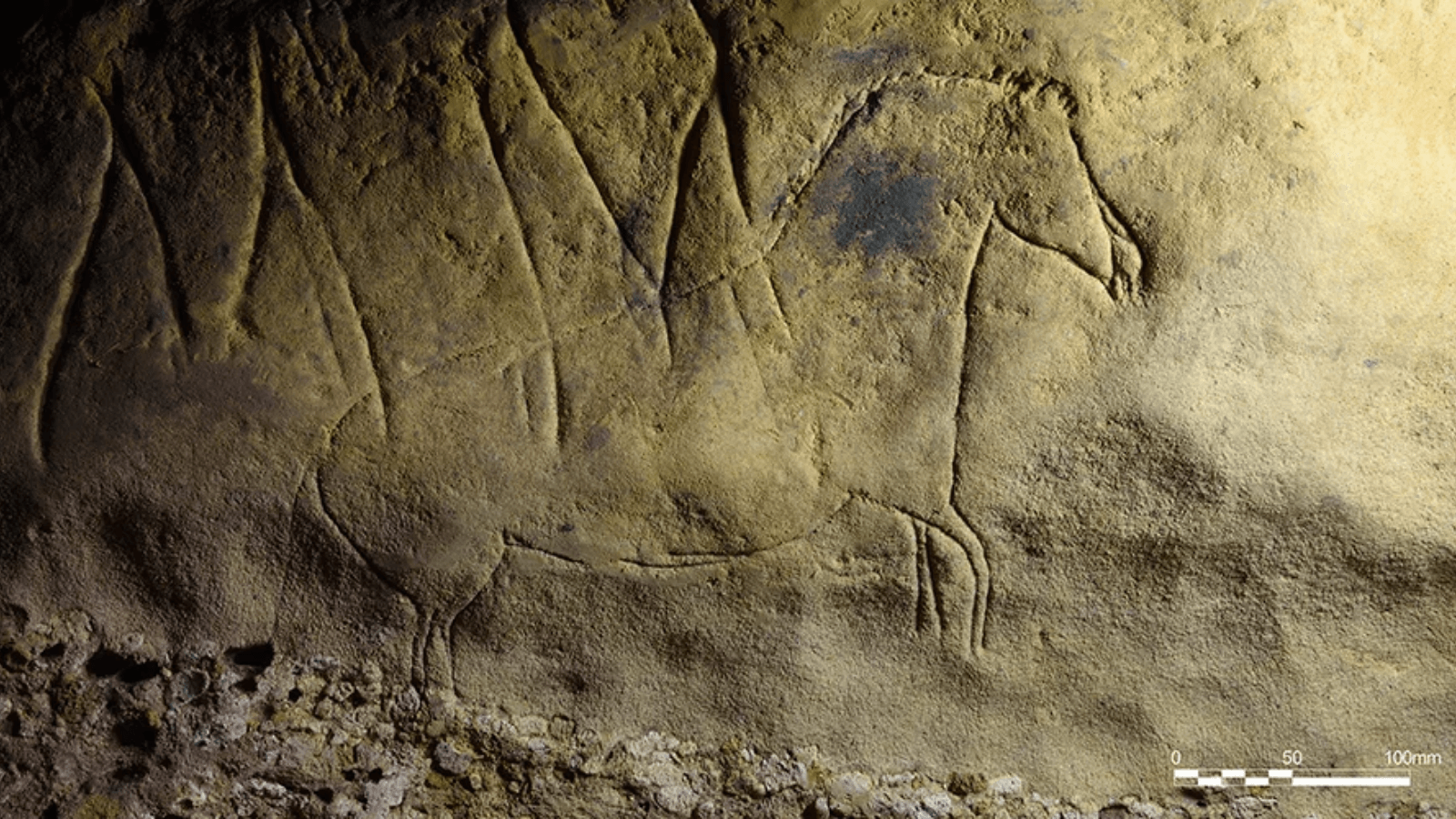
For decades, archaeologists knew of only two possible examples of Upper Palaeolithic cave art in Catalonia, northeastern Spain. One had been stolen, while the human origin of the other remained uncertain. Now, 55 animal engravings documented in a single cave are challenging the long-standing picture of a region almost absent from Europe’s Ice Age art record.
The engravings belong to Cova de la Font Major, beneath the town of Espluga de Francolí in Tarragona. Researchers Josep Maria Vergès Bosch and Míriam Salas-Altès, affiliated with IPHES-CERCA and Rovira i Virgili University, have documented 280 graphic elements across five sections of the cave. Their study, published in Antiquity on November 5, 2026, offers a substantially different picture of prehistoric artistic activity in northeastern Iberia.
An Archaeological Gap in Catalonia
The scarcity of Palaeolithic cave art in Catalonia had long contrasted with the extensive collections documented elsewhere in Spain and southwestern France. Even the region’s two previously known examples were difficult to assess.
A black-painted bovine figure discovered at Cova del Tendo was stolen shortly after its discovery and survives only in photographs and a tracing. At Cova de la Taverna, an incomplete figure resembling a deer remains controversial because researchers cannot establish whether humans produced it.
However, other archaeological evidence already suggested that the apparent absence of cave art did not reflect a complete absence of prehistoric artistic activity. Nearby Molí del Salt had yielded decorated portable objects, while excavations elsewhere in southern Catalonia identified human occupations dating to earlier phases of the Upper Palaeolithic.
The discovery at Font Major therefore raises a broader question about the archaeological record: how much of the apparent geographical gap resulted from the way researchers searched for and recognised prehistoric images?
The Cave Walls Everyone Walked Past
The first engravings were recognised on October 30, 2019, during an archaeological campaign inside the cave. Their location made the discovery particularly unexpected.
The cave’s main entrance reopened in 1957, and the site became a tourist attraction in 1993. Thousands of visitors subsequently passed the engraved surfaces, sometimes scratching names and dates over prehistoric figures without recognising their significance.
Researchers had previously considered the irregular conglomerate walls poorly suited to extensive cave art. Yet prehistoric artists appear to have selected softer marl layers between the harder geological formations, creating images through shallow incisions and occasional scraping.
The documented collection includes 55 animal figures, with 33 concentrated in a single sector. Horses, deer, bovids and caprines appear alongside a rare representation of a bear. The bear’s ears face forward, while its mouth is depicted slightly open.
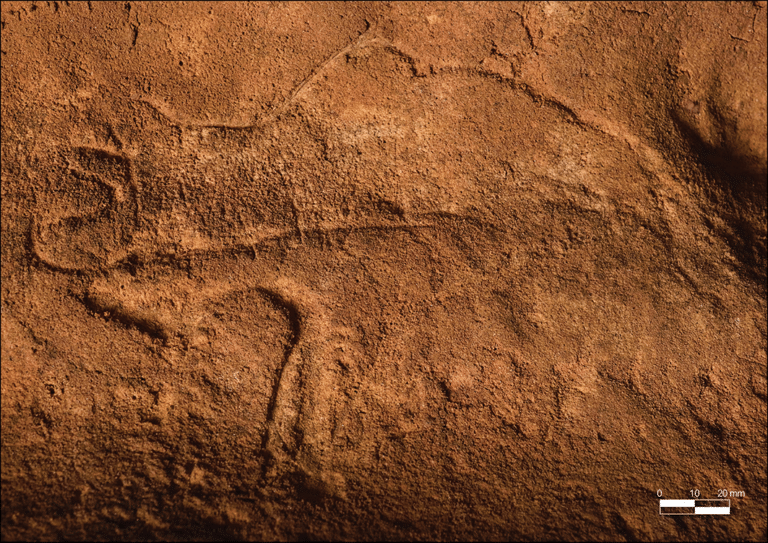
Not every figure can be confidently identified. Approximately 30 percent lack sufficient anatomical detail for a reliable classification, while another 15 percent could represent more than one animal group.
Some engravings also suggest that artists incorporated natural features of the cave into their compositions. In one horse figure, the boundary between two rock layers appears to form the ground beneath the animal. Another engraving shows a deer lowering its head toward a fissure that may have represented a ground line or water surface.
The researchers caution that these interpretations remain uncertain. Nevertheless, the relationship between the figures and the surrounding rock suggests that the artists may have used the cave’s natural formations as part of their designs.
Dating the Engravings Remains Difficult
Although the researchers attribute numerous engravings to the Upper Palaeolithic, the precise age of the artwork has not been established through direct dating.
Radiocarbon evidence documents episodes of human presence in the cave’s inner galleries between approximately 40,810 and 25,850 years ago, with an apparent gap in the evidence between 35,400 and 26,300 years ago. These dates establish an archaeological context but cannot determine when individual figures were engraved.
Stylistic comparisons offer additional clues. Certain animal representations have distinctive limb and head conventions also found in pre-Magdalenian art elsewhere in Mediterranean Europe. However, the researchers cannot rule out the possibility that some engravings belong to the Magdalenian or later periods.
The chronological uncertainty is particularly important for the non-figurative markings. One panel contains hundreds of loop-shaped incisions whose cultural attribution remains unresolved. A separate inscription bearing the year 1199 also demonstrates that people entered and marked parts of the cave long after the Ice Age.
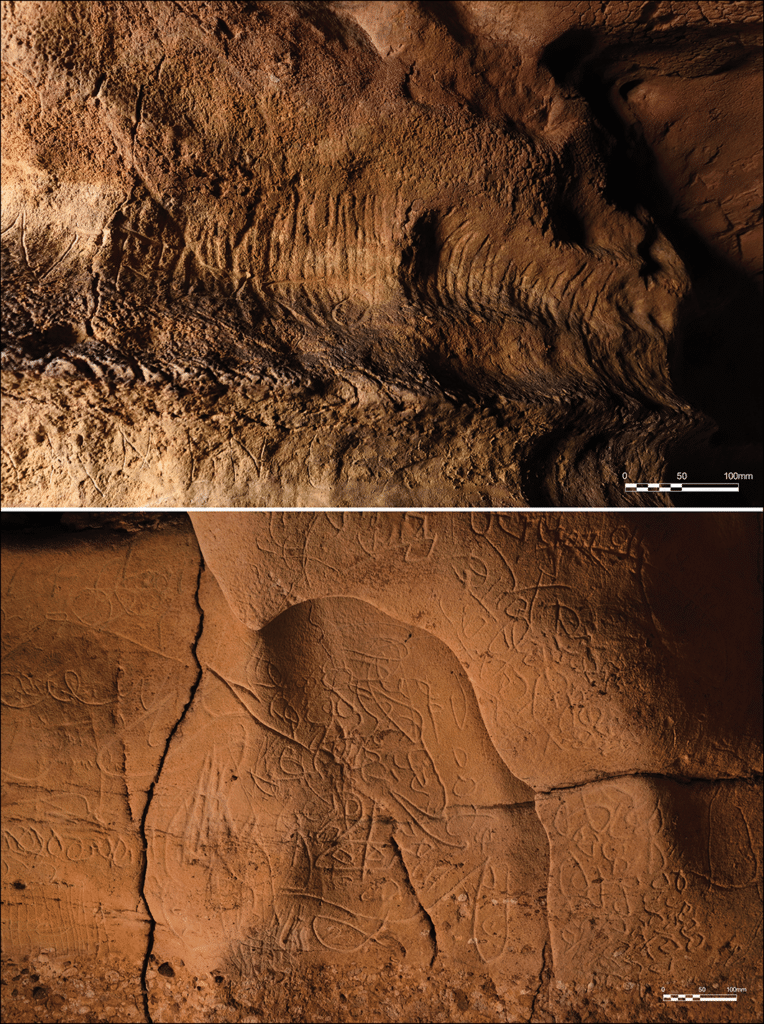
Further investigation may help clarify the chronology. At least one animal engraving is covered by calcite deposits suitable for uranium-series dating, potentially providing a minimum age for that particular figure. Even a reliable result would not establish the age of the entire collection.
Reassessing Mediterranean Cave Art
With 55 animal figures, Cova de la Font Major now ranks as the third-largest known Palaeolithic cave-art assemblage along the Mediterranean side of the Iberian Peninsula, surpassed only by Ardales and La Pileta in southern Spain.
The scale becomes clearer through comparison. Approximately 75 percent of known Palaeolithic cave-art assemblages along the Iberian Mediterranean contain no more than five animal figures, while more than 90 percent contain 20 or fewer.
Beyond its size, the Font Major collection may help researchers better distinguish the artistic traditions of Mediterranean Iberia from those of the better-known Franco-Cantabrian region. Its discovery also challenges earlier interpretations of northeastern Iberia as a marginal area of prehistoric artistic activity.
The engravings do not establish how densely populated Catalonia was during the Upper Palaeolithic, nor do they reveal the precise purpose of the figures. What they demonstrate is that the region’s previously limited cave-art record did not adequately reflect the evidence preserved underground.
Investigations at other Catalan caves, including Cova Simanya, have already identified further Palaeolithic graphic evidence. Together, these findings suggest that more prehistoric art may survive in places researchers once considered unlikely to contain it.
At Font Major, a substantial collection remained unrecognised for decades inside a frequently visited cave. Its discovery shows how gaps in the archaeological record can sometimes reflect limitations in investigation and preservation rather than an actual absence of human activity.
Cover Image: A Palaeolithic horse engraving at Cova de la Font Major in Catalonia, Spain. The natural boundary between rock layers appears to form the ground beneath the animal. Credit: Vergès Bosch & Salas-Altès / Antiquity (2026).