
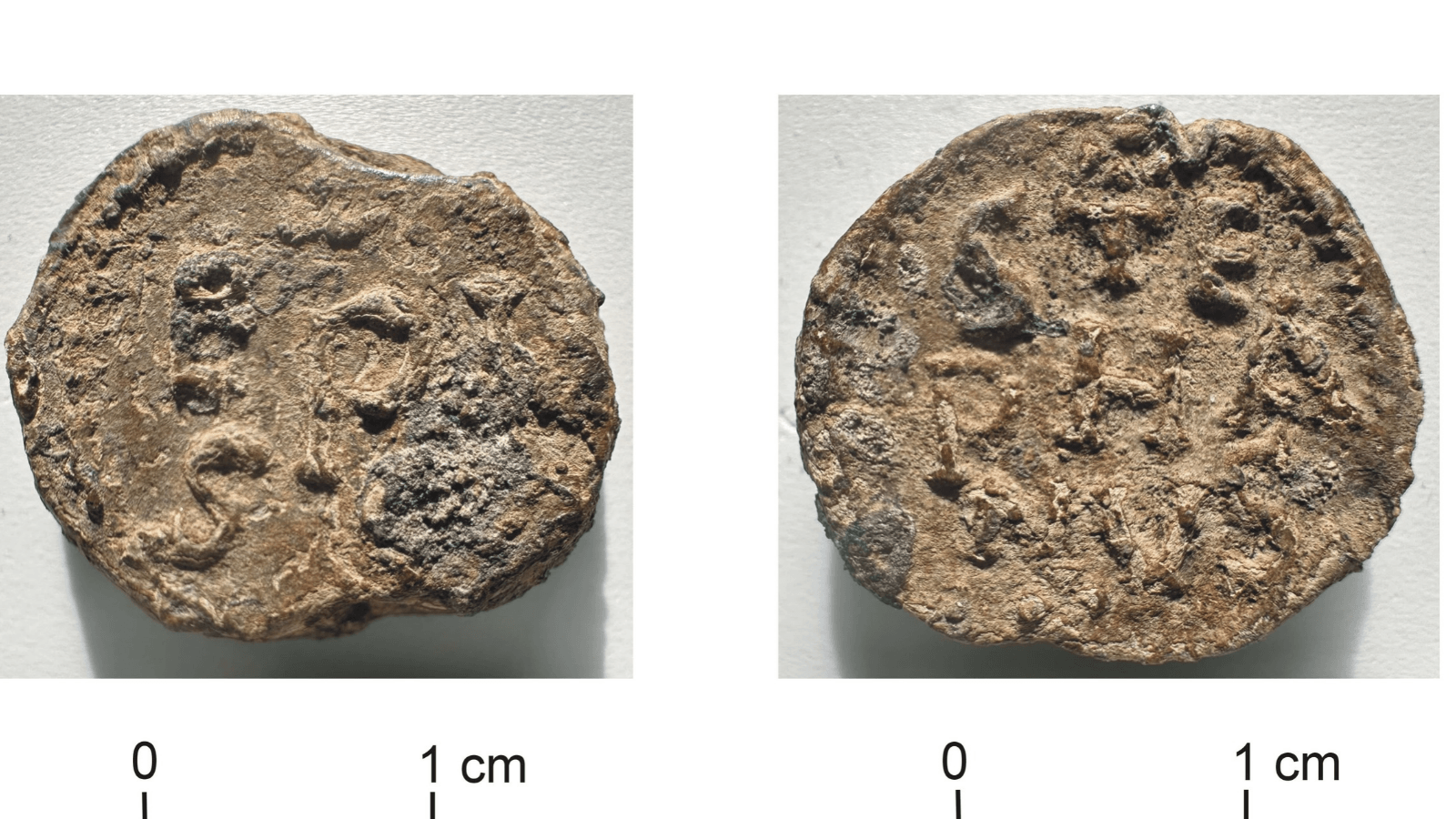
A 1,400-year-old lead seal discovered on a tiny island off Croatia’s Adriatic coast bears the name of a bishop missing from surviving historical records. Polish and Croatian archaeologists recovered the object on Lukovac, near the island of Rab. Researchers believe it could be one of the oldest episcopal seals ever found in the eastern Adriatic.
The seal is barely two centimeters across, yet its inscription remains legible. Although researchers can read the name, they have been unable to identify its owner in any known historical source.
A Bishop’s Name Preserved in Lead
The inscription identifies a man named Stefan. One side bears the Latin name STEPHANVS, arranged across three lines, while the other carries EPISC, an abbreviation of episcopus, meaning bishop.
The seal measures approximately 22 by 19 millimeters, roughly the size of a one-euro coin. Decorative wreaths surround the inscriptions, and two four-petaled rosettes appear above and below the bishop’s name. A narrow channel through the lead disc once held a cord.
Such seals, known as bullae, secured official correspondence and legal documents. Professor Fabian Welc of Cardinal Stefan Wyszyński University in Warsaw, who leads the Polish excavation team, explained that a cord was threaded through the lead and compressed with special pliers. Opening the document would then leave visible signs of tampering.
Researchers provisionally date the seal to the sixth or seventh century, based on its shape, lettering, and archaeological context. Similar episcopal seals from this period are known from Italy, but the team has not yet identified a direct parallel from the eastern Adriatic.

Could Stefan Be One of Rab’s Missing Bishops?
The discovery has drawn attention to a centuries-long gap in the ecclesiastical history of nearby Rab Island.
Historical records identify a bishop named Titianus in the sixth century, but the next documented bishop, Peter I, appears only in 986. The intervening centuries remain poorly understood.
Stefan may have served as bishop of Rab during this undocumented period. If researchers can establish that connection, the seal would provide a previously unknown name in the island’s episcopal history.
However, Welc and Dr. Ana Konestra of the Institute of Archaeology in Zagreb, who leads the Croatian research team, emphasize that this remains a hypothesis. Stefan could also have belonged to another diocese, such as Osor or Krk.
The discovery site cannot establish where the original document was written, who received it, or whether Stefan ever visited Lukovac.
A Small Island with Connections Across the Mediterranean
Lukovac is now an uninhabited rocky islet in the northern Rab archipelago. Since 2019, Polish and Croatian archaeologists have investigated a fortified settlement dating from the sixth to eighth centuries, including an early Christian church and a water cistern.
Excavations have also produced Egyptian porphyry slabs, decorated seventh-century bronze belt buckles, and amphorae originating from Byzantine Egypt. These finds indicate that the settlement maintained connections with distant parts of the Mediterranean.

The newly discovered seal adds another dimension to the island’s history. According to Konestra, Lukovac may have accommodated members of the ecclesiastical, military, or secular elite who maintained contact with a bishopric.
Unlike many historical seals that entered collections through the antiquities market, the Lukovac example comes from a documented excavation layer. Its precise archaeological context strengthens the proposed dating and allows researchers to connect the object with the settlement’s history.
The original letter or document has not survived, and the bishop’s identity remains unresolved. Further research may determine whether Stefan belonged to Rab’s undocumented episcopal succession or another church community along the Adriatic coast.
Cover Image: Both sides of the 1,400-year-old lead seal discovered on Lukovac Island, Croatia. Photo: Fabian Welc.