
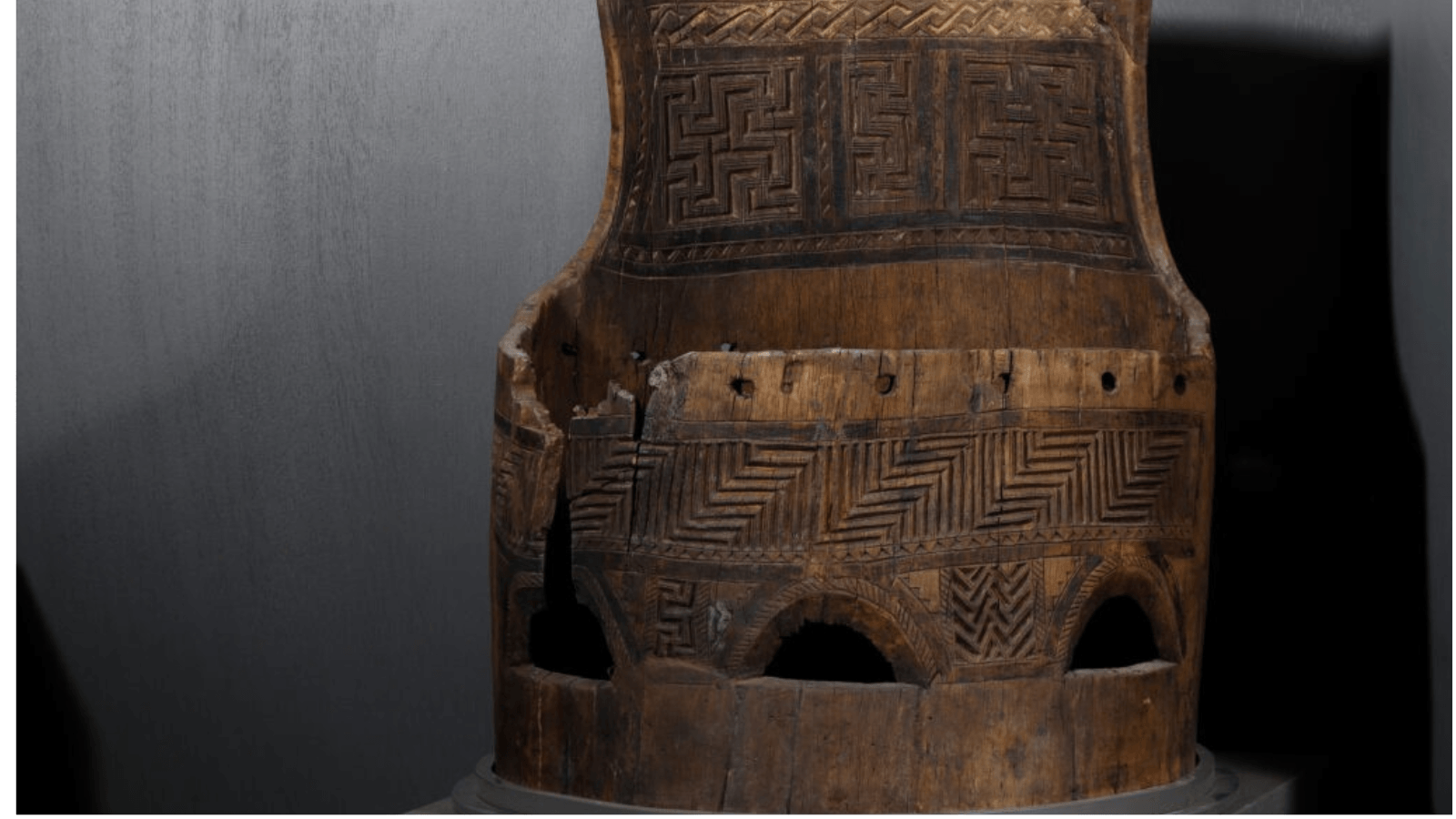
A man buried in a wooden boat on Germany’s North Sea coast nearly 1,600 years ago was accompanied by a carved wooden throne and objects associated with the Roman world. New DNA research has now revealed that he carried the bacterium responsible for leprosy, although his skeleton showed no visible signs of the disease.
Researchers from Kiel University and the Lower Saxony Institute for Historical Coastal Research (NIhK) made the discovery while examining human remains from the Fallward cemetery in northwestern Germany. Their study, published in iScience, also suggests that the man had genetic connections to populations living near the Roman Empire’s Danube frontier.
A Wooden Throne Beside a Boat Burial
Archaeologists excavated the Fallward cemetery during the 1990s, uncovering approximately 200 cremation burials and 60 graves containing human skeletons. The cemetery served communities living between the Elbe and Weser rivers during the fourth and fifth centuries CE.
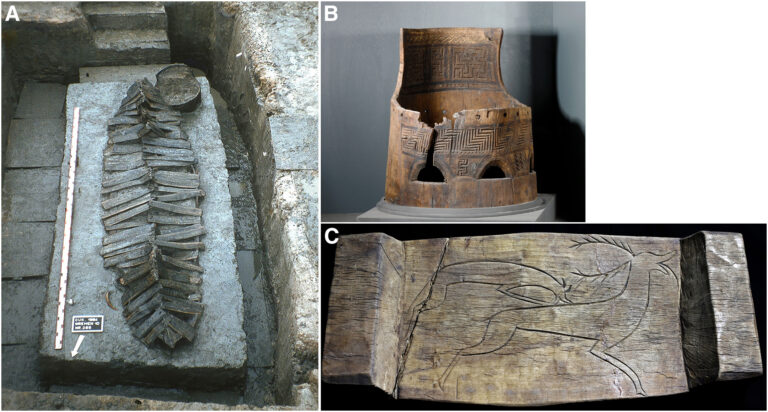
The region’s waterlogged soil preserved wooden furniture, textiles and other organic objects that rarely survive in archaeological contexts. One particularly elaborate burial, recorded as grave 265, contained the remains of a man who died at approximately 50 years of age during the second quarter of the fifth century.
His body rested on a reed mat inside an oak boat measuring more than four metres long. Wooden panels formed a roof-like covering over the vessel, while several carefully arranged possessions accompanied the deceased.
Among the most remarkable objects was a large chair carved from an alder trunk, decorated with intricate notched patterns. Researchers often describe it as the “Throne from the Marsh,” although its precise function during the man’s lifetime remains uncertain.
A maple footstool decorated with a hunting scene and a runic inscription lay near his feet. Archaeologists also recovered a gaming board, a bronze basin, pottery and a late Roman military belt. Several objects showed signs of use and repair, suggesting that they had belonged to the man or his household before the funeral.
Genetic Clues Lead Toward the Roman Frontier
To investigate the cemetery’s population, researchers analysed 12 skeletal samples belonging to 11 individuals. Only three provided sufficient human DNA for detailed comparisons with ancient European populations.
Two showed genetic similarities to communities from northwestern Europe, including Iron Age and early Anglo-Saxon groups. The man from the boat grave, identified as G265, produced a different result.
His genetic profile showed affinities with populations associated with the Roman frontier along the Danube, particularly in areas of present-day central and southeastern Europe. These similarities suggest that he or his ancestors may have had connections to communities far from the North Sea.
The findings also provide new context for the Roman-style military equipment found in his grave.
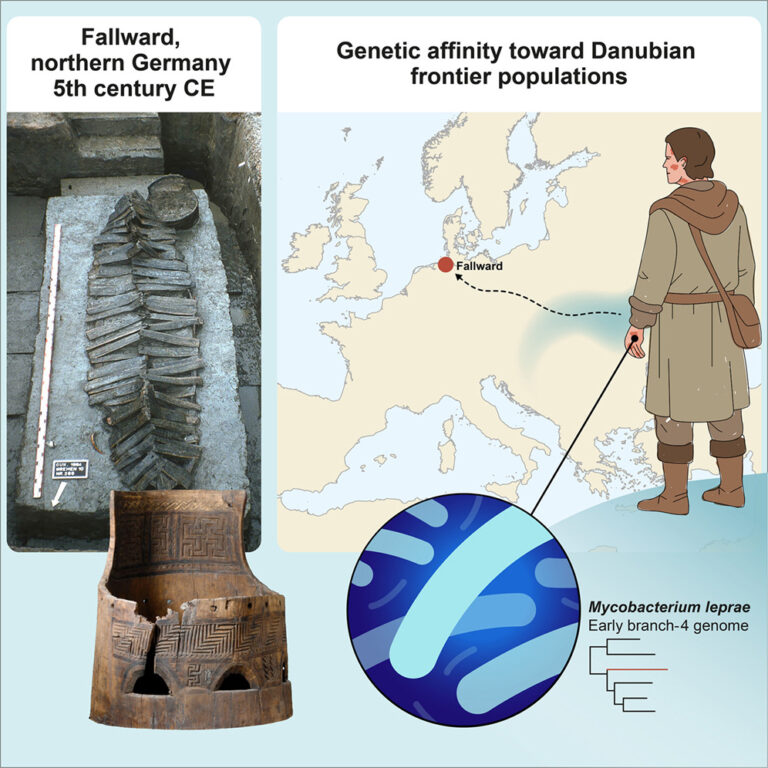
Ben Krause-Kyora of Kiel University suggested that the man might have served in the Roman army before settling in northern Germany. Long-distance trade offers another possible explanation for his connections with the wider Roman world.
However, the researchers caution that the available genetic data cannot establish his exact birthplace. The military belt also provides no definitive proof that he personally served as a Roman soldier.
A Leprosy Infection Without Visible Bone Damage
The genetic investigation revealed another unexpected detail about the man’s life.
Scientists detected DNA from Mycobacterium leprae, the bacterium that causes leprosy, in samples taken from his tooth and heel bone. They reconstructed the bacterial genome and identified it as belonging to phylogenetic branch 4.
This bacterial lineage has an ancient history. Its earliest known representative comes from an Egyptian mummy dating between the fourth and second centuries BCE.
According to Daniel Myburgh, the study’s lead author, the Fallward individual represents the first identified European case involving this particular group of the pathogen. The discovery expands the known geographical distribution of the lineage during antiquity, although it does not establish how the infection reached northern Germany.
Despite the presence of bacterial DNA, researchers found no characteristic leprosy-related damage in the man’s skeleton.
Almut Nebel of Kiel University explained that leprosy can develop slowly, with symptoms sometimes taking years to appear. The man may have experienced an infection that had not yet affected his bones, or the disease may have been confined to soft tissues.
The researchers cannot determine how severely the infection affected him. They also found no evidence that leprosy caused his death.
A Life Connected to Two Distant Worlds
The Fallward burial provides an unusual combination of archaeological and genetic evidence from a period of considerable movement across Europe.
Its wooden furniture reflects local craftsmanship, while certain decorative features and the military belt reveal influences associated with the Roman world. The man’s genetic profile adds another possible connection to the empire’s frontier populations.
The burial itself suggests that the deceased held a privileged position within his community. The elaborate furnishings and carefully prepared grave required considerable resources, although their presence cannot establish his exact social rank.
The Kiel University research team also highlights the significance of the bacterial discovery for understanding how infectious diseases circulated between distant populations.
The man’s precise origins, occupation and movements remain unresolved. Yet the combination of grave goods, human DNA and pathogen evidence shows that communities along the North Sea maintained connections with regions far beyond their immediate surroundings during the final centuries of the Western Roman Empire.
Cover Image: The intricately carved wooden throne discovered alongside a fifth-century boat burial at Fallward in northern Germany. Credit: Rolf Kiepe / NIhK.