
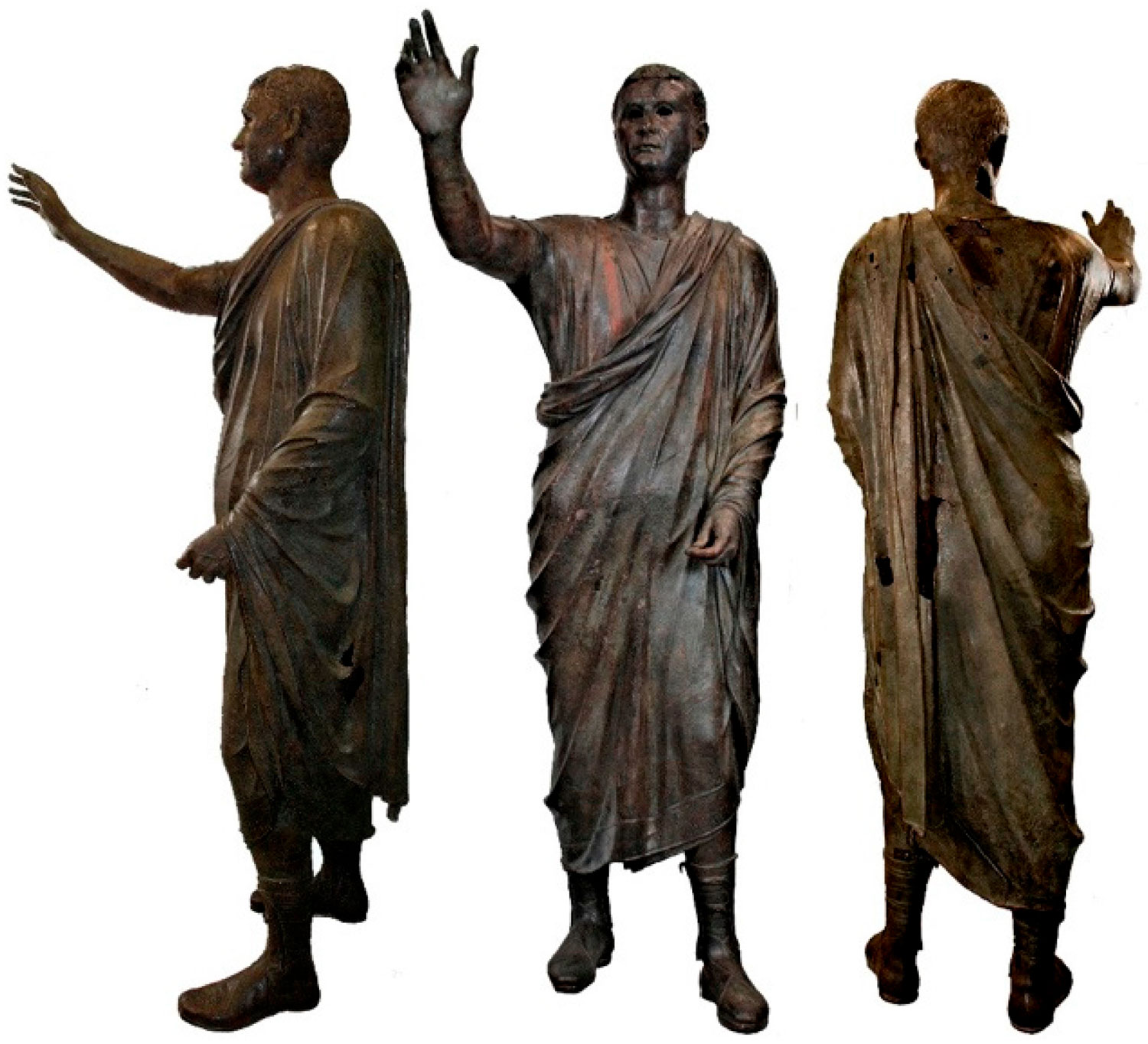
One of the most celebrated surviving Etruscan bronze statues may have looked strikingly different more than 2,200 years ago. Scientists have found evidence that the life-sized figure known as the Arringatore was deliberately given a black surface, potentially complemented by red decorative details, pale highlights, and realistic glass eyes.
The 179-centimeter-tall statue, displayed at the National Archaeological Museum of Florence, portrays Aule Meteli, a prominent Etruscan citizen of the second century BCE. According to a study published in the journal Heritage on October 2, 2026, its unusual dark finish was probably an intentional artistic treatment rather than simply the result of centuries of corrosion.
Scientific Evidence for an Ancient Black Finish
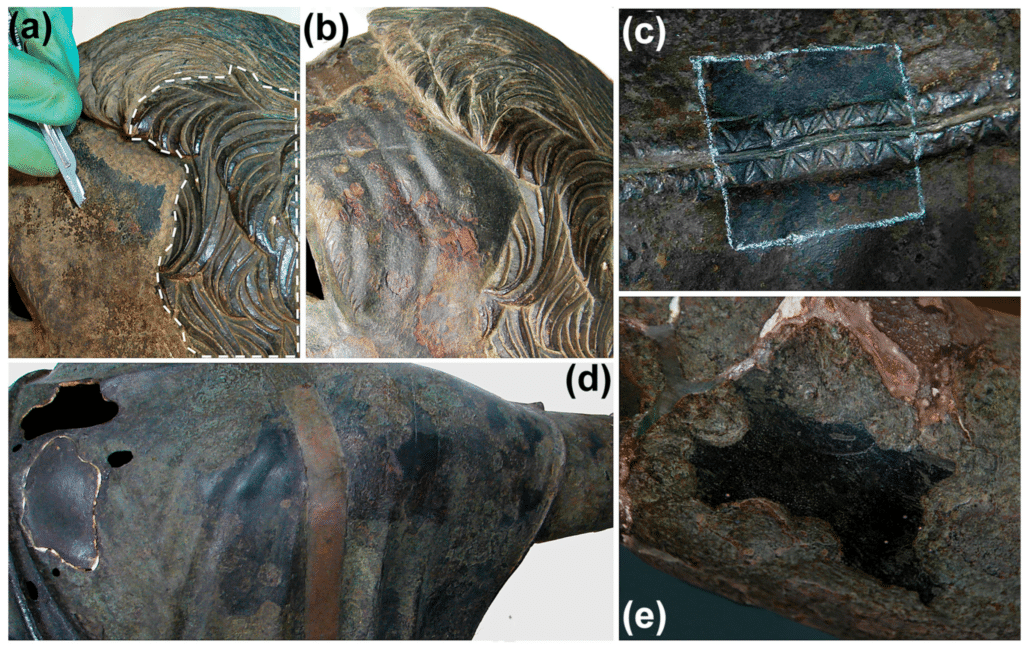
Researchers led by Salvatore Siano of Italy’s National Research Council examined microscopic layers preserved on the bronze surface. Their analysis identified a black copper oxide called tenorite above a reddish layer of cuprite, a combination that offers important clues about how the statue was originally treated.
The arrangement suggests that ancient craftsmen heated and treated the bronze under conditions that encouraged the formation of a dark surface. Although natural corrosion can produce similar compounds, the researchers consider it a less convincing explanation for the extensive black mineral layer documented on the statue.
The findings represent the first analytical documentation of this particular type of possible intentional black patination on an ancient bronze sculpture. However, the team could not establish the precise treatment procedure, leaving some uncertainty about how the finish was achieved.
The statue may also have featured a more varied color scheme. A copper-rich stripe on the tunic could have provided a reddish accent, while the researchers identified possible evidence for pale mineral highlights and discussed the use of realistic glass-paste eyes.
The Remarkable Engineering Behind the Bronze Figure
The Arringatore depicts Aule Meteli wearing a toga and raising his right arm in a gesture traditionally associated with public speaking. His clothing and distinctive footwear reflect his elevated social position during a period of increasing Roman influence in Etruscan society.
An Etruscan inscription on the statue identifies Aule Meteli and indicates its votive character. Yet the new investigation reveals that the sculpture’s technical construction is as significant as its historical identity.
Using radiographic images and detailed metallurgical examinations, researchers established that ancient craftsmen cast the figure in separate sections before joining them with molten bronze. Despite its considerable height, some hollow bronze walls measure less than two millimeters thick.
The lower body presented a particular challenge. Rather than casting the legs separately, the sculptor incorporated them into a larger section with the surrounding drapery, apparently reducing the need for difficult structural joints.
Chemical analysis revealed a copper alloy containing approximately 13.2 percent tin and 4.1 percent lead. The researchers interpret the lead content as an intentional addition, offering further evidence of carefully selected materials and sophisticated metalworking techniques.
Centuries of Restoration Concealed the Original Surface
The statue was discovered in July 1567 by a farmer at Pila, near Perugia, and subsequently entered the Medici collections in Florence. Its long history after excavation complicated efforts to determine how it originally appeared.
During the eighteenth and nineteenth centuries, restorers applied brown coatings to numerous bronze sculptures to achieve a more uniform appearance. Similar treatments covered the Arringatore, concealing surviving traces of its earlier surface.
Conservation work in 2008–2009 removed portions of these later coatings. Researchers subsequently examined material collected during that intervention, combining the earlier results with more recent microscopic and spectroscopic investigations.
The removal of modern layers exposed areas where the ancient dark surface had survived, sometimes with details of the sculptor’s original finishing work still visible.
The research does not establish the statue’s complete original color scheme. Nevertheless, the combination of black patination, possible contrasting colors, carefully constructed eyes, and exceptionally thin bronze casting offers a substantially different picture of this celebrated Etruscan portrait.
Cover Image: The Arringatore of Pila, a 2,200-year-old Etruscan bronze statue depicting Aule Meteli, shown from three angles following its 2008 restoration. New research suggests its original surface was intentionally blackened. Credit: Siano et al., Heritage (2026).