
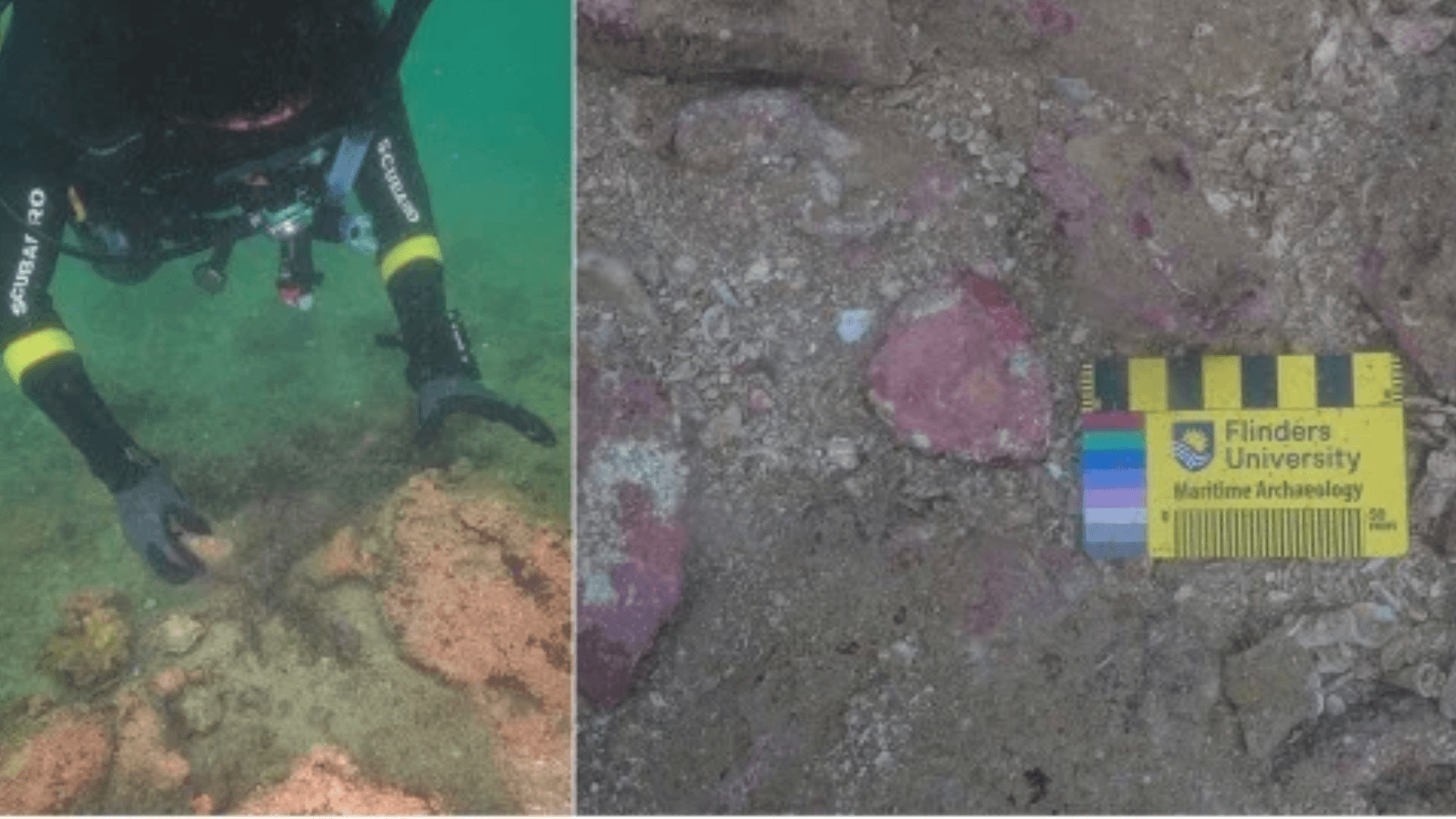
More than 20 stone artefacts discovered off Australia’s northwest coast are revealing how Aboriginal communities travelled, selected materials and used a landscape that eventually disappeared beneath the sea.
One of the archaeological sites is associated with an ancient freshwater spring that remains part of traditional Aboriginal songlines, despite having been submerged for thousands of years. The discovery connects archaeological evidence with cultural knowledge preserved by local communities.
Researchers identified two archaeological sites at depths of approximately 10 to 15 metres in Murujuga, off the coast of Western Australia. Some of the stone artefacts were made from materials sourced around 23 kilometres away, suggesting that people transported them across the ancient landscape.
Research published in Quaternary Science Reviews suggests that Aboriginal communities deliberately selected and transported stone materials across a landscape that has been underwater for at least 9,000 years.
A Freshwater Spring Beneath the Sea
One site is associated with an ancient freshwater spring that would have provided an important source of water for people living in the region. The second lies near a rocky hill overlooking a former river channel, showing how Aboriginal communities used different parts of the landscape before it was submerged.
Together, these findings show how individuals utilized various sections of a landscape linking islands that are currently apart.
Analysis of the artefacts revealed that some were made from stone originating near Rosemary Island, roughly 23 kilometres from where they were discovered. This suggests that prehistoric communities deliberately selected certain materials and carried them across considerable distances rather than relying entirely on locally available stone.
Professor Jonathan Benjamin from Flinders University led the study, likening their actions to how modern individuals pick a favored kitchen knife according to its tactile feel or sharpness retention.
An Ancient Place Still Remembered
Archaeologists worked alongside rangers from the Murujuga Aboriginal Corporation during the underwater investigations. Two of the rangers, Malik Churnside and Richard Variakojis, trained as scientific divers, helped discover artefacts and contributed as co-authors of the study.
Speaking to ABC News, Variakojis explained that the submerged freshwater spring remains part of traditional songlines, even though the area has been underwater for thousands of years. For Murujuga’s Traditional Owners, this connection shows how their cultural knowledge extends beyond the present coastline into landscapes now covered by the sea.
The locations were underwater for at least 9,000 years, though the items themselves might be much older than that time frame. A specific date for when those objects were made has not been set by researchers yet.
Published in 2026, the study builds on underwater archaeological discoveries reported in 2020 and 2023. The new findings provide further evidence that these sites formed part of a broader cultural landscape rather than isolated areas of human activity.
Following the end of the last Ice Age, rising sea levels submerged more than two million square kilometres of Australia’s continental shelf. Much of this land had previously been inhabited by generations of Aboriginal communities.
Murujuga is now recognised as a UNESCO World Heritage-listed cultural landscape. The underwater discoveries suggest that much more archaeological evidence may remain beyond its present shoreline, offering researchers and Traditional Owners further opportunities to investigate and protect this submerged heritage.
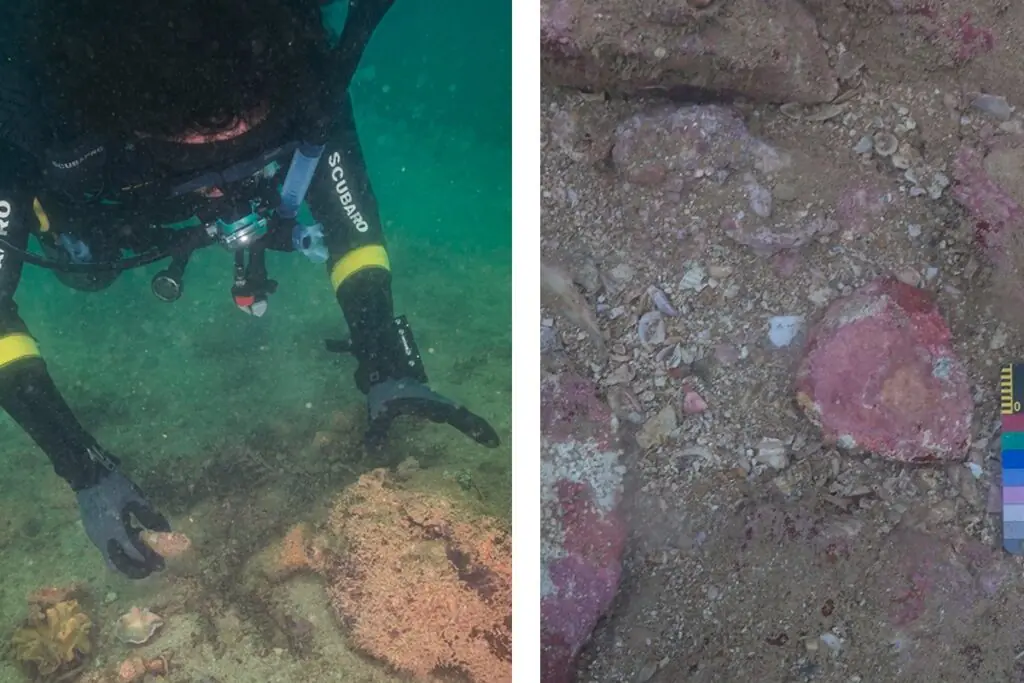
Cover Image: Underwater archaeological investigations at Murujuga, Western Australia. A scientific diver examines the seabed (left), while the right image shows the archaeological survey area with a measuring scale. Credit: © Benjamin et al., 2026, Quaternary Science Reviews.