
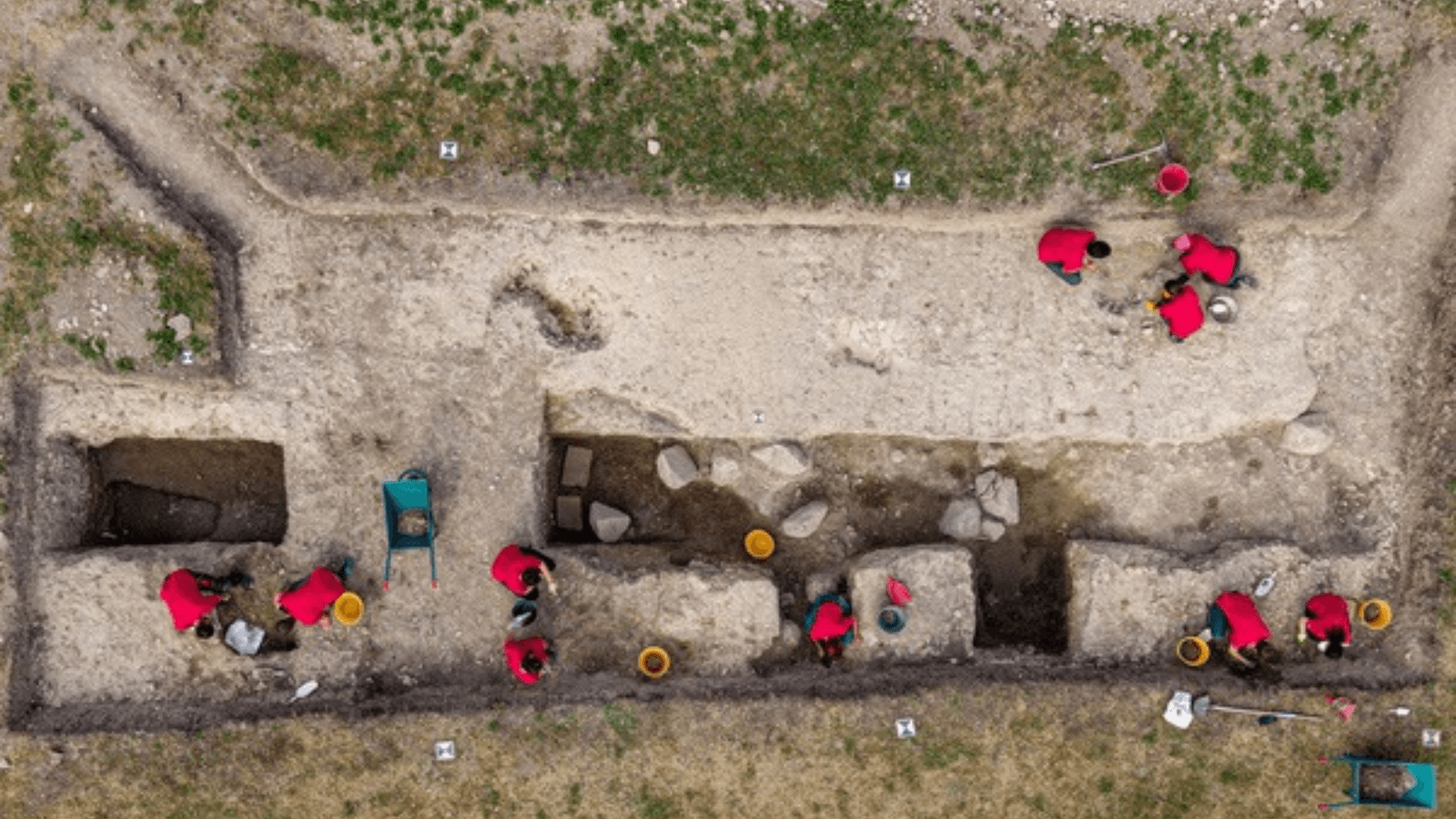
Archaeologists in northern Italy have uncovered the remains of a 1,600-year-old church that may help explain how the ancient Roman city of Altinum gradually gave way to the settlements of the Venetian Lagoon.
The discovery, announced by Ca’ Foscari University of Venice on October 15, follows excavations at the Altino Archaeological Park in 2025 and 2026. Researchers believe they have located the city’s long-lost episcopal church, along with a substantial building that may have served as the bishop’s residence.
The complex also contains evidence of a remarkable transformation: Roman roads were dismantled to provide building materials for the growing Christian establishment.
A Lost Church from the Age of Saint Jerome
Measuring approximately 30 by 20 meters, the church has a rectangular plan without an apse. It faces east rather than following the orientation of Altinum’s Roman street grid, supporting its identification as an early Christian place of worship.
Archaeological evidence dates its construction to between the late fourth and the first half of the fifth century AD.
The chronology is particularly intriguing because Saint Jerome mentioned a church in Altinum in AD 396. In a letter concerning the priest Nepotian, nephew of Bishop Heliodorus, he described the care devoted to its altar, walls, floors, curtains, and sacred vessels.
Although the dating corresponds closely with Jerome’s account, the identification of the excavated building with the church he described remains unconfirmed.
The religious complex continued to evolve over the following centuries. During the sixth and seventh centuries, a portico and cemetery were established in front of the church.
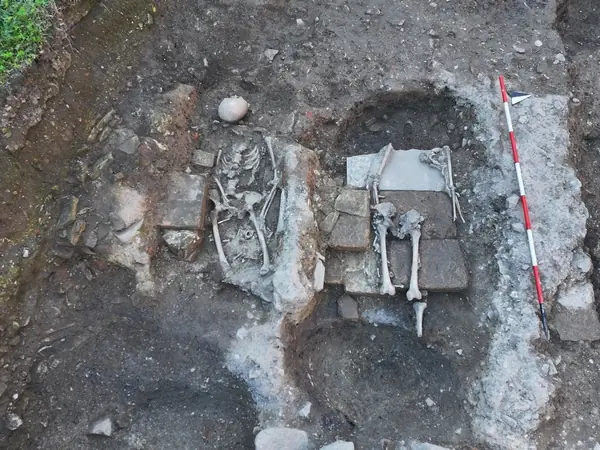
Excavations revealed brick-lined burials, many disturbed when construction materials were removed for reuse. A small container decorated with a cross was also recovered.
Roman Roads Reused in a Bishop’s Palace
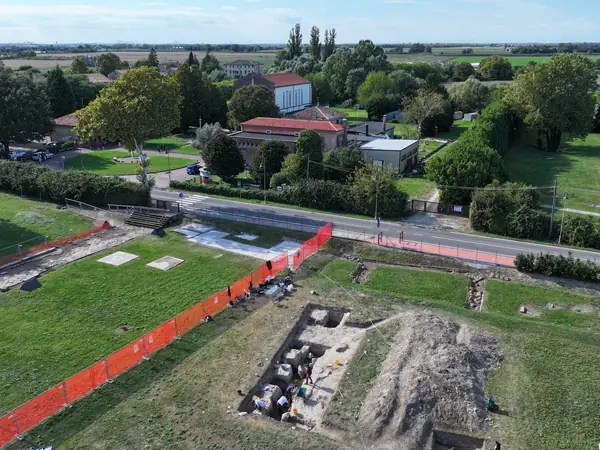
The 2026 excavations exposed another substantial building immediately east of the church. Its surviving foundations suggest a structure that may once have stood two stories high.
Archaeologists propose that the upper floor accommodated clergy, while the ground floor possibly contained privileged burials. Fragments of late antique mosaics lend support to this interpretation, although the building’s precise function remains uncertain.
More strikingly, its foundations incorporate large trachyte paving stones taken from Roman roads and placed upside down.
Roman roads were public infrastructure protected by late imperial legislation. The excavation team believes their dismantling reflects the considerable civic authority acquired by bishops during Late Antiquity.
Much of the complex subsequently disappeared. Farmers destroyed upper archaeological layers, while builders removed stone and brick for construction projects elsewhere in the lagoon.
Today, a modern road cuts directly through the former church, complicating efforts to reconstruct its original layout.
The Gradual Transformation That Led to Venice
The excavations also shed light on the relationship between Altinum and Torcello, one of the islands associated with Venice’s early history.
Traditional accounts portray the movement into the lagoon largely as a response to barbarian invasions. Archaeological evidence, however, suggests a more gradual and organized transition.
Researchers believe Altinum’s episcopal center was transferred to Torcello during the seventh century, partly because of demographic and environmental changes.
The church at Altinum appears to have been systematically dismantled by the first half of that century, while a new religious center developed on Torcello. This chronology is consistent with the island’s inscription dated AD 639 and archaeological investigations of its baptistery.
Excavation director Diego Calaon of Ca’ Foscari University describes the process as a prolonged transformation rather than a sudden flight. The ancient city’s buildings became a source of construction materials as population and religious institutions shifted toward the lagoon.
The findings do not establish a new founding date for Venice. They instead provide physical evidence of how one Roman city’s decline contributed to the development of the lagoon communities from which Venice eventually emerged.
Further investigations will include radiocarbon dating, analysis of human remains, and geophysical surveys. Archaeologists also hope to locate the complex’s missing baptistery.
Cover Image: Archaeologists excavating the foundations of the early Christian complex at Altinum. The discoveries include building materials reused from ancient Roman roads. Photo courtesy of Ca’ Foscari University of Venice