
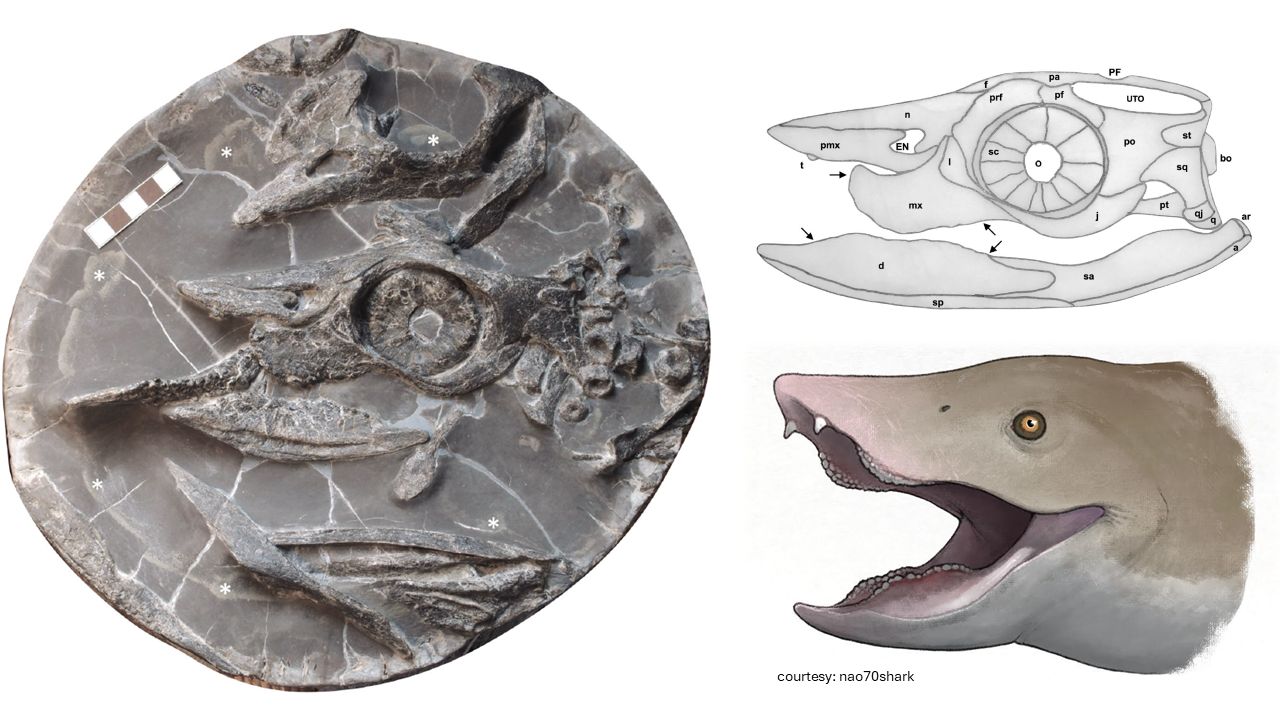
A 250-million-year-old fossil skull discovered in the Arctic remained largely overlooked for more than a decade until a paleontologist recognized its importance in photographs from a fossil exhibition. The specimen has now been identified as a new species of marine reptile, shedding light on a mysterious group of ancient predators and their relationship to ichthyosaurs.
Discovered on Norway’s Svalbard archipelago, the nearly complete skull belongs to Ammonitritor scientiacivium, a previously unknown species of omphalosaurid. The findings, published in the journal Biological Reviews, provide the first three-dimensionally preserved skull of this unusual group of marine reptiles, which inhabited Earth’s oceans during the Triassic Period.
The Skull That Went Unrecognized for 11 Years
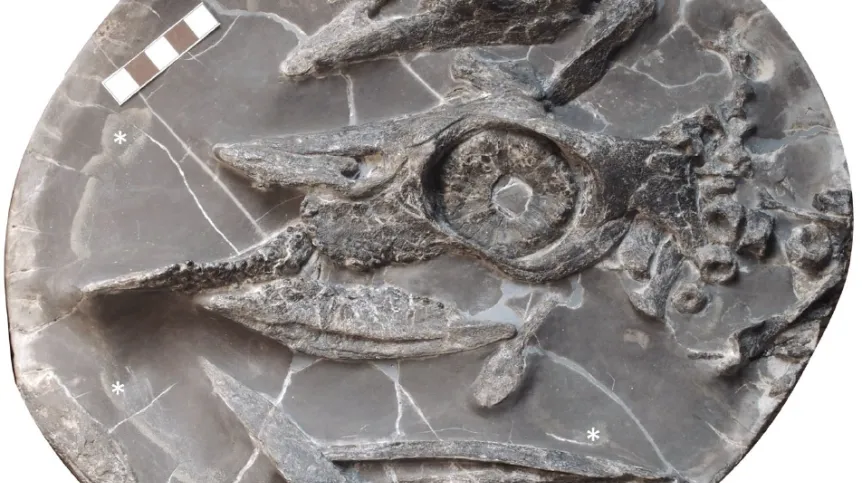
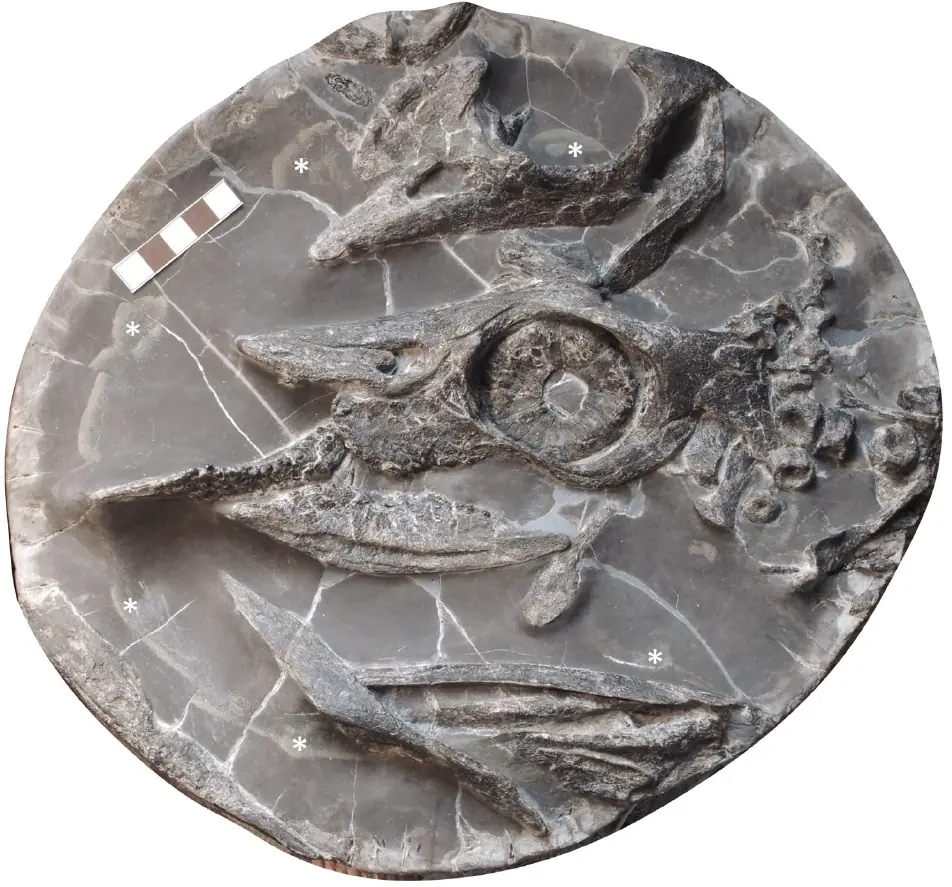
The skull was found in 2010 inside a broken rock concretion on the slopes of Mount Vikinghøgda in Svalbard. However, because scientists knew relatively little about omphalosaurid skull anatomy at the time, the French expedition team did not initially recognize the specimen’s importance.
The breakthrough came in 2021 when Andrzej Wolniewicz, a paleobiologist at the Polish Academy of Sciences, received photographs of the fossil displayed at an exhibition. Recognizing its unusual features, he contacted colleagues in China and France, launching an international investigation into the specimen.
According to a report by Poland’s PAP Science service, the breakthrough came in 2021 when Andrzej Wolniewicz, a paleobiologist at the Polish Academy of Sciences, received photographs of the fossil displayed at an exhibition. Measuring around 20 centimeters long and preserved alongside several neck vertebrae, the skull belonged to an animal estimated to have reached three meters in length.
The researchers named the new species Ammonitritor scientiacivium. Its genus name means “ammonite grinder,” referring to the animal’s presumed diet, while the species name recognizes the contributions of amateur paleontologists and fossil collectors. It also honors the involvement of Luc Ebbo, a French amateur paleontologist who organized the 2010 expedition.
Strange Teeth Reveal an Unusual Marine Predator
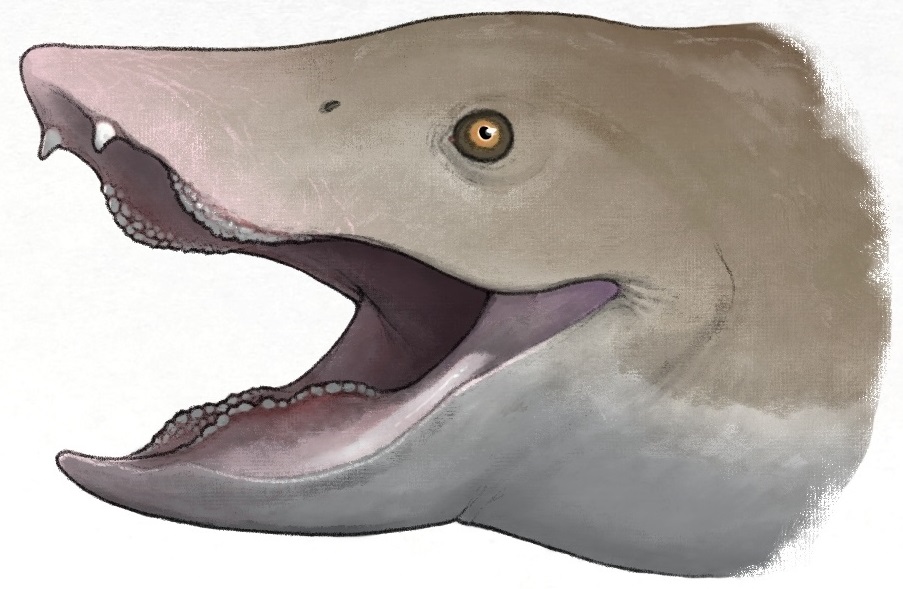
Omphalosaurids were unlike many other prehistoric marine reptiles. Rather than possessing elongated jaws lined with sharp teeth, they had short snouts with toothless tips and multiple rows of small, rounded teeth designed for crushing hard material.
These features suggest that they specialized in feeding on shelled marine invertebrates, particularly ammonoids, extinct relatives of modern squid and octopuses. Their powerful jaws would have allowed them to break through protective shells, although direct evidence of the new species’ diet remains limited.
The group also displayed considerable variation in body size. While some species measured approximately one meter long, the new study suggests that Early Triassic omphalosaurids could exceed six meters, with later Middle Triassic representatives potentially growing beyond ten meters.
Despite their distinctive anatomy, scientists had long struggled to establish their evolutionary relationships. Earlier discoveries, including isolated jaws and teeth from North America, Svalbard, and Poland, provided only fragmentary evidence of what these animals looked like.
The new skull offers a clearer picture. Evolutionary analysis places omphalosaurids close to ichthyosaurs, the streamlined marine reptiles that became successful predators during the Mesozoic Era. However, rather than representing amphibious ancestors of ichthyosaurs, omphalosaurids appear to have belonged to a separate lineage already specialized for life in the open ocean.
Ancient Oceans Recovered After Earth’s Greatest Extinction
The discovery also provides evidence of how marine ecosystems developed following the end-Permian mass extinction, approximately 252 million years ago. This catastrophic event eliminated most marine species, fundamentally transforming life in Earth’s oceans.
Yet omphalosaurids appeared in the fossil record roughly two million years later, with some members already reaching considerable sizes and possessing specialized feeding adaptations. Their geographical distribution across the Northern Hemisphere suggests that marine reptile diversification was underway relatively soon after the catastrophe.
The study indicates that omphalosaurids and other early ichthyosauriform reptiles were among the dominant marine reptile groups inhabiting the vast Panthalassa Ocean during the Early and Middle Triassic. The Svalbard skull now provides some of the clearest anatomical evidence of how these unusual predators fitted into that recovering marine world.
Cover Image: The 250-million-year-old skull of Ammonitritor scientiacivium, alongside an anatomical diagram and an artistic reconstruction of the newly identified marine reptile. Credit: Courtesy of Andrzej Wolniewicz.