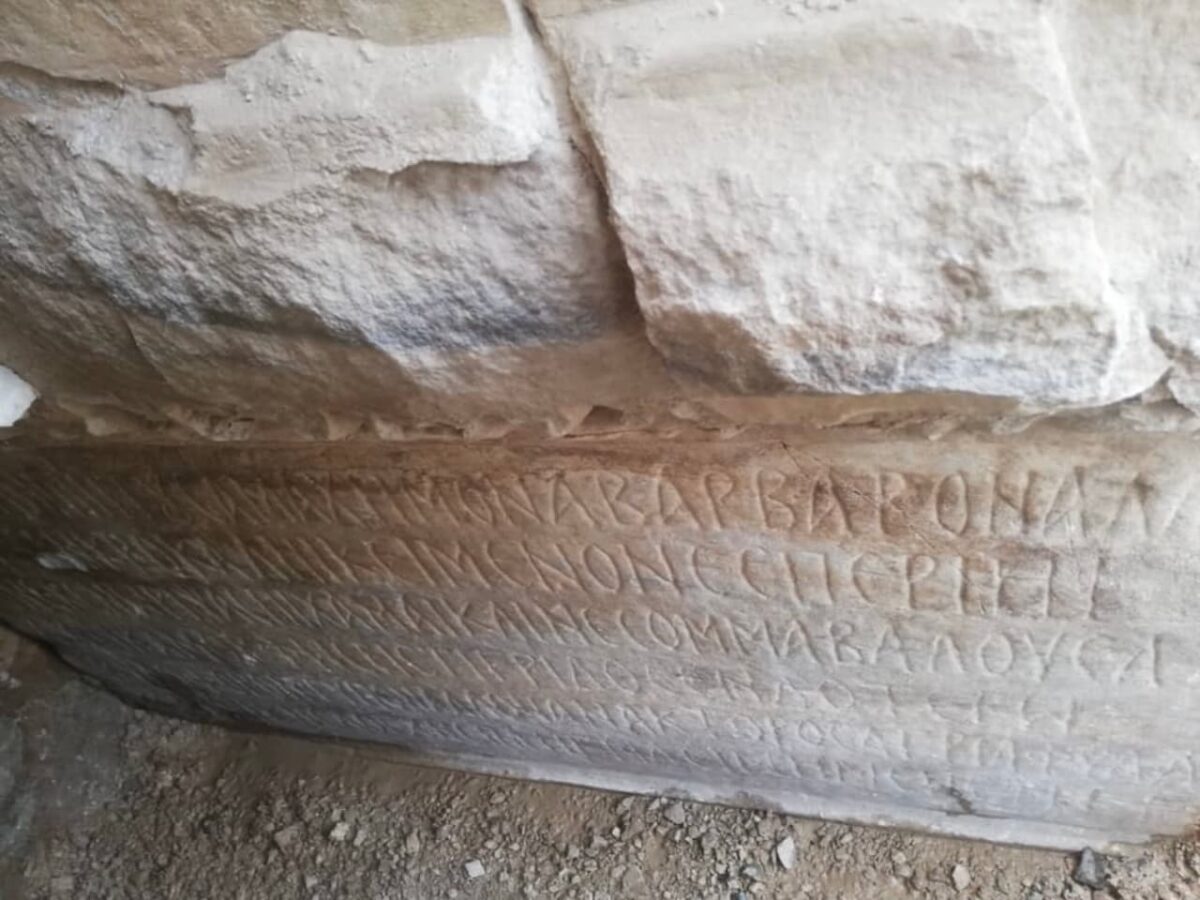
A Greek inscription discovered beneath a column inside the Great Mosque of Homs is reopening a long-standing debate about the precise location of the ancient Temple of the Sun at Emesa — the sanctuary whose high priest rose to become Roman emperor in the third century under the name Elagabalus.
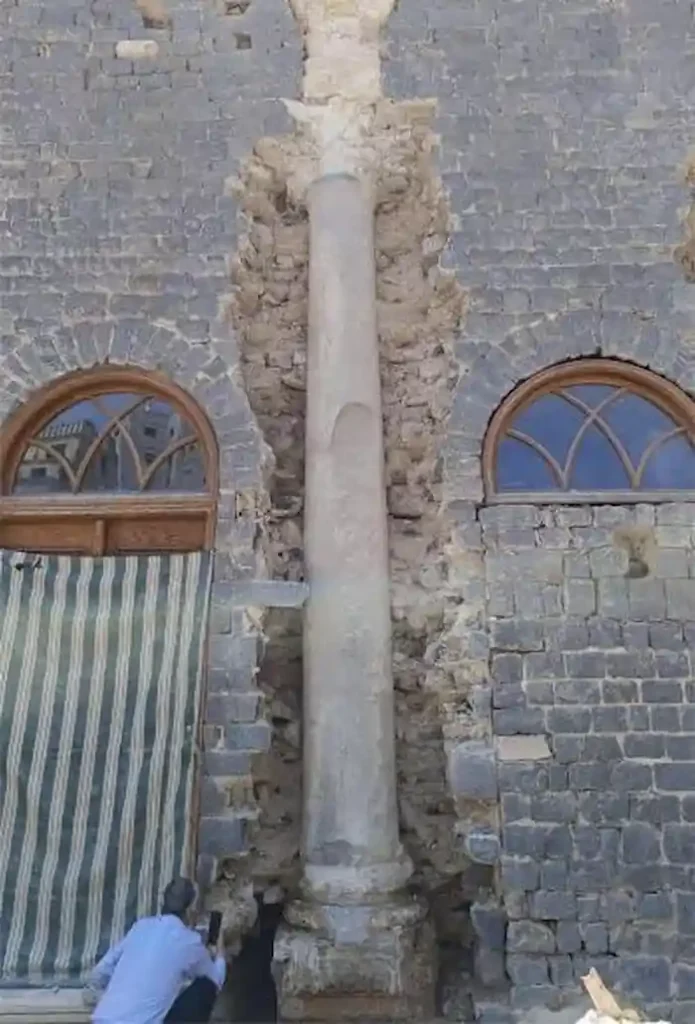
The inscription, carved directly into a granite column base, was brought to light during restoration works in 2016. Although political instability delayed its full academic study, a recent publication in the journal Shedet by Professor Maamoun Saleh Abdulkarim of the University of Sharjah argues that the text may offer decisive evidence linking the mosque to the earlier pagan sanctuary.
A Layered Sacred Landscape
Homs, known in antiquity as Emesa, was once the capital of a Roman provincial center whose identity revolved around the worship of a local solar deity. The Great Mosque stands today as one of the city’s most prominent landmarks. Medieval tradition holds that it was built under the Zangid ruler Nur al-Din in the 12th century and that it replaced a Christian church dedicated to John the Baptist.
For decades, historians have debated whether that church itself stood on the remains of the Temple of the Sun — the cult center associated with Elagabalus, the Roman emperor who attempted to elevate his Syrian sun god to supreme status across the empire.
Until now, conclusive archaeological proof had remained elusive.
The Inscription
The newly studied inscription forms part of the column’s structural base and measures roughly one meter square. The inscribed panel occupies about three-quarters of the visible face, framed by a decorative border. According to Teriz Lyoun, head of excavations in Homs, the lettering is formal and symmetrically arranged in horizontal lines — a style typical of commemorative or dedicatory texts.
The Greek text carries a heroic and militaristic tone. It praises a ruler likened to wind, storm, and leopard — a warrior capable of subduing enemies and enforcing tribute with royal authority.
Although the inscription does not explicitly name the Temple of the Sun, Professor Abdulkarim argues that its language and placement strongly suggest a connection to the pagan cult that once dominated Emesa.
Continuity Rather Than Rupture
If the interpretation is confirmed, the implications extend beyond the identification of a single monument. The site may represent a continuous sacred space that transitioned from pagan sanctuary to Christian church and later to Islamic mosque.
Rather than a clean break between religious eras, the evidence points to architectural superimposition and reinterpretation. Sacred space in Emesa appears to have been reshaped across centuries without being abandoned.
Abdulkarim emphasizes that the transformation of the site reflects a broader pattern in Near Eastern urban history, where religious change often unfolded through adaptation rather than destruction.
Emesa and the Rise of Elagabalus
In Roman times, Emesa’s spiritual and political identity centered on its solar deity, known to the Romans as Elagabalus. The temple functioned as a regional focal point for ritual and seasonal festivals. The cult’s high priesthood wielded exceptional authority — so much so that one of its members became emperor in 218 CE.
Elagabalus attempted to elevate his Syrian sun god above Jupiter, reshaping imperial religious policy before his eventual assassination. Though his reign was short-lived, it cemented Emesa’s place in Roman religious history.
The newly analyzed inscription does not resolve every question surrounding the temple’s exact architectural footprint. However, it narrows the field considerably. Each additional Roman-era inscription recovered from the site may further clarify the relationship between the mosque and its predecessors.
A City That Reinterpreted Its Past
The study presents Emesa not as a city that erased earlier identities, but as one that layered them. Pagan, Christian, and Islamic phases did not simply replace one another; they redefined the same physical space.
The Great Mosque of Homs thus stands within a continuum of sacred architecture stretching back to the Roman era. If the inscription’s association with the solar cult is confirmed, the long-debated location of the Temple of the Sun may finally be closer to resolution.
And with it, a clearer understanding of how religious transformation shaped the urban landscape of the ancient Near East.
Maamoun Saleh Abdulkarim, Religious Transformation in the City of Emesa, Syria: From Paganism to Christianity During the Roman and Early-Byzantine Periods, Shedet, 15, 15.1, 2026, 82-98. doi: 10.21608/shedet.2025.392640.1307