At the end of the last Ice Age, people moving through the Tennessee River Valley faced a challenge that went far beyond finding food. They also had to learn an unfamiliar landscape — where rivers led, where animals moved and where the stone needed to make and repair their hunting weapons could be found.
Nearly 13,000 years later, archaeologists believe hundreds of stone projectile points, or spear points, preserve traces of that learning process. A new study suggests that differences in how Clovis and later Cumberland groups resharpened and discarded their tools may reveal how knowledge of the landscape accumulated over generations.
The research, led by Jesse W. Tune of the University of Mississippi and D. Shane Miller of the University of Alabama, examined projectile points from the Tennessee River Valley not simply as markers of different archaeological traditions, but as tools whose changing shapes can preserve evidence of decisions about risk, mobility and resources.
Their results suggest that Clovis groups behaved more conservatively with their stone tools, repeatedly resharpening them to extract more use. Several centuries later, Cumberland groups were more willing to discard points that still retained useful material.
Nearly 500 spear points reveal a changing strategy
Tune and Miller analyzed 489 projectile points recorded in the Paleoindian Database of the Americas, including 326 Clovis points and 163 Cumberland points.
Clovis represents the earlier tradition examined in the study. Evidence for Clovis occupation in the Tennessee River Valley region extends back roughly 13,200 years, while Cumberland groups appeared several centuries later toward the end of the Ice Age.
The region was rich in chert, the stone commonly used to make these weapons. For people entering an unfamiliar landscape, however, the problem was not necessarily a shortage of suitable stone. It was knowing where reliable sources could be found.
That knowledge mattered for highly mobile hunter-gatherers. Carrying large quantities of stone added weight, yet throwing away a usable spear point could also be risky when the location of the next suitable source was uncertain. Other evidence from North America has likewise offered clues to how Ice Age communities moved people and materials across the landscape.
Researchers therefore asked whether the amount of wear and resharpening preserved on the points could reveal how familiarity with local resources changed through time.
Clovis hunters kept their spear points working longer
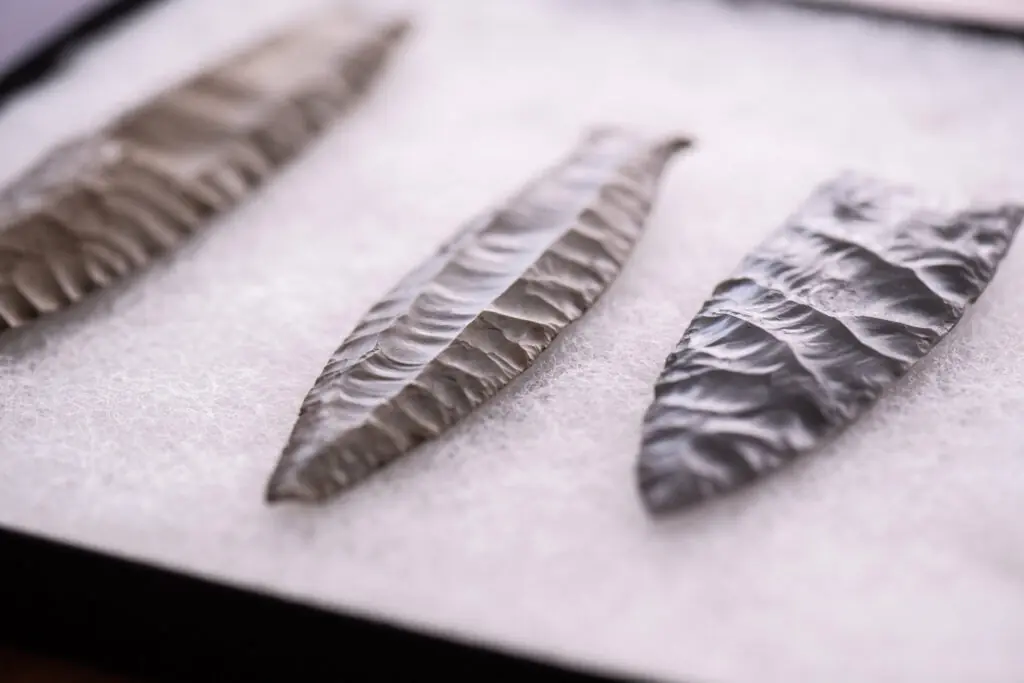
Clovis projectile points reveal a comparatively conservative strategy, with repeated resharpening showing that their users tried to extend the working life of each tool for as long as possible.
Tune and Miller found that Clovis groups generally resharpened their points more extensively before discarding them. Each episode of sharpening removed a little more stone, gradually reducing the tool while extending its usable life.
The researchers measured the relationship between blade length and maximum point length to estimate how much utility had been extracted from individual points. The Clovis examples tended to be reduced further before they were abandoned.
The pattern is consistent with the risks of moving through a landscape whose resources were not yet fully understood. Even where chert was abundant, newcomers would initially have had limited knowledge of exactly where deposits occurred, how accessible they were and how those locations fitted into their movements through the region.
Keeping an existing spear point in service for longer would reduce the risk of needing replacement material before another dependable source could be reached.
Cumberland hunters could afford to discard usable tools
Several centuries later, Cumberland projectile points show a noticeably different pattern, suggesting that later groups were more willing to discard tools before their full usable potential had been exhausted.
These tools were more frequently discarded while still retaining varying amounts of usable material. Some had been repeatedly resharpened, while others entered the archaeological record earlier in their potential use-lives.
The researchers interpret this greater variability as evidence that uncertainty surrounding local resources had diminished.
By this period, knowledge accumulated through generations of movement across the Tennessee River Valley could have provided people with a much clearer understanding of where chert deposits and other resources were located.
That did not simply mean knowing that a stone source existed. Familiarity with a landscape could also involve understanding the quality of different deposits, their accessibility and how they related to rivers, hunting areas and established travel routes.
With greater confidence that replacement material could be obtained, people had less reason to preserve every spear point until almost all of its utility had been exhausted.
The distinction is subtle, but significant. Knowledge itself rarely leaves a direct archaeological trace. The everyday decisions shaped by that knowledge, however, can survive in the objects people leave behind.
Stone tools preserve the process of learning a landscape
The study treats spear points as more than weapons. Their changing dimensions and patterns of resharpening can also provide evidence for mobility, resource management and perceptions of risk.
That gives archaeologists an unusual way to explore how unfamiliar territory gradually became a known landscape.
The researchers distinguish between physically discovering a resource and developing the deeper knowledge needed to incorporate it reliably into everyday life. People might encounter a source of chert relatively quickly, but learning its quality, accessibility and relationship to other resources would require repeated experience.
Over time, that information could be shared and passed between generations, reducing the uncertainty faced by later groups occupying the same region.
The contrast between Clovis and Cumberland spear points suggests that part of this process may still be visible in stone. Earlier groups extracted more utility from their tools, while their successors were more willing to replace them before they were completely exhausted.
For Tune, the underlying problem has parallels far beyond archaeology. Humans entering unfamiliar environments must decide what to carry, locate useful resources and gradually build reliable knowledge about their surroundings.
The chipped and repeatedly sharpened spear points of the Tennessee River Valley therefore record more than Ice Age hunting technology. They may also preserve traces of how people learned a new land and, generation by generation, made it familiar.
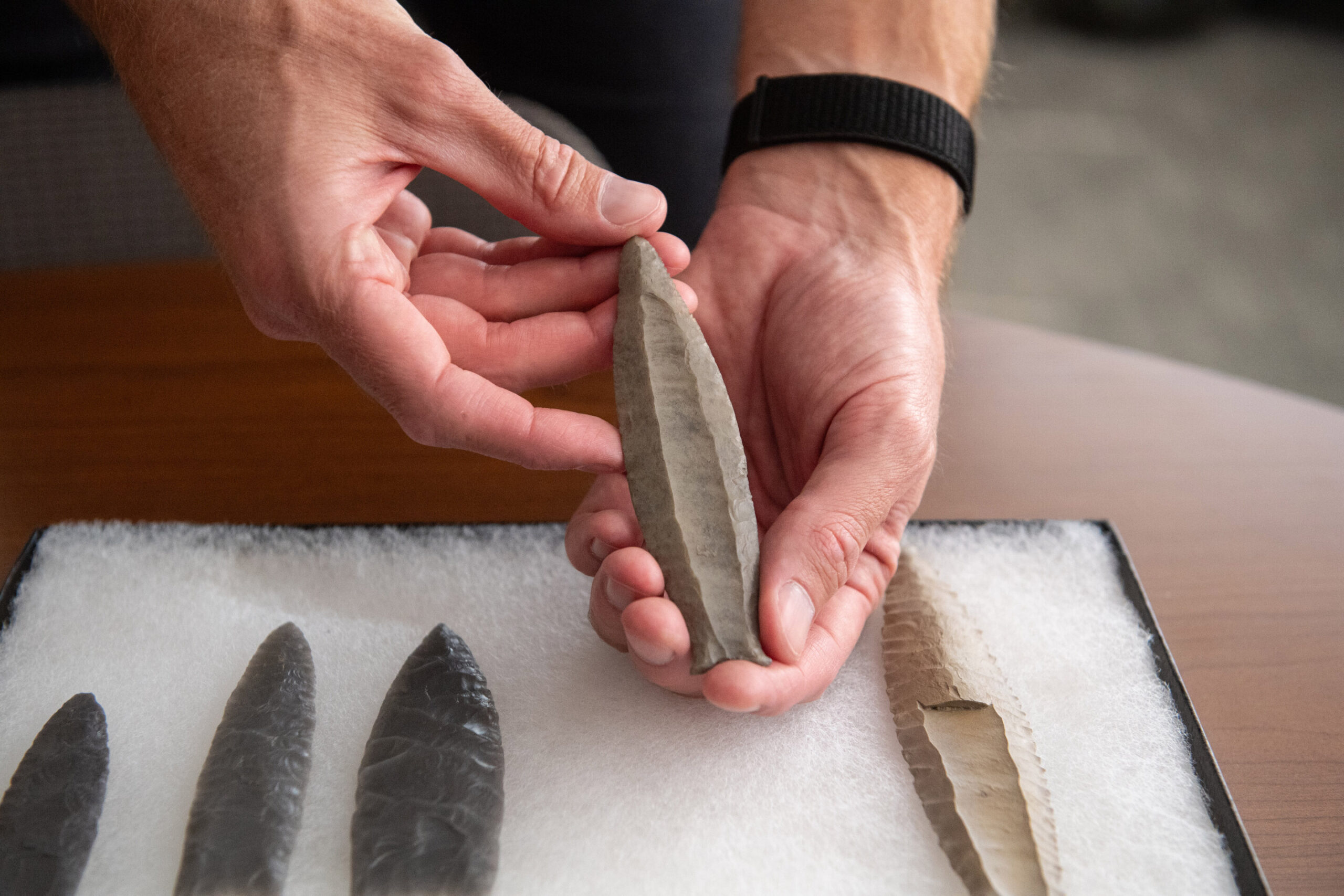
Cover Image: Jesse Tune examines a replica of a Cumberland spear point, one of the projectile types studied to understand how Ice Age people adapted to the Tennessee River Valley. Credit: Kevin Bain/Ole Miss Digital Imaging Services.
Tune, J. W., & Miller, D. S. (2027). Foraging theory and the colonization of unfamiliar landscapes: Assessing Late Pleistocene projectile point reduction strategies. Journal of Archaeological Method and Theory, 34, Article 14. https://doi.org/10.1007/s10816-026-09825-w
Published online: August 27, 2026.