
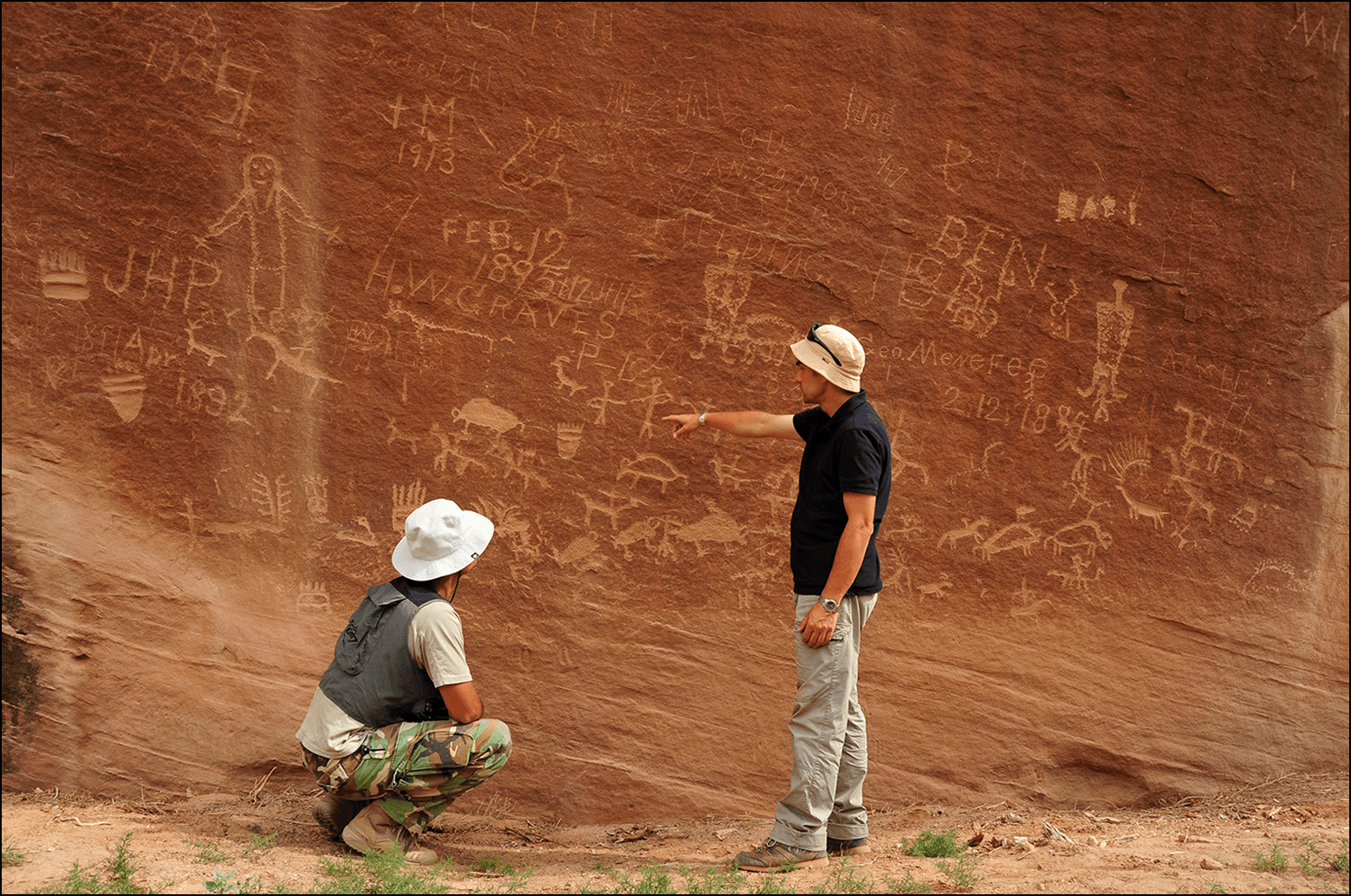
Ancient sandstone cliffs in southwestern Colorado preserve a remarkable record of Native American history, from Ancestral Pueblo symbols and intricate rock carvings to Ute hunting scenes and horseback warriors. A detailed archaeological investigation at Canyons of the Ancients National Monument has documented hundreds of figures across four rock art sites, revealing how different communities left their marks on the same landscape over centuries.
Among the most striking details documented is an elaborate sandal carving containing four smaller sandal figures, along with depictions of bison herds, armed confrontations, and human figures. Researchers also found evidence suggesting that additional ancient carvings may remain buried beneath sediment deposited by historic floods, raising the possibility that much of the canyon’s archaeological record has yet to be documented.
The findings were detailed in a study published in Arts in May 2025, expanding on an earlier investigation published in Antiquity in 2023. The research was led by archaeologists from Jagiellonian University in Poland in collaboration with American researchers and institutions.
Ancestral Pueblo Symbols Carved in Stone
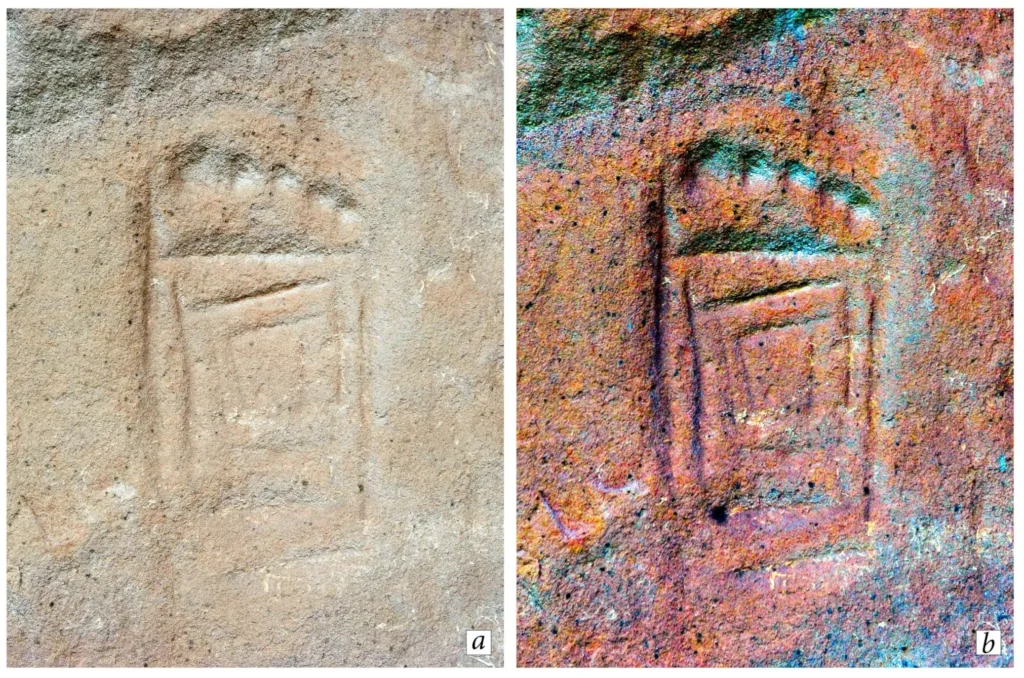
The distinctive sandal design was recorded at Sandal Panel, approximately 800 meters northeast of another important rock art location known as Strawman Panel.
At the site, researchers identified nine carefully carved footprints and sandal representations associated with Ancestral Pueblo communities. Several feature interior markings resembling patterns found on woven sandals.
One carving proved particularly remarkable. At first, it appeared to depict a single large sandal divided into four geometric sections. Further examination using digital image enhancement showed that the sections actually formed four smaller sandals, with two positioned horizontally and two vertically.
The researchers describe the arrangement as an exceptionally elaborate example of sandal imagery.
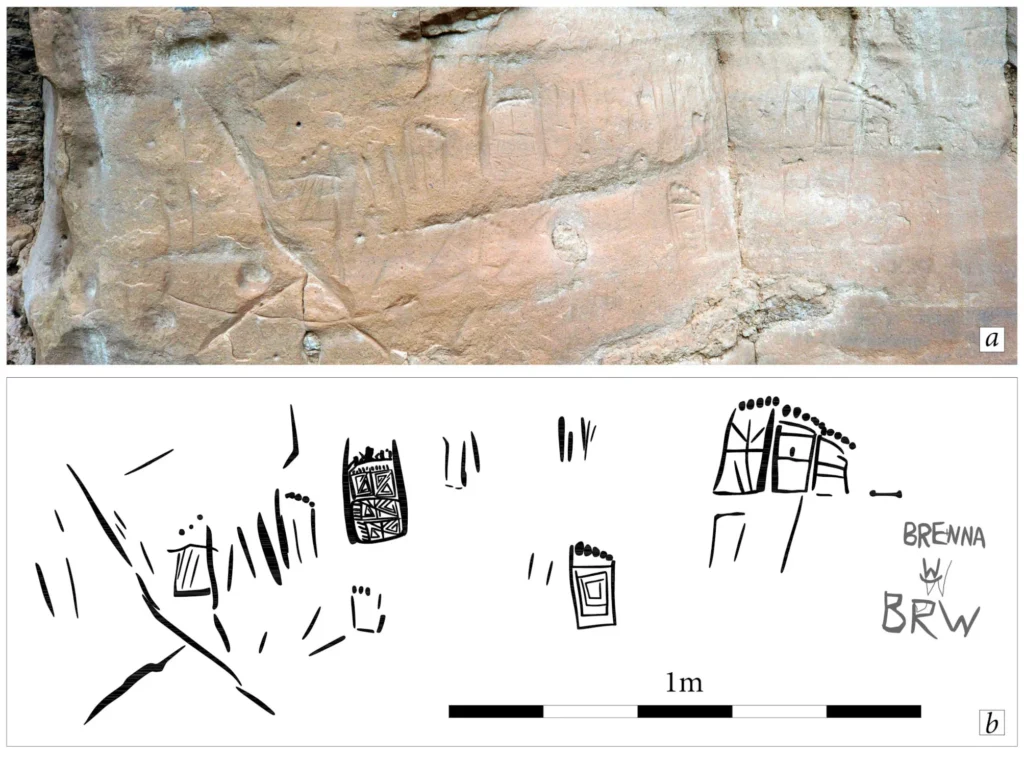
Although its meaning remains unknown, previous archaeological studies have explored whether sandal designs in the American Southwest could have conveyed information about social identity or group affiliation.
The Sandal Panel contains more than footwear imagery. Nearby carvings include human figures, abstract patterns, and symbols from different periods of occupation, suggesting that the location continued to hold significance long after the earliest images were created.
Bison Herds and Scenes of Conflict
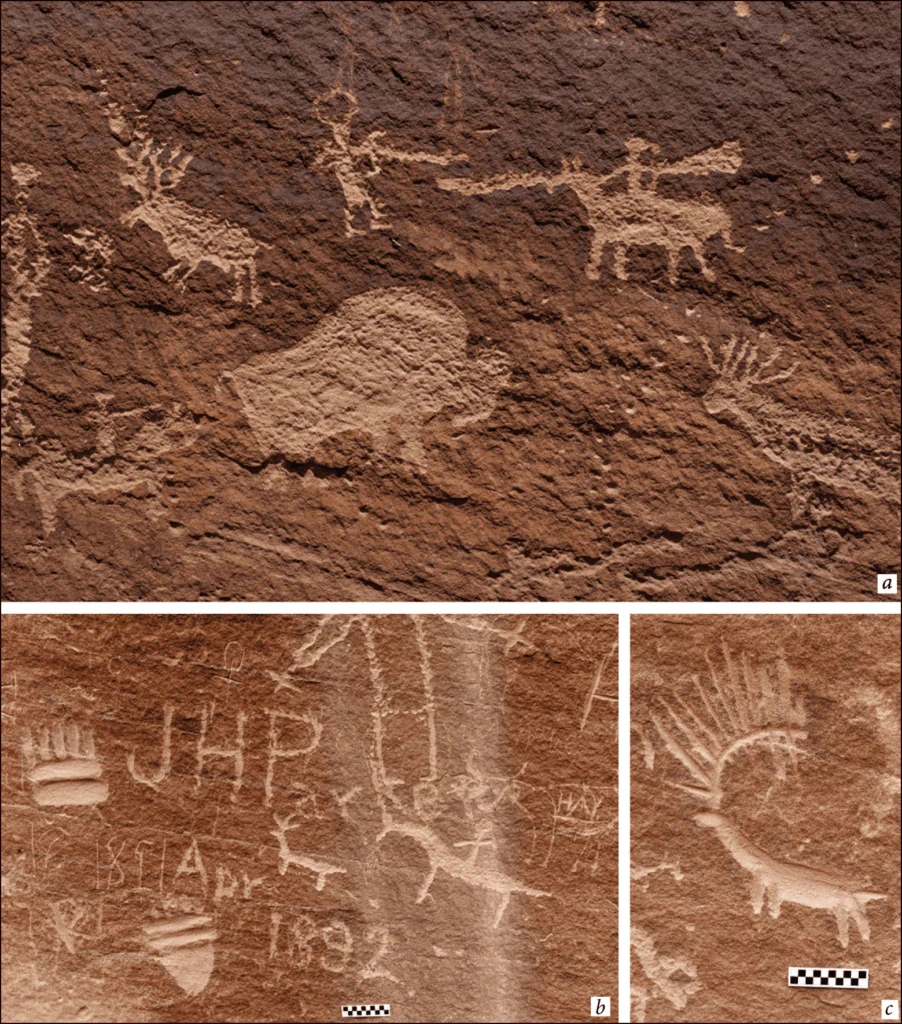
Another remarkable composition appears approximately six meters above the present ground level at Sandal Panel.
Here, researchers documented at least 11 or 12 bison alongside other animals, including probable deer or elk and bighorn sheep. Several human figures appear near the herd, accompanied by what may be dogs.
Two figures seem to be engaged in a confrontation, possibly involving knives or other weapons.
The imagery is attributed to historic Ute communities, although the precise meaning of the scene remains uncertain. The absence of horses is particularly notable because mounted warriors and hunters appear frequently in other Ute rock art across the region.
At nearby Strawman Panel, the scale of the surviving imagery is considerably greater.
The sandstone cliff extends approximately 129 meters in length and reaches 26 meters in height. Researchers recorded at least 27 bison, 44 deer or elk, 17 bighorn sheep, and more than 34 horseback riders among its historic carvings.
Some figures carry bows or firearms, while others appear in hunting or fighting scenes.
The site also preserves evidence of a later chapter in Colorado’s history. Names, dates, initials, and livestock brands carved by ranchers, travelers, and sheepherders appear beside Indigenous imagery.
These inscriptions, including examples from the late nineteenth and early twentieth centuries, document the changing use of the canyon as ranching and settlement expanded across the region.
Researchers caution, however, that the cultural origins of individual historic carvings are not always easy to distinguish, particularly where Ute, Hispanic, and Anglo-American traditions overlapped.
What Remains Beneath the Canyon Floor?
Not all of Sandstone Canyon’s archaeological record is visible.
At Strawman Panel, geophysical investigations and test excavations identified indications of archaeological remains approximately 1.6 to 2 meters below the modern surface.
Researchers have suggested that older Ancestral Pueblo carvings could also remain concealed beneath accumulated sediment, although this possibility has not yet been confirmed by excavation.
Elsewhere in the canyon, the cliffs preserve evidence of significant environmental changes.
At a site featuring older Basketmaker-period human figures, some carvings are located roughly six to eight meters above today’s ground level. Remnants of sediment lodged in rock cavities suggest that powerful floods once deposited large quantities of material against the cliff face.
Those deposits were subsequently eroded away, exposing portions of the rock surface again.
The findings raise questions about how much additional archaeological evidence may have been buried, damaged, or destroyed over time.
Preserving a Record of Colorado’s Past
To document the extensive rock art, researchers combined digital photography, photogrammetry, three-dimensional laser scanning, and traditional hand tracing.
At Strawman Panel alone, 918 reference points were established to produce accurate records of the carvings. Subsequent field checks showed that some digitally recorded details still required manual correction, particularly where strong sunlight complicated the photography.
The resulting documentation provides an important record of images threatened by erosion and other environmental pressures.
The researchers also identified a more recent source of damage. Heavy livestock grazing during the late nineteenth and early twentieth centuries contributed to soil erosion, while major floods altered the canyon landscape and affected some of its rock art.
Today, the carvings preserve evidence of Ancestral Pueblo traditions, historic Ute communities, and the settlers who later occupied the region.
The intricate sandal design stands out for the precision of its execution, but it is only one element of this larger history. Across Sandstone Canyon, images created centuries apart remain side by side, preserving cultural traditions that might otherwise have left few surviving traces.
Cover Image: Researchers examine Indigenous rock carvings and historical inscriptions at Strawman Panel in Canyons of the Ancients National Monument, Colorado. Credit: R. Słaboński / Antiquity, 2023.