
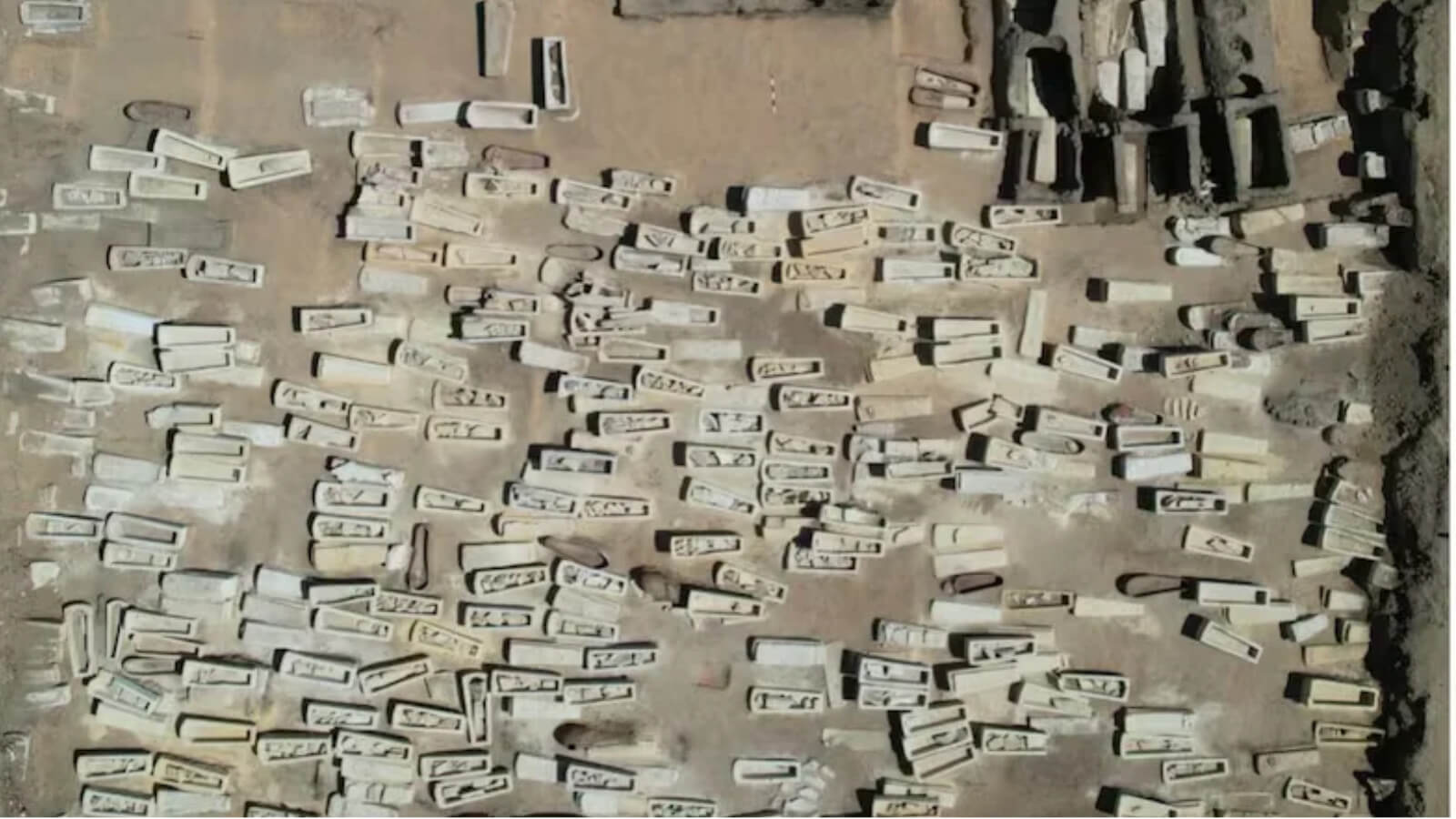
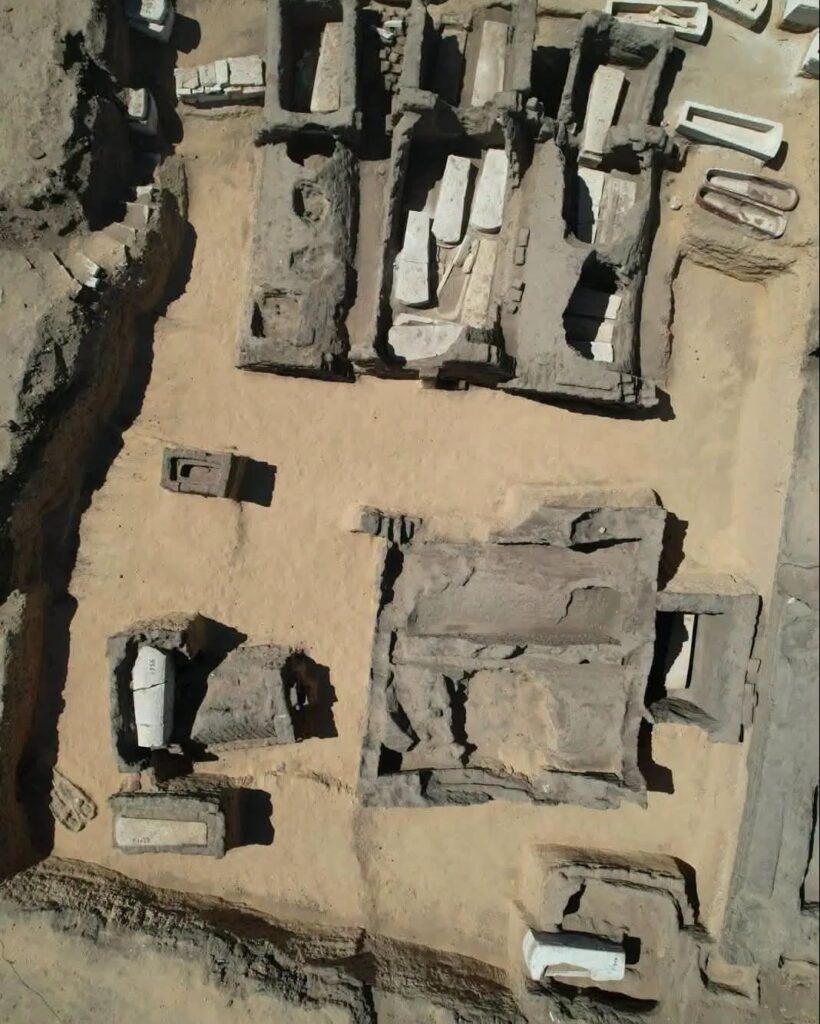
An ancient cemetery in northern Egypt has yielded hundreds of stone and ceramic coffins, gold funerary objects, and burial structures dating largely to the Ptolemaic period, more than 2,200 years ago. Located at Tell Kom Abu Billo in Menoufia Governorate, the burial ground offers an unusually extensive record of how people outside Egypt’s ruling elite prepared their dead for the afterlife.
Egypt’s Ministry of Tourism and Antiquities highlighted the cemetery in an announcement on November 18, 2026. The discoveries are part of an archaeological investigation that began several years earlier, with hundreds of coffins already documented during excavations in 2023 and 2024.
The site belongs to ancient Terenouthis, a settlement near the western edge of the Nile Delta, not far from Wadi El Natrun, where Egyptians obtained natron salt used in mummification.
Hundreds of Coffins Across an Ancient Burial Ground
The Egyptian archaeological mission working at Tell Kom Abu Billo has uncovered limestone sarcophagi, ceramic burial containers, wooden coffin fragments, vaulted mudbrick tombs, and a burial chamber lined with limestone.
The scale of the cemetery was documented before the latest announcement. In a scientific conference abstract published in 2025, excavation director Mostafa Rezk Ibrahim reported that work conducted between September 2023 and May 2024 had uncovered 227 limestone sarcophagi, 94 ceramic coffins, and remains of 12 wooden coffins in the first two archaeological layers.
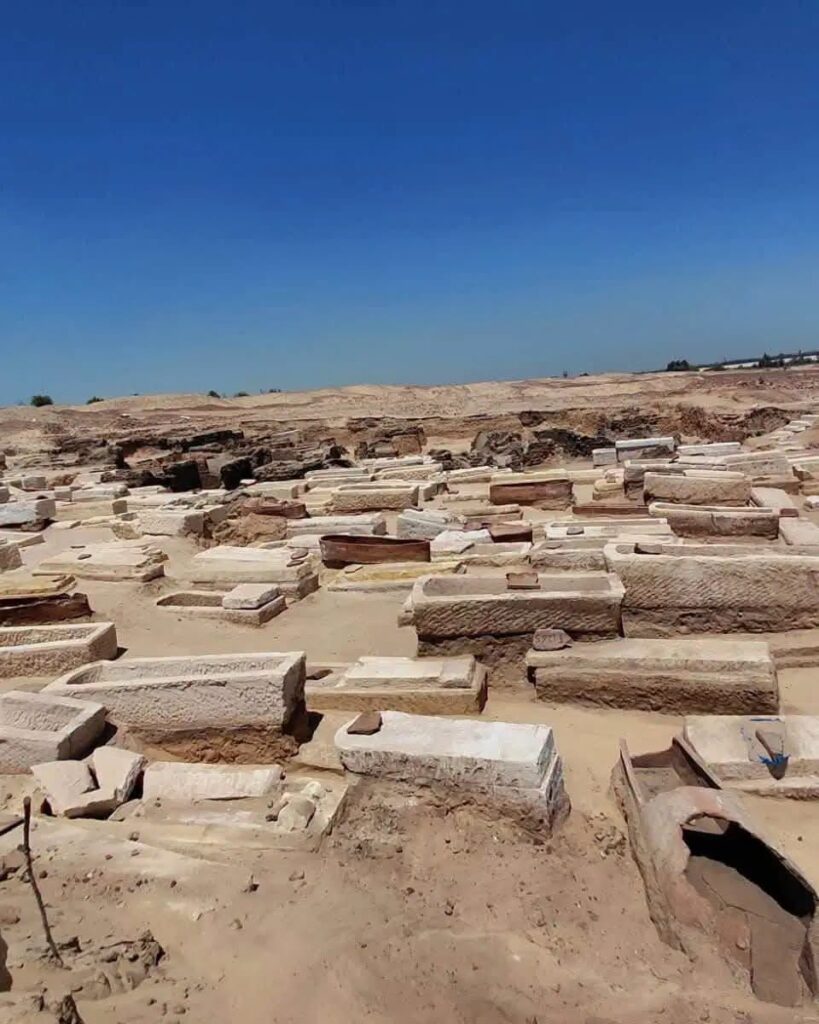
The ministry’s November announcement describes a large concentration of burials in an open courtyard, with additional structures extending beneath the surrounding sand and debris.
Many of the stone coffins have suffered damage from earlier looting and quarrying. Some were missing their lids, while others had been broken apart. Despite this disturbance, archaeologists identified human remains bearing traces of embalming resins and fragments of funerary coverings decorated with yellow, red, blue, and gold pigments.
Hisham El-Leithy, secretary-general of the Supreme Council of Antiquities, said the concentration of burials was unprecedented at the site. Preliminary examination of the grave goods suggests that the cemetery served primarily members of the middle classes, although researchers have yet to establish the social standing of individual occupants.
Gold Tongues and a Goddess Who Bridged Two Cultures
Among the funerary objects are tongue-shaped pieces of gold, jewelry, gold sheets, scarab amulets, and numerous faience ushabti figurines, some bearing hieroglyphic inscriptions.
The gold tongues are particularly striking. Similar objects were discovered in Roman-era burials at Oxyrhynchus, where they were placed inside the mouths of the deceased. In Egyptian funerary tradition, these objects were associated with the ability to speak in the afterlife. Ushabtis, meanwhile, were small figures intended to carry out work on behalf of their owners after death.
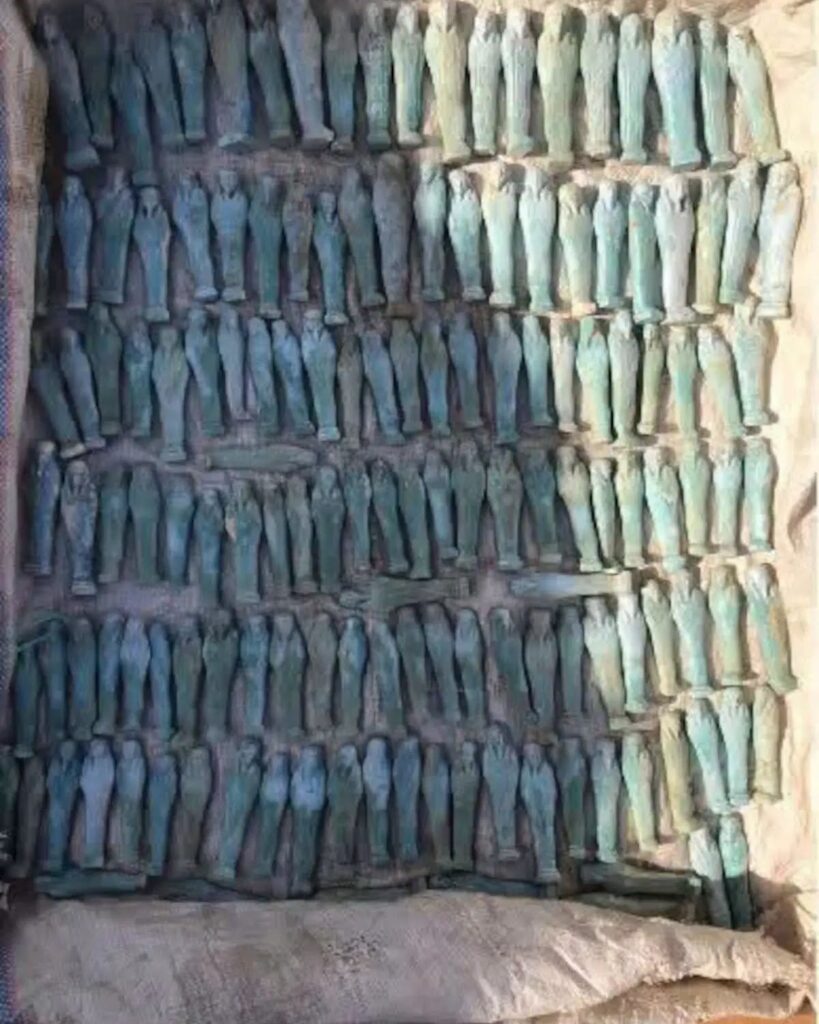
The excavation also produced Wedjat-eye amulets, offering tables, small sphinx figures, fragments of statues depicting the god Horus, and two falcon burials.
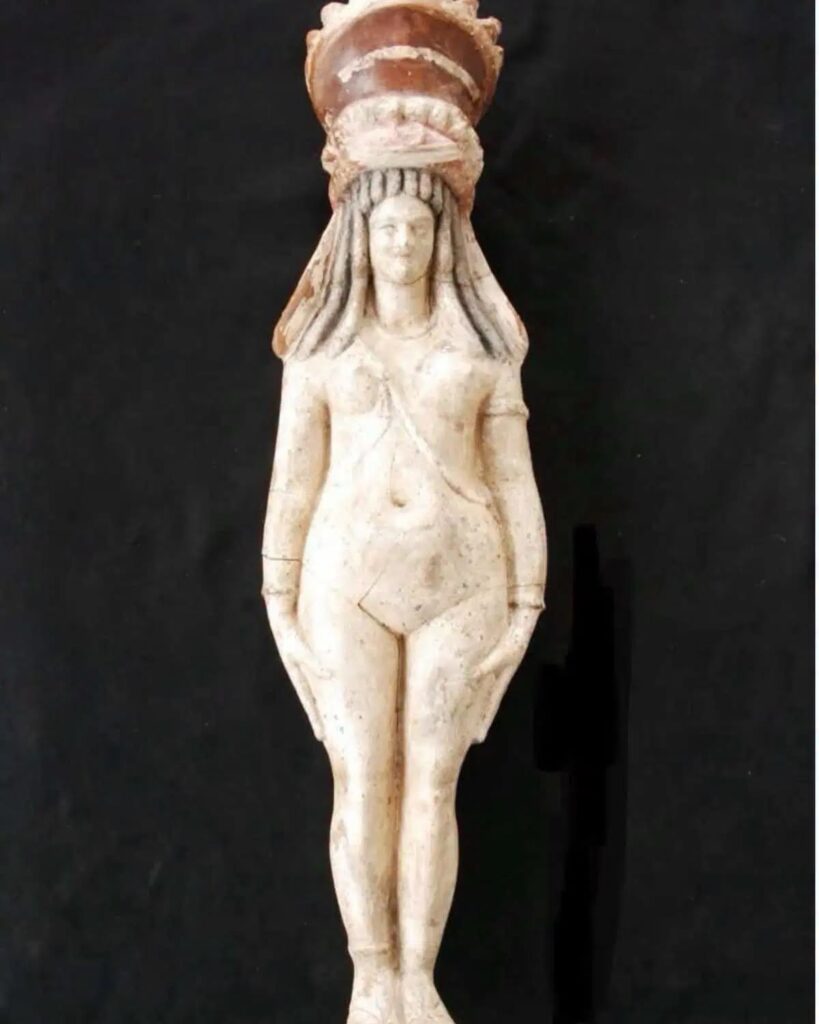
One of the most revealing finds is a terracotta vessel-lid fragment depicting Isis-Aphrodite seated on a lotus flower while nursing the infant Harpocrates.
The image brings together two religious worlds. Isis was among ancient Egypt’s most important goddesses, associated with motherhood, protection, and divine power. During the Ptolemaic period, she became closely linked with the Greek goddess Aphrodite, while Harpocrates represented the Greek interpretation of the Egyptian child god Horus.
Such objects illustrate how Egyptian religious beliefs continued to evolve under Greek rule without losing their older foundations.
What the Burials Reveal About Ancient Terenouthis
Archaeologists believe much of the cemetery dates to the third and second centuries BC, during the early Ptolemaic period. Some burials appear to belong to the end of Egypt’s Late Period, while the broader archaeological landscape also contains evidence from the early Roman era.
The dating rests on several lines of evidence, including archaeological layers, pottery, coffin types, burial customs, and tomb architecture.
Earlier investigations at Terenouthis identified remains of the ancient settlement and a temple dedicated to Hathor, worshipped locally as the Lady of Turquoise. Objects associated with Isis, Osiris, Hathor, and Renenutet demonstrate the continuing importance of Egyptian deities within the burial community.
The cemetery’s location near Wadi El Natrun is also significant. Natron, a naturally occurring mixture of salts, played an essential role in drying bodies during mummification. Although the nearby deposits were an important resource for ancient embalmers, researchers have not established whether the materials found in these particular burials came from the valley.
What makes the cemetery especially valuable is the social picture it may eventually provide. Egypt’s monumental tombs have preserved the lives and beliefs of pharaohs and powerful officials, but the people buried at Terenouthis appear to represent a wider section of society.
Their coffins, amulets, and burial arrangements suggest that traditions commonly associated with elite Egyptian funerals were also practiced in different forms by people of more modest means.
The full extent of the burial ground remains uncertain. Excavation and documentation are continuing, and further investigation may establish how the cemetery expanded and how burial customs changed between the final centuries of pharaonic rule and the Roman period.
Cover Image: Aerial view of hundreds of ancient stone coffins at Tell Kom Abu Billo in Egypt’s Menoufia Governorate, where archaeologists documented a vast Ptolemaic-era cemetery. Credit: Egyptian Ministry of Tourism and Antiquities.