
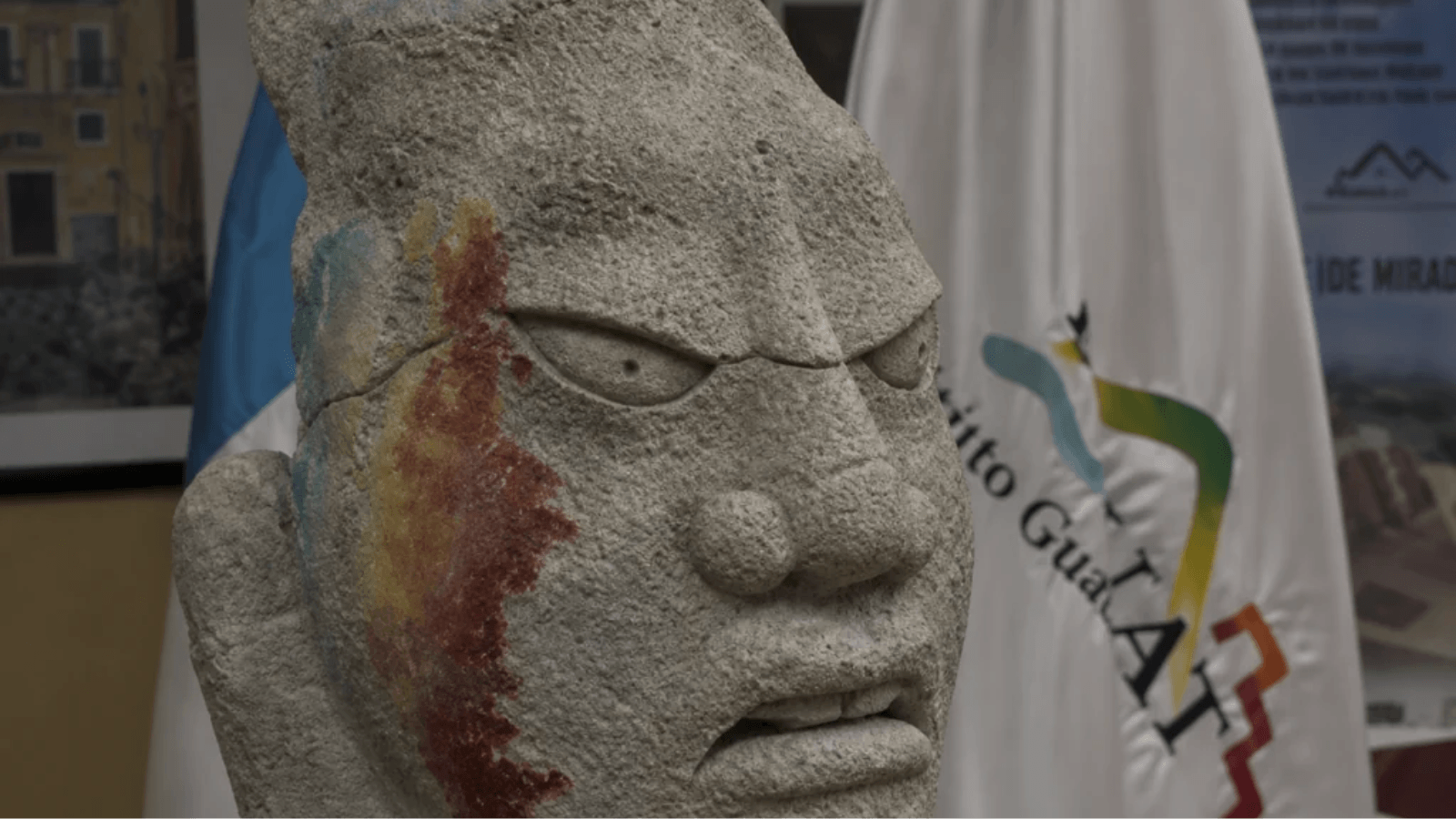
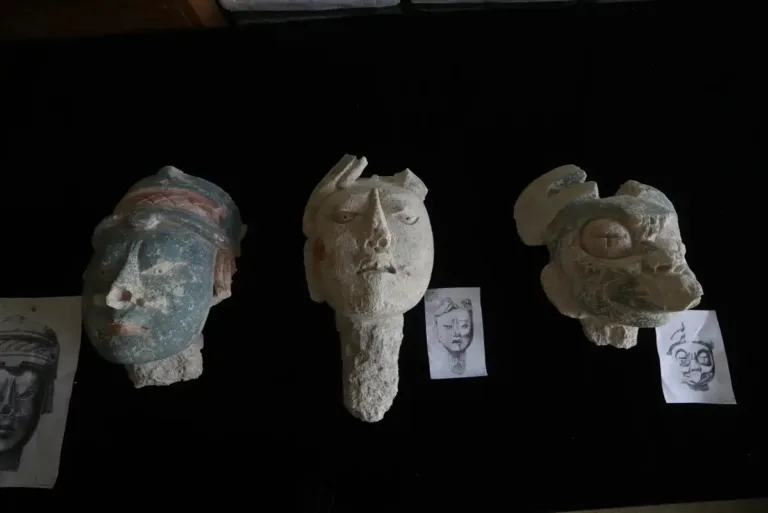
Archaeologists working at the ancient Maya city of El Mirador in northern Guatemala have recovered three additional stucco sculptures, adding to a remarkable collection of human and supernatural faces found within a single building. The discoveries offer new evidence of artistic activity at the site centuries after its greatest period of political and architectural influence.
The finds, recovered during the 2026 excavation season, were presented on November 18 by the Mirador Basin Archaeological Project and the Guatemalan Tourism Institute (INGUAT). They belong to an ongoing investigation that has uncovered more than 30 sculpted faces, along with dozens of ceramic vessels, in the Casa del Coral architectural group.
The newly recovered sculptures have yet to undergo detailed restoration and analysis. Earlier examples from the same complex, however, belong to the Late Classic period, when El Mirador was no longer the powerful Maya center it had once been.
A Different Chapter in El Mirador’s History
Deep in Guatemala’s Petén rainforest, El Mirador is best known for its enormous pyramids and monumental architecture. The city reached its greatest prominence during the Preclassic period, long before many of the better-known Maya cities flourished.
Its decline did not mean the surrounding landscape was permanently abandoned.
Archaeological research has identified later residential occupation at El Mirador, including areas dating to approximately AD 600–800. Among them is Casa del Coral, located east of the immense La Danta pyramid complex.
The sculptures found here belong to that later history. Elsewhere in Guatemala’s Petén region, a 1,200-year-old Maya inscription from Xultun has provided another perspective on intellectual life during the Classic Maya period.
Unlike El Mirador’s towering Preclassic monuments, these smaller works provide evidence of how subsequent Maya inhabitants represented human authority, supernatural beings and perhaps their own ancestors.
Their discovery also raises questions about the relationship between those later communities and the ancient city whose monumental buildings still dominated the landscape.
More Than 30 Faces in One Building
Investigations at Casa del Coral began in 2012, when archaeologists encountered fragments of modeled stucco near a structure damaged by looters.
Further excavation revealed an extraordinary concentration of sculptural material in a building now known as the Edificio de los Rostros, or Building of the Faces.
The structure measures approximately 17 meters (56 feet) long and 10 meters (33 feet) wide, rising about 5 meters (16 feet). Excavations have recovered more than 30 sculptures, although many were broken and displaced before archaeologists could document their original positions.
The faces were fashioned from stucco modeled over stone supports. Their surviving features include carefully shaped eyes, noses, mouths and elaborate expressions.
Some have been interpreted as representations of Maya deities, including a death god and a supernatural paddler associated with the passage of the dead. Others may depict human figures belonging to the ruling elite.
Archaeologist Douglas Mauricio Martínez, who has investigated the building for years, described the collection as an exceptional example of Late Classic Maya artistic craftsmanship.
His published archaeological research documents the sculptural discoveries and the architectural context in which they were recovered.
Yet one important question remains unanswered: how were all these faces originally arranged?
Because the building suffered extensive looting, archaeologists cannot securely reconstruct the complete composition. The sculptures may once have formed part of a larger architectural display, but its precise appearance remains uncertain.
Ceramic Vessels Point to Possible Ritual Activity
The sculptures were not the only significant objects recovered from the building.
More than 35 ceramic vessels were also discovered, including containers known as tecomates and bucules. Such vessels could have held liquids, and researchers have suggested that some may have been associated with fermented beverages.
Their presence has led archaeologists to consider whether the building served a ceremonial purpose.
In an interview with Guatemala’s Prensa Libre, Mauricio Martínez explained that the combination of sculpted figures and ceramic vessels supports the possibility that ceremonies took place there.
The interpretation is significant, but not conclusive. Neither the sculptures nor the vessels establish exactly what activities occurred inside the building.
Nevertheless, their association offers a more complete picture of the people who occupied this part of El Mirador during its later history.
Restoring Faces from the Maya Past
Recovering the sculptures is only the beginning of the work.
Many were found in extremely fragile condition, broken into numerous pieces or affected by roots and surrounding debris. The delicate stucco requires painstaking conservation before researchers can fully examine individual features.
Conservator Lilian Vega de Zea explained during the November presentation that restoring a single sculpture can take as long as a year.
Some previously recovered examples have already reached Guatemala’s National Museum of Archaeology and Ethnology, while others remain under conservation. The three sculptures found in 2026 will also require further treatment.
The discoveries form part of a much larger investigation of the Mirador Basin. According to the Guatemalan News Agency, researchers have identified more than 964 archaeological sites across approximately 1,700 square kilometers through surveys incorporating LiDAR technology.
Those surveys have helped reveal the extent of ancient settlement and the networks that connected communities across the region.
The sculptures tell a different part of that history. While El Mirador’s monumental architecture records the ambitions of an early Maya center, the faces from Casa del Coral preserve evidence of artistic traditions that continued long after its political peak.
Their original arrangement may remain uncertain, but each recovered sculpture adds another piece to the history of a city whose importance extended beyond the age of its great pyr