
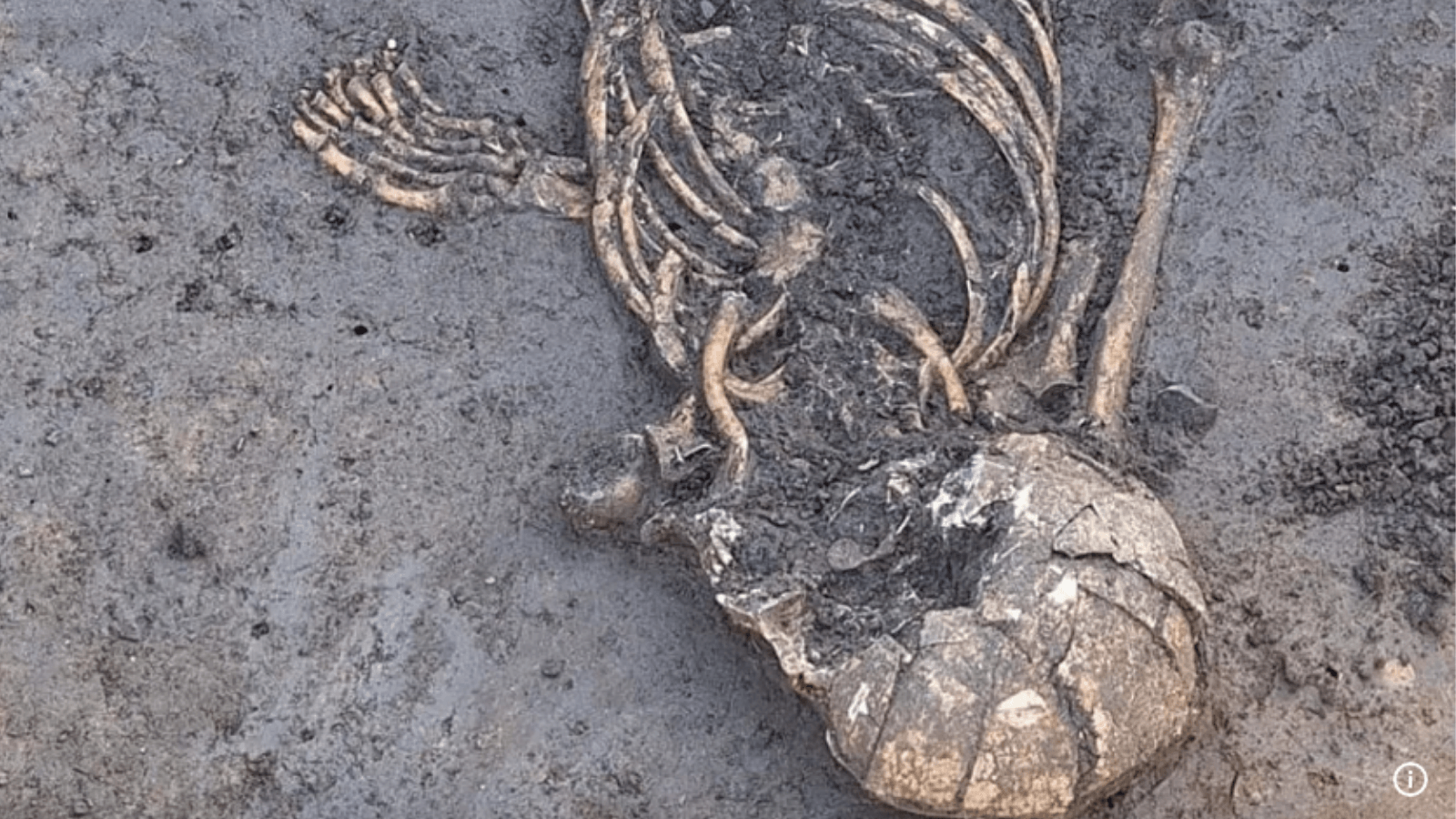
Archaeologists in southern Germany are puzzled by a 7,000-year-old skeleton they have found regarding the unusual stance of its legs and significant bending of the neck. The individual was a youth who existed during the Neolithic era when farming groups across Central Europe were building lasting communities.
Archaeologists investigating land set aside for housing in Großköllnbach, Lower Bavaria, uncovered beneath the ground the traces of an old community and a burial that broke with standard practices of the time; they found the remains of an ancient settlement there as well. The bones of a young person were found there, but their legs lay in an odd arrangement while the neck showed clear signs of twisting.
A young person’s right limb lay twisted tightly against their torso, while the opposite side stretched away from them at an impossible angle. Investigators are currently attempting to decide if a human intentionally positioned the corpse in this fashion or if gravity moved it following interment. This unusual resting place was located beneath the ground at Großköllnbach in Lower Bavaria during work on land set aside for housing projects. While digging, workers uncovered traces of an old community and a funeral that defied standard habits for the era.
A Burial That Raises More Questions Than Answers
The skeleton came from a pit situated close to an ancient cooking facility. Eventually, noticing a dark patch in the soil led archaeologists to find human remains.
According to district archaeologist Dr. Florian Eibl, the position of the legs differs from the burial customs generally associated with the Linear Pottery culture, which spread across Central Europe with the arrival of early farming communities.
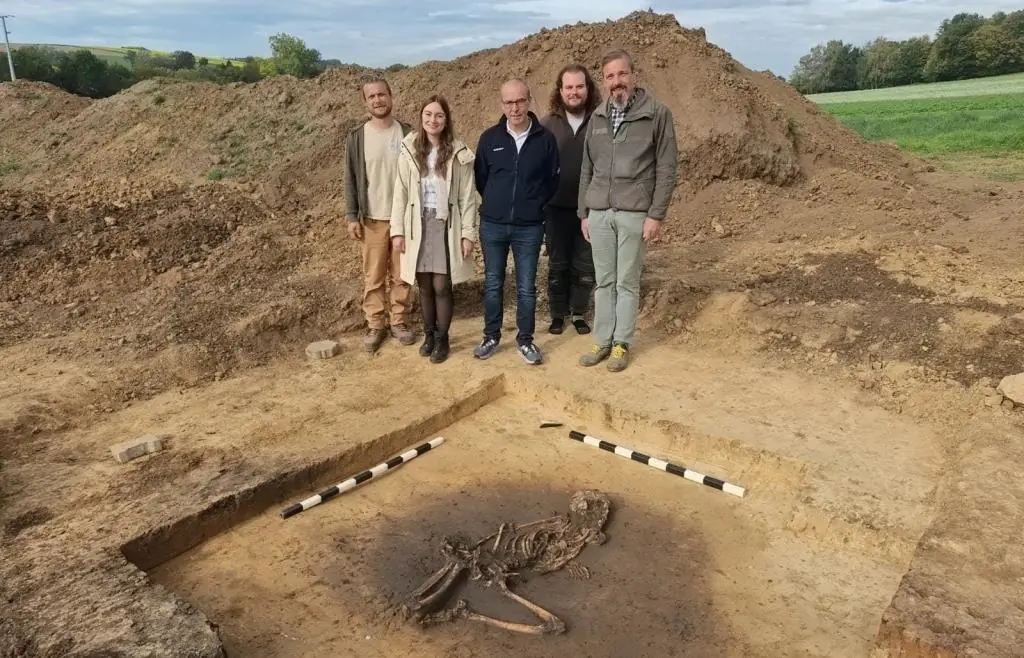
People belonging to this culture commonly buried their dead on their sides, with their knees drawn toward the body. At Großköllnbach, though, the boy’s legs were positioned in noticeably different ways. According to Eibl, maintaining that posture would have been painful for a living person.
The form of the grave might provide a reason; its floor slopes downward as archaeologists suspect the body slipped when surrounding soil settled. If true, this odd bone arrangement might not show where the teenager actually lay when buried.
Another unusual feature is located in the neck. Although researchers have not established whether the pronounced deformation of several cervical vertebrae developed while the individual was a teenager or occurred after death, these bones show significant distortion.
The person’s exact age and biological gender are still unconfirmed. An initial examination determined that the remains belonged to an adolescent since several bones’ growth plates had not fully fused yet. Further anthropological analysis might assist in clarifying the teenager’s health and physical development.
An Early Farming Community Beneath the Fields
Archaeologists uncovered more than just a single burial at Großköllnbach. While excavating for five weeks at the Steigäcker IV development site, they recorded approximately 150 archaeological features, which included evidence of three Neolithic longhouses.
Researchers think that not more than two of these buildings existed simultaneously. They also uncovered clay ovens with pebble-lined floors, providing proof of how the settlement’s residents cooked their meals.
Other discoveries included grinding stones crafted from rock that might have come from the Bavarian Forest or areas beyond the Danube. These items indicate the group possessed materials found outside its direct neighborhood. While some of these rocks were local, their presence implies access to distant sources. The specific origin remains uncertain due to the possibility that they originated in regions far away.
The skeletal remains of a young person are now with the Dingolfing-Landau district archaeology unit for additional study. Even though this settlement provides important information about how early farmers lived, the details surrounding where and why the teenager was laid to rest remain unknown.
A closer examination of the remains could help tell apart physical differences that existed while alive and alterations that happened after death. Whether the odd placement was deliberate, however, might turn out to be far more difficult to determine. The settlement provides important proof of everyday activities among early farmers, yet details surrounding how the teenager died remain unclear.
Cover Image: Close-up of the 7,000-year-old skeleton discovered at Großköllnbach in Bavaria, Germany, showing the skull and upper body of the Neolithic teenager. Credit: © Kreisarchäologie Dingolfing-Landau