
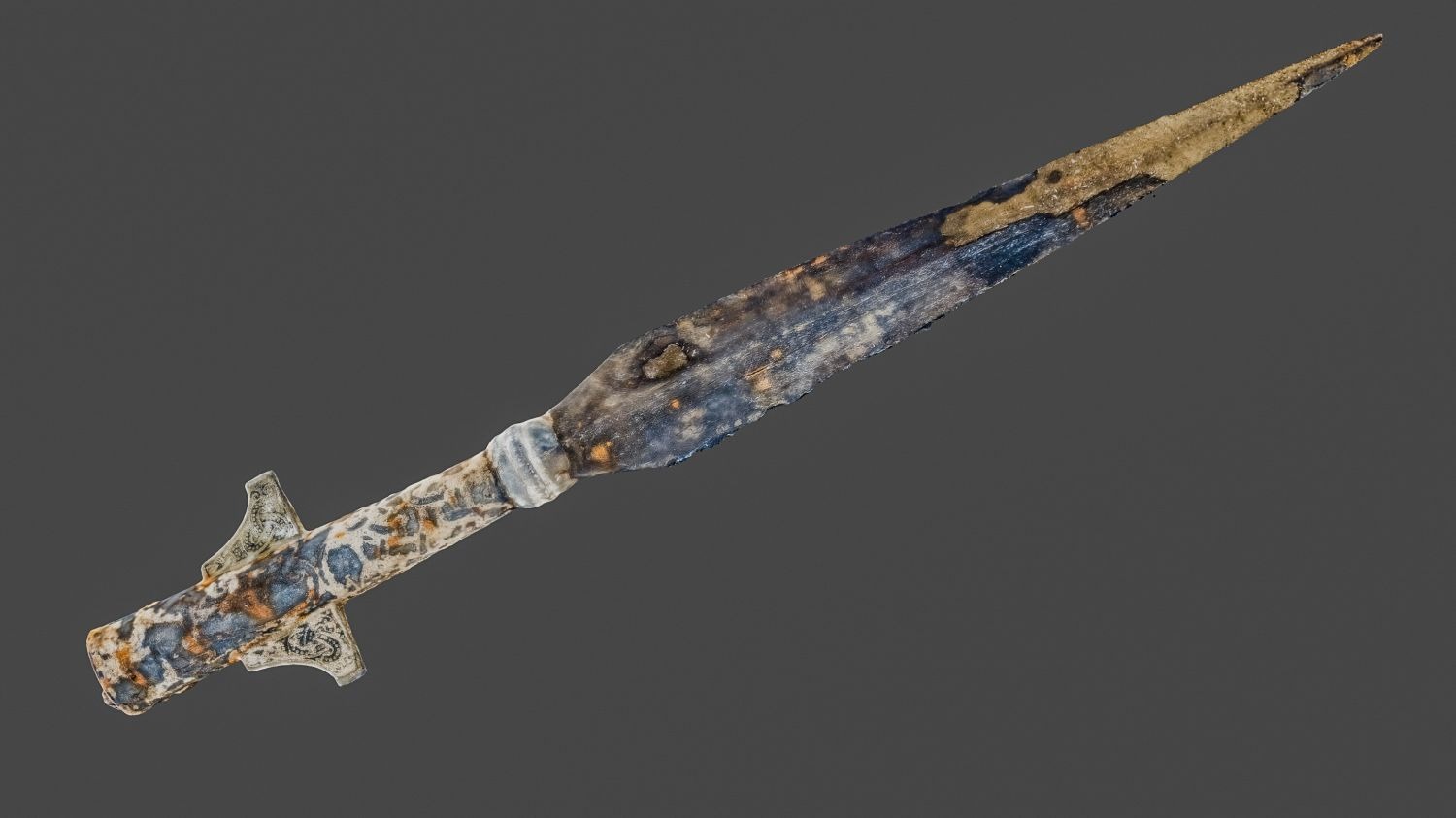
A 1,000-year-old spear decorated with gold and silver, recovered from a lake in Poland, may have belonged to a prince or high-ranking warrior of the early Piast dynasty. Laboratory examinations have identified six metals in its intricate decoration, suggesting that the weapon represented wealth and political authority as well as military power.
Underwater archaeologists from Nicolaus Copernicus University in Toruń discovered the spear near Ostrów Lednicki, an island that served as one of the principal strongholds of Poland’s first rulers. The weapon was among four early medieval spears recovered during the 2025 excavations, conducted in cooperation with the Museum of the First Piasts in Lednica.
A Medieval Spear Decorated with Gold and Silver
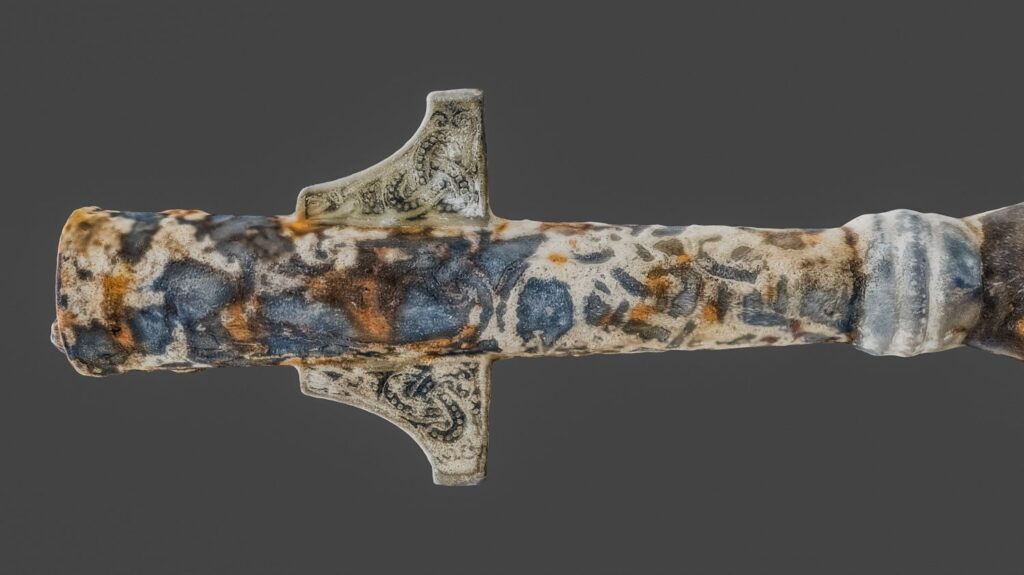
The most elaborate of the four weapons has a steel blade attached to an ornate socket, with two wing-like projections extending from its base. Its surface features spirals, triskelion motifs, and interwoven patterns resembling stylized animal claws or bird beaks.
Rows of tiny raised dots complete the decoration. Although archaeologists have previously recovered similarly shaped spearheads from northern and eastern Europe, the combination of materials and craftsmanship distinguishes the Lednica specimen.
According to the Centre for Underwater Archaeology at Nicolaus Copernicus University, chemical examinations identified gold, silver, copper, tin, zinc, and lead in the weapon’s decoration.
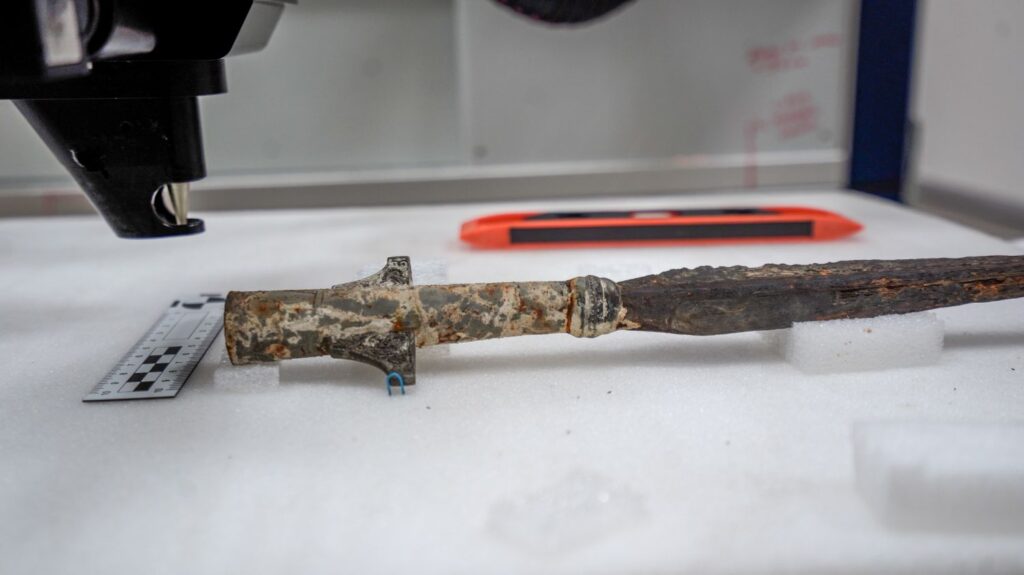
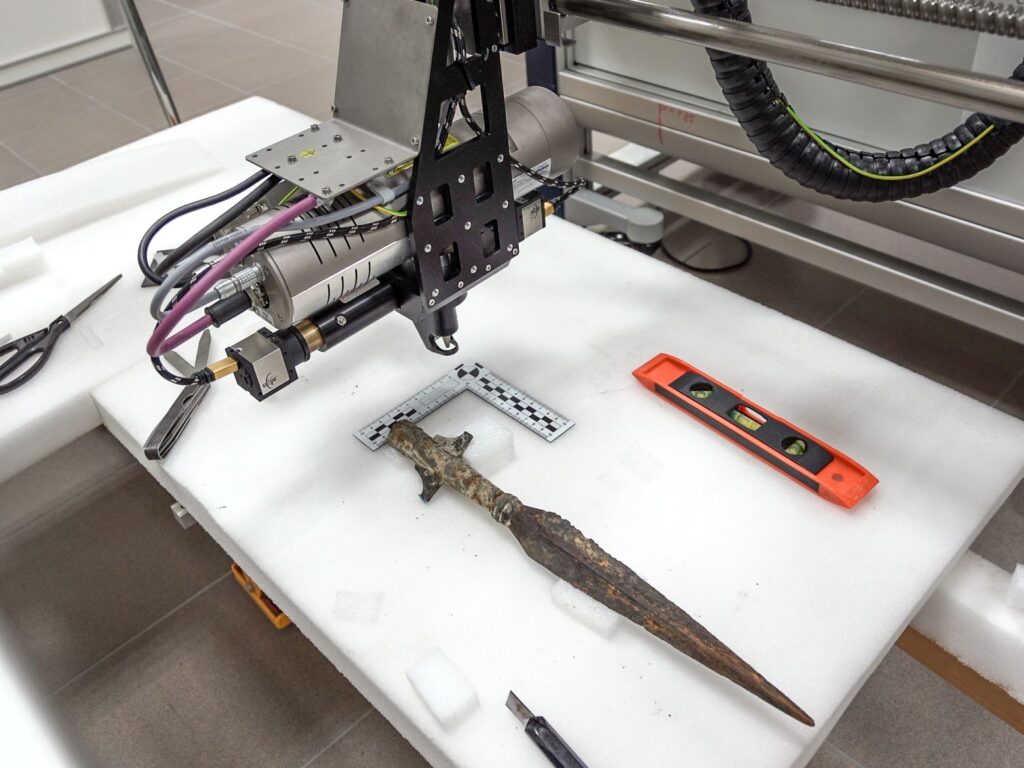
Researchers used macro X-ray fluorescence spectroscopy (Macro-XRF) to map the distribution of these metals without damaging the artifact. The examination detected traces of silver plating on the socket and gilding on the wings, while copper and zinc indicated the use of brass.
Scientists also identified lead, which may have filled parts of the decorative patterns. These findings demonstrate the technical sophistication involved in producing a weapon intended for a wealthy or influential owner.
A Weapon from the Heart of the Early Polish State

Ostrów Lednicki lies between Poznań and Gniezno in western Poland. During the 10th and 11th centuries, the island functioned as a major political and military center of the Piast dynasty, which established the foundations of the Polish state.
Its fortified settlement, monumental buildings, and bridges connecting it to the mainland played important roles during the reigns of Mieszko I and his son, Bolesław I the Brave.
Other discoveries from early medieval Poland demonstrate the importance of decorated weapons and fittings. An 11th-century sword-scabbard fitting discovered in Mazovia has also raised questions about connections between Polish warriors and eastern Baltic craftsmanship. Although the two artifacts served different purposes, both demonstrate how weapon decoration could communicate status in early medieval society.
Decades of underwater investigations have recovered an extensive collection of weapons from Lake Lednica, including 145 axes, 64 spearheads, and eight swords. These discoveries reflect the military importance of the island and the surrounding waterways.
The three other spears recovered in 2025 provide additional information about early medieval weapon-making. One retained an approximately 2.1-meter-long ash-wood shaft, while another featured a blade produced by repeatedly forging together steels with different carbon contents.
Radiocarbon analysis of preserved wooden shafts supports a date around the beginning of the 11th century. When researchers combined the results under the assumption that the samples were contemporary, they obtained an overall 95.4% probability range of AD 993–1032.
A Prince’s Weapon or an Offering to the Gods?
Researchers believe the gilded spear may have belonged to a noble warrior or someone associated with the ruling Piast elite. Its elaborate decoration could have distinguished its owner during ceremonies or military gatherings.
Dr. Mateusz Popek of Nicolaus Copernicus University’s Centre for Underwater Archaeology has suggested that the ornamentation may have served as a form of identification while demonstrating the owner’s prestige and social position.
However, archaeologists have found no direct evidence linking the weapon to a particular prince. Its designation as the “Duke’s Spear” reflects its exceptional quality and possible association with the ruling class rather than a confirmed ownership.
The circumstances surrounding its deposition in the lake also remain uncertain.
One explanation connects the weapons to the political and military crises of the 1030s. During this period, the Piast state suffered internal instability and attacks, including an invasion by the Bohemian ruler Břetislav I.
Some weapons may have entered the water during fighting near the bridges that connected Ostrów Lednicki to the mainland. Yet archaeologists cannot establish whether the decorated spear was lost during a specific battle.
Another possibility involves ritual deposition. Communities across northern Europe sometimes deliberately placed valuable weapons in lakes, rivers, and wetlands as offerings to supernatural powers.
Both interpretations remain plausible, and researchers have not determined whether the gilded spear entered the lake through warfare, accident, or a deliberate ritual act.
Further Research into the Spear’s Origins
The weapon’s place of manufacture remains another unanswered question. Archaeologists are examining whether local craftsmen produced it for the Piast elite or whether it reached Ostrów Lednicki through contacts with Scandinavian or eastern European workshops.
The research team has outlined plans to use computed tomography to examine the weapon’s internal structure and manufacturing techniques. Isotopic analyses of selected metals could also help identify the origins of its raw materials.
These investigations may clarify the technological traditions and exchange networks that connected early medieval Poland with other European regions.
The spear will undergo conservation in cooperation with specialists from Nicolaus Copernicus University and the Museum of the First Piasts in Lednica. Researchers plan to display it at the museum after conservation, adding one of the lake’s most elaborate weapons to its collection of early Piast artifacts.
Cover Image: A 1,000-year-old gold-decorated winged spear recovered from Lake Lednica in Poland, possibly associated with the early Piast elite. Credit: Nicolaus Copernicus University in Toruń