
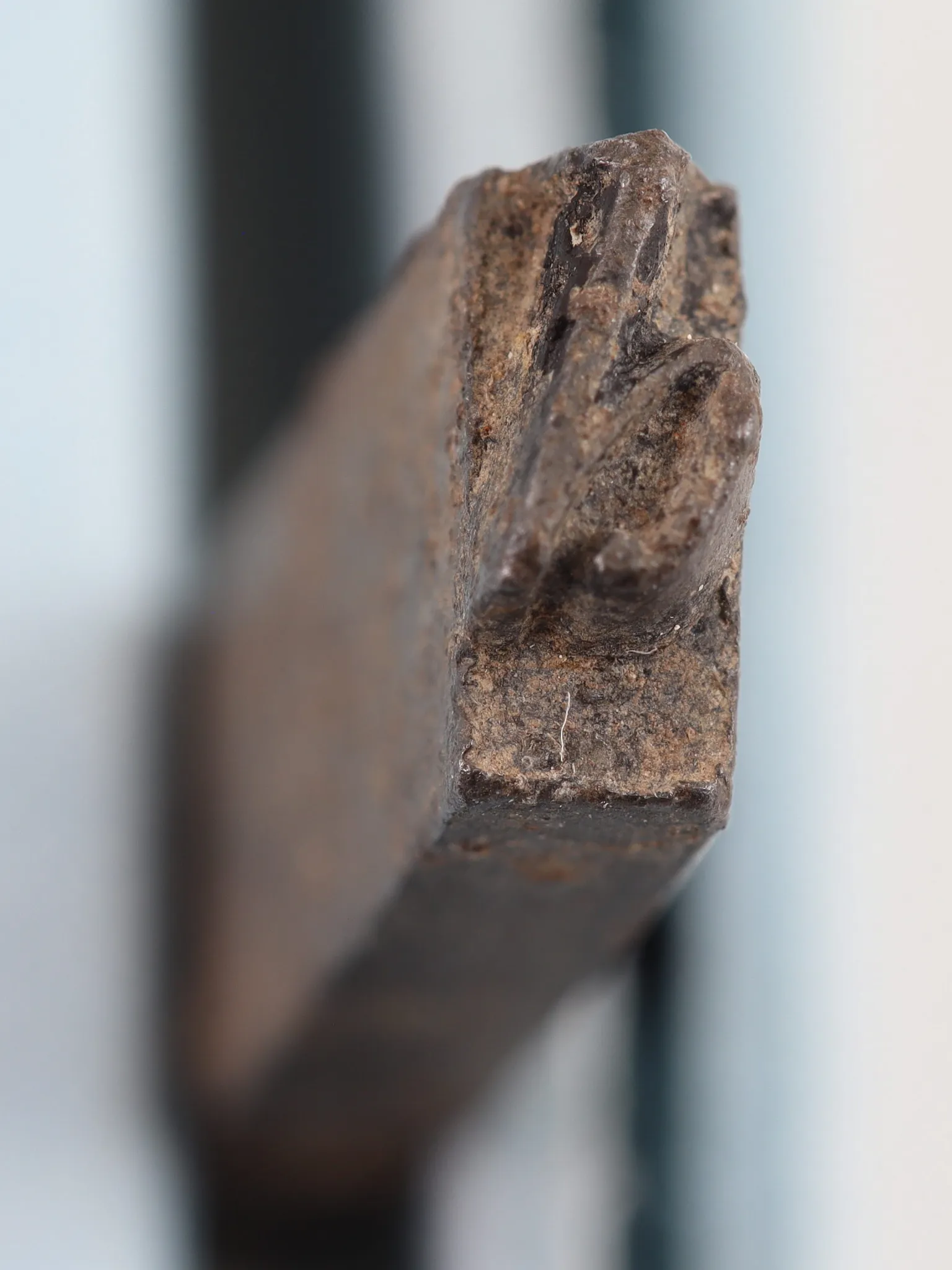
A tiny metal printing letter discovered beneath the historic center of Tartu, Estonia, may have belonged to one of the Baltic region’s earliest university printing presses. Measuring just 6 millimeters in height, the nearly 400-year-old artifact bears a reversed lowercase “h” and could be linked to the University of Tartu’s printing house, established in 1632.
The discovery, announced by the City of Tartu, marks what researchers believe is the first archaeological identification of an early modern metal printing type bearing a letter in Estonia. Although its precise date remains unconfirmed, its design closely resembles characters used in university publications during the seventeenth century.
A Tiny Metal Letter from the 17th Century
Archaeologists discovered the object during excavations ahead of the construction of the Siuru Cultural Centre in Tartu, Estonia’s second-largest city. The project involves extensive investigations of medieval and early modern archaeological deposits beneath the city center.
The metal block measures approximately 25 millimeters in length and 6 millimeters in height, dimensions consistent with movable printing type used in early modern European presses. Its character size corresponds roughly to 17 points in modern typography.
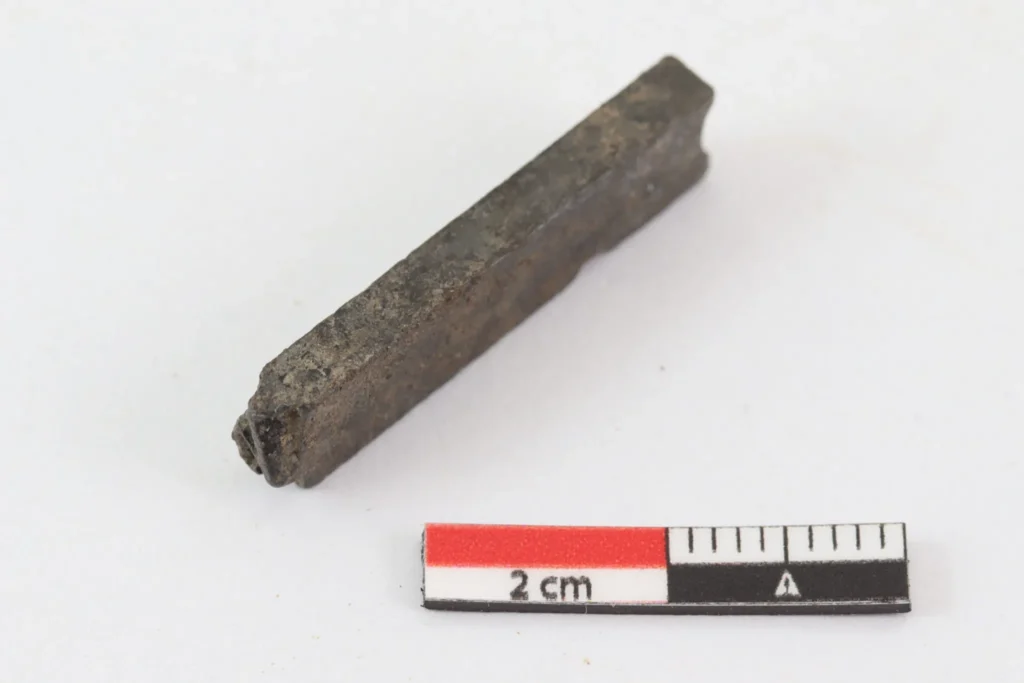
Arvi Haak, head of archaeology at Tartu City Museum, identified a reversed italic lowercase “h” on one end of the object. The metal block also has grooves along its back and side, features that helped printers arrange individual letters in the correct orientation.
Movable type allowed printers to assemble separate metal characters into lines of text, ink them, and transfer the resulting impression onto paper. Individual letters could then be rearranged and reused for new publications.
According to Haak, the artifact most likely came from the University of Tartu’s early printing house. The press operated at several locations near university buildings, and the metal letter may have entered the archaeological deposits with discarded materials.
The University Printing Press Founded in 1632
The University of Tartu established its printing press in 1632, the same year the university was founded under Swedish rule. Among its earliest publications was Jacob Becker’s Postordnung, a German-language document dated September 28, 1632.
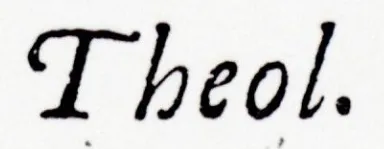
The printing house primarily produced Latin academic texts, including dissertations, speeches, and university announcements. Printers commonly used upright Roman type for the main text and italic characters to emphasize particular passages.
Meelis Friedenthal, associate professor of intellectual history at the University of Tartu and a specialist in book history, examined the possible historical connection between the newly discovered letter and the university’s early publications.
He noted that the italic “h” closely resembles characters used in books printed during the seventeenth-century Swedish period. This similarity supports the possibility that the artifact formed part of the original university printing equipment.
However, the letter has not been conclusively linked to a specific publication, and its exact manufacturing date remains unknown.
University Printing Equipment Hidden Beneath a Church
The history of Tartu’s printing press includes an unusual episode of wartime concealment.
In 1656, Russian troops captured Tartu, forcing the university’s professors to flee to Tallinn. The printing equipment remained behind, along with other university property.
Following the peace settlement of 1661, the printing materials and university library were transferred to St. Mary’s Church. Workers concealed the equipment by walling it into a vaulted space near the altar.
The printing type, together with its storage cases and drawers, weighed 3,564 pounds according to contemporary records. The substantial quantity reflects the value of printing equipment at a time when metal characters were expensive to manufacture and could be melted down for reuse.
The university recovered the hidden materials when it resumed operations later in the seventeenth century. Printer Johann Brendeken subsequently sent worn letters to Lübeck, in present-day Germany, for recasting and ordered additional type.
In 1699, the university and its printing house relocated to Pärnu. Printing did not resume in Tartu until 1789, when Michael Gerhard Grenzius transferred his printing operation from Põltsamaa.
Friedenthal observed that the newly discovered italic letter more closely resembles seventeenth-century printing characters than those used after printing returned to Tartu in the late eighteenth century.
A First for Estonian Archaeology
Archaeologists have recovered movable printing type elsewhere in Europe, including more than 2,700 examples from Wittenberg, Germany. Metallurgical studies of those discoveries identified lead-based alloys containing additional metals such as tin, bismuth, copper, and antimony.
Estonia’s archaeological record also includes evidence of earlier written communication, including a 14th-century papal seal discovered in Tallinn. However, unlike the newly discovered printing letter, the seal belonged to a tradition of authenticating handwritten documents rather than producing printed texts.
Until the Tartu discovery, researchers had not documented an early modern printing type bearing an actual letter in Estonia. Three elongated metal objects previously found in Tallinn are believed to have served as spacing materials rather than printing characters.
The composition of the Tartu artifact has not yet been analyzed, although researchers suspect it was manufactured from a similar lead-based alloy.
Excavations at the Siuru Cultural Centre site began in April 2026 and are expected to continue through the end of 2027. The work, conducted by archaeological company Arheox OÜ with oversight from Tartu City Museum during the initial excavation stages, is among the largest archaeological investigations undertaken in Estonia.
The site has also yielded medieval weapons, coins, decorative stove tiles, and other objects associated with urban life.
The metal printing letter stands out because of its potential connection to the university’s earliest publishing activities. If its proposed identification is confirmed, it would represent a surviving component of the equipment used to produce academic texts in seventeenth-century Tartu.
Cover Image: A close-up of a metal printing type bearing a reversed lowercase “h,” discovered during archaeological excavations in Tartu, Estonia. The artifact may date to the 17th century and belong to the University of Tartu’s early printing press. Credit: Tartu City Museum