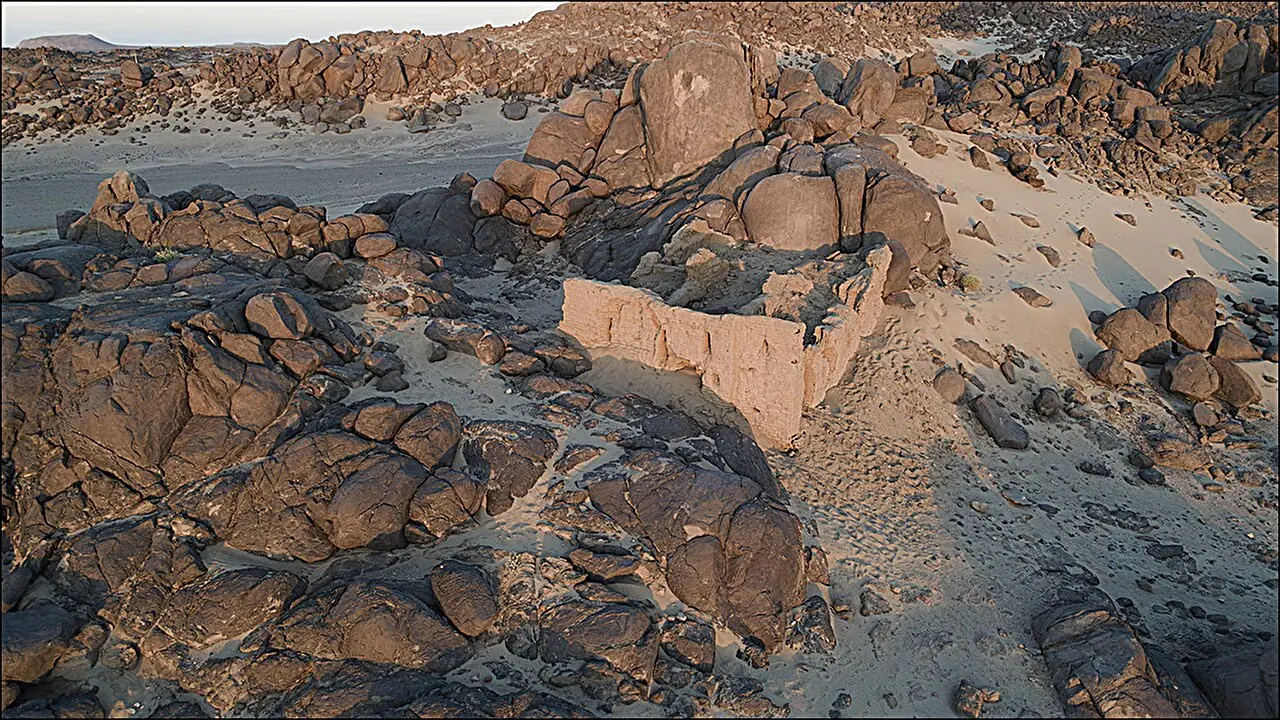
On a granite hill overlooking the Nile’s Third Cataract in northern Sudan, archaeologists are reconstructing the history of a remarkable site. At its center stands the ruin of a seventh-century Christian church built around a much older, life-size human figure carved into the rock.
The mysterious petroglyph may depict a ruler from the ancient Kingdom of Kush, although its precise date and identity remain uncertain. Its survival inside a later Christian setting has become one of the most intriguing clues to how people repeatedly returned to the same place and gave it new meaning.
The findings come from the Good Shepherd of Miseeda project, whose researchers have surveyed nearly 300 archaeological sites across the Mahas region. Their study, published in Antiquity, combines archaeological survey, rock-art analysis, ethnographic research and spatial mapping to trace thousands of years of activity around Miseeda.
A church built around an older image
The church, recorded as site MAS.021, was constructed during the seventh century CE. Its builders did not choose an empty stretch of ground. Instead, they incorporated a granite outcrop bearing the much older human figure into the setting of the church.
The surrounding rocks contain numerous other carvings. Researchers documented large images of a lion, a possible rhinoceros and an elephant, together with smaller representations of cattle and human figures whose dates are not always clear. Later Christian imagery includes crosses and depictions of ships, some apparently oriented toward the church.
The concentration of imagery suggests that the hill already carried significance before the church was built. Rather than replacing an earlier sacred landscape, the Christian building appears to have become part of it.
Could the figure represent a Kushite ruler?
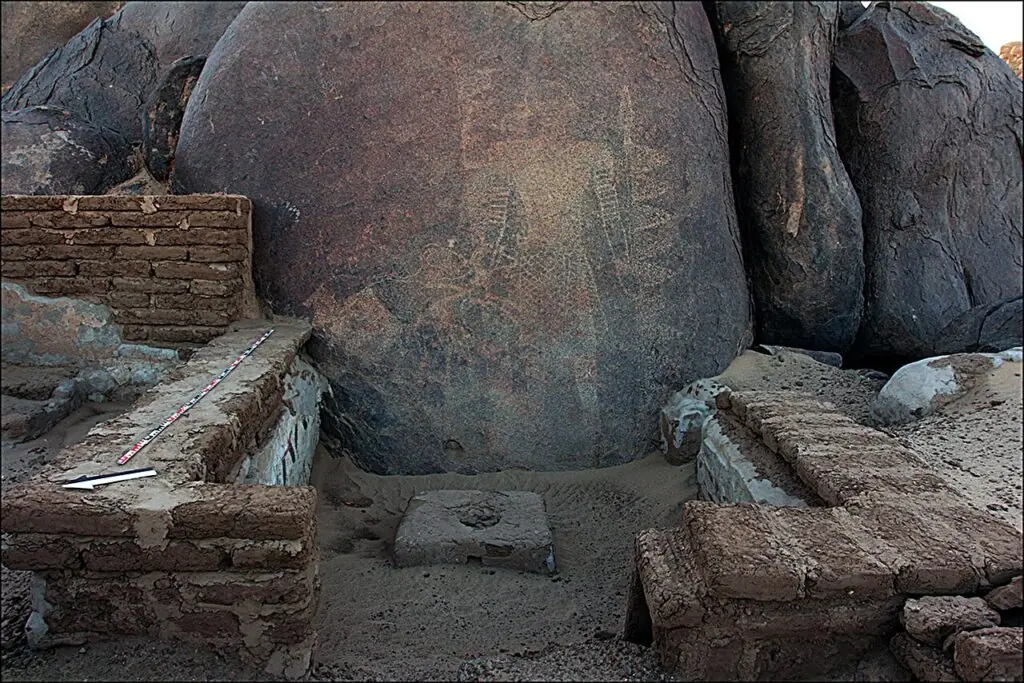
The life-size carving is one of the most unusual features at Miseeda. Earlier researchers proposed either a Kerma-period or broader Kushite date, while the new study describes it more cautiously as a possible representation of a Nubian ruler.
Monumental human carvings of this type are rare in the region. The researchers compare the Miseeda figure with a well-known representation of the Meroitic king Sherkarer at Gebel Qeili, where a monumental royal image has been interpreted as a statement of political authority.
That comparison does not mean the Miseeda figure represents Sherkarer himself. Its identity remains unknown, but its scale and position near the Third Cataract raise the possibility that it once carried political as well as symbolic meaning.
The Mahas region repeatedly stood between political and cultural spheres to the north and south. In such a setting, a monumental human image may have served as a visible statement of presence or authority.
Nearly 300 sites reveal a much longer history
The church and petroglyph belong to a landscape used over thousands of years. Survey work around Miseeda identified nearly 300 archaeological sites, with especially strong evidence from the Mesolithic, Late Neolithic, Pre-Kerma and medieval Christian periods.
Ceramics from the region also reveal contact in more than one direction. Some early pottery combines features associated with northern and southern traditions, while later material links Miseeda with the Christian kingdoms of Nobadia and Makuria.
By the medieval period, the area formed part of wider political, religious and economic networks along the Nile. The church therefore emerged in a place that had already seen long periods of settlement, movement and cultural contact.
That longer history is important because it changes how the church itself is understood. It was not an isolated Christian monument, but one element within a much older archaeological landscape.
A sacred place that survived changing religions
The story of Miseeda continued long after medieval Nubian Christianity declined. Ethnographic research carried out alongside the excavations shows that ancient ruins and rock carvings remained part of local memory.
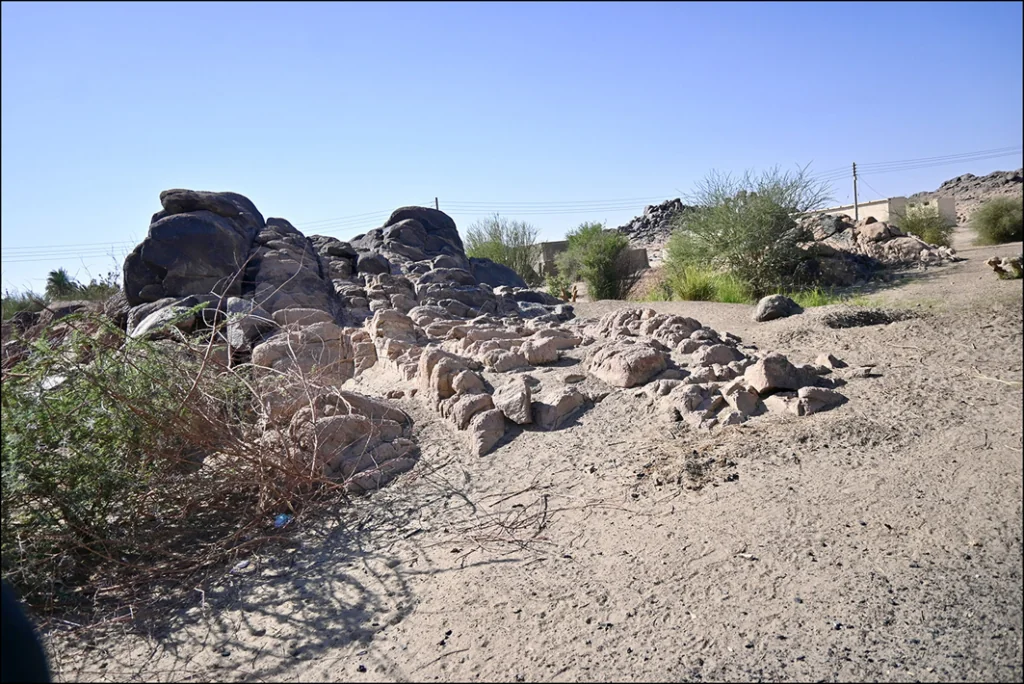
Oral traditions connected several sites with gold, spirits, miraculous events and dangerous supernatural forces. The ruined church itself was remembered both as a place capable of miracles and as a potentially cursed location, while researchers also recorded traditions of pilgrimage and ritual offerings in the area.
In more recent times, the sacred focus shifted toward the shrine of Sheikh Kuman in Miseeda village, where local traditions combine water symbolism, stories of supernatural beings and Sufi religious practices. The beliefs changed, but the wider landscape continued to attract religious meaning.
The life-size figure at Miseeda may never be identified with certainty. But the seventh-century church built around it offers unusually direct evidence that people living centuries later still recognized the power of that ancient image and chose to make it part of their own sacred world.
Cover Image: The church of Miseeda, built in the seventh century CE around a much older petroglyph carved into the granite outcrop. Credit: S. Lenarczyk / Antiquity.