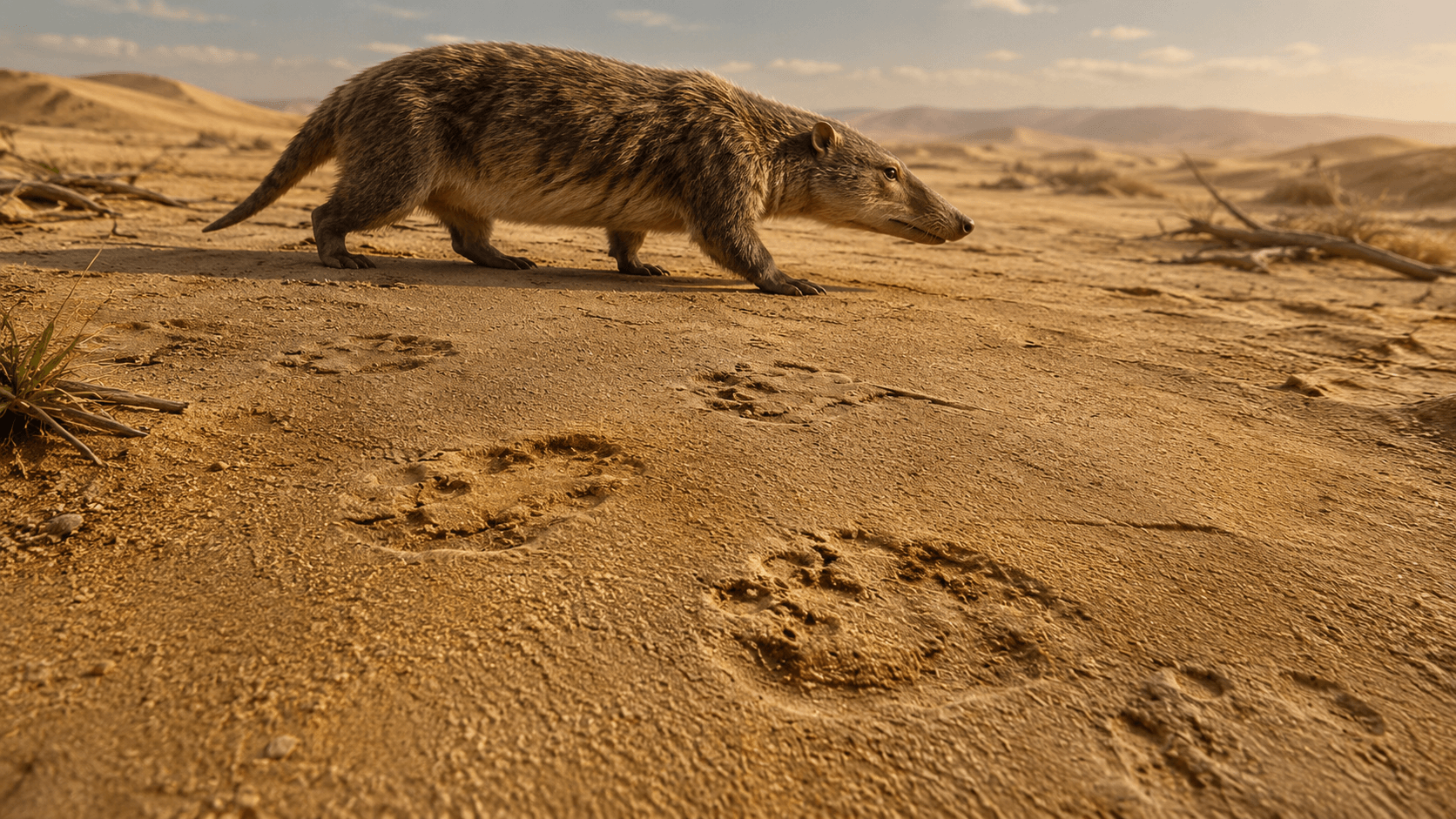
The fossil record has long encouraged a simple picture of mammals during the age of dinosaurs: most were small, while giant reptiles dominated the landscape. Unusually large footprints from an Early Cretaceous desert in Brazil suggest that this picture may be incomplete.
Researchers studying the Botucatu Formation in southern Brazil have described two large four-toed trackways attributed to mammaliaforms, the broader evolutionary group that includes mammals and some of their closest extinct relatives. The tracks rank among the largest mammal-like footprints known from the Early Cretaceous and are the largest yet reported from Gondwana.
Their significance, however, extends beyond size. The footprints suggest that mammaliaforms may have occupied a wider range of body sizes and ecological roles than their sparse skeletal record implies.
The study, led by paleontologist Pedro Victor Buck and colleagues, appears online in the Journal of South American Earth Sciences.
Footprints preserve what bones did not
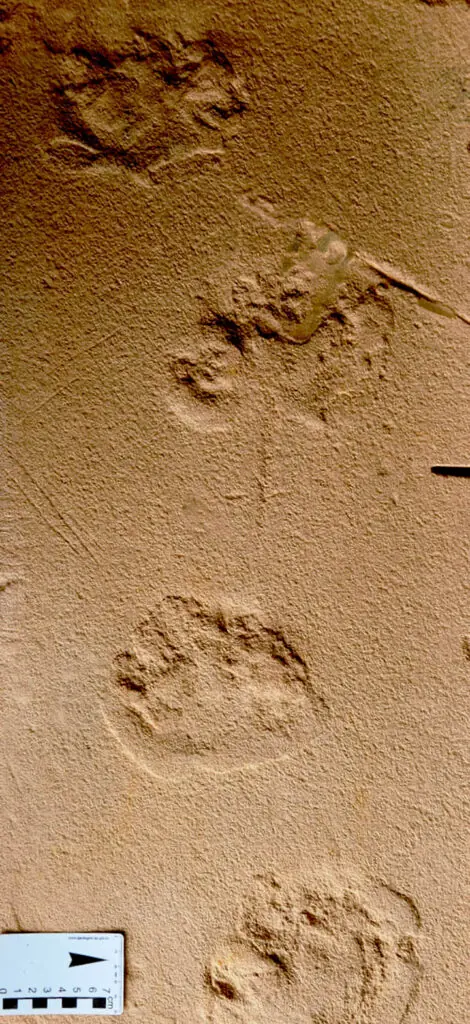
The researchers examined two trackways preserved on sandstone slabs collected near Turvo in Santa Catarina State. The prints show four short, rounded digits, while their arrangement indicates that the animal moved on four limbs.
Based on their shape and proportions, the researchers assigned the tracks to Chelichnopodidae, an ichnofamily used to classify fossil footprints rather than the animals themselves. That distinction matters because tracks rarely preserve enough anatomical information to identify their maker at species level.
The team therefore does not claim to know exactly what animal crossed the ancient sand.
What they can say is that the trackmaker belonged to a mammal-like lineage and was considerably larger than the tiny creatures often associated with Mesozoic mammaliaforms.
The Botucatu Formation makes this discovery particularly revealing.
During the Early Cretaceous, an immense dune field stretched across large parts of what is now southern Brazil and neighboring regions of South America. Animals moving across its sandy surface left behind a rich record of footprints.
Body fossils from the same formation are far rarer.
That imbalance creates a major problem for paleontologists. If researchers relied only on bones, many of the animals that inhabited the Botucatu desert would remain almost invisible. Tracks provide an independent record of creatures that walked through the landscape even when their skeletons never fossilized.
Previous discoveries had already revealed numerous mammaliaform tracks from the formation. The newly described examples expand that known range and strengthen evidence for unexpectedly broad body-size diversity.
Mesozoic mammals were more varied than once thought
For much of the history of paleontology, mammals living alongside dinosaurs were portrayed as uniformly small and ecologically restricted. Fossil discoveries from recent decades have steadily complicated that view.
Mesozoic mammals and their close relatives included climbers, burrowers, swimmers and specialized predators. Some also reached body sizes considerably larger than the stereotypical mouse-sized mammal of popular reconstructions.
The Brazilian tracks contribute a different type of evidence.
A skeleton can reveal anatomy. A trackway records an animal moving through a specific environment. Its footprints can preserve information about posture, locomotion and habitat use while documenting species whose bones may never have survived.
The Botucatu evidence therefore points to a broader problem in reconstructing ancient ecosystems: the skeletal fossil record may systematically underestimate some parts of past biodiversity.
The exact size of the Brazilian trackmaker remains uncertain. Estimating body mass from footprints alone involves substantial margins of error, and the researchers remain cautious about identifying the animal responsible.
For that reason, the new study does not prove that the largest mammal of the dinosaur age has been found.
Instead, the tracks provide further evidence that large-bodied mammaliaforms appeared earlier and perhaps more often than the surviving bones suggest.
That may ultimately be the more important discovery.
Sometimes the animals missing from the fossil record are still there. They simply left footprints instead of bones.