
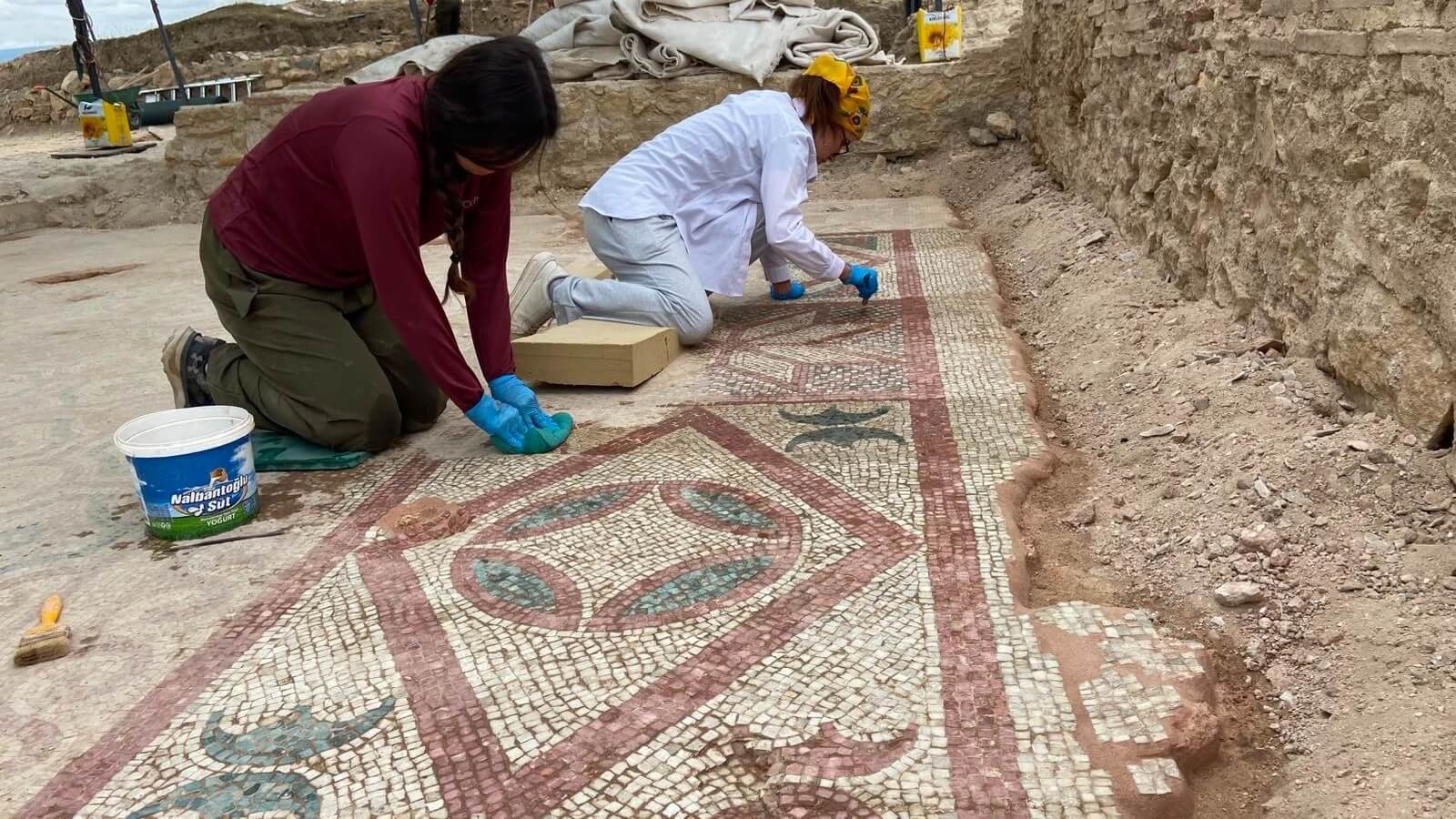
Archaeologists at Pompeiopolis in northern Anatolia have uncovered approximately 105 square meters of a fourth-century mosaic, but the number comes with an important qualification: it is not the total size of the floor.
Part of the decorated pavement remains buried beneath the central nave of a monumental basilica. Until excavation reaches its outer limits, archaeologists cannot determine the mosaic’s complete dimensions or reconstruct the full arrangement of its geometric designs.
Türkiye’s Minister of Culture and Tourism Mehmet Nuri Ersoy announced the discovery following the 2026 excavations near Taşköprü in Kastamonu Province. He described the exposed sections as remarkably well preserved and confirmed that work in the central nave remains incomplete.
The 105 square meters currently visible cover an area of more than 1,100 square feet. Even this substantial surface may represent only one part of a larger decorative program extending across the building’s interior.
A Design That Cannot Yet Be Seen as a Whole
The mosaic is composed of numerous geometric arrangements rather than one image repeated across the floor. Photographs released with the announcement show fields of interlocking forms surrounded by bands containing circles, diamonds, braided patterns and other symmetrical combinations.
Different panels appear to have been conceived as individual compositions while remaining connected within a broader scheme. Contrasting tesserae distinguish the patterns and prevent the expansive pavement from appearing uniform.
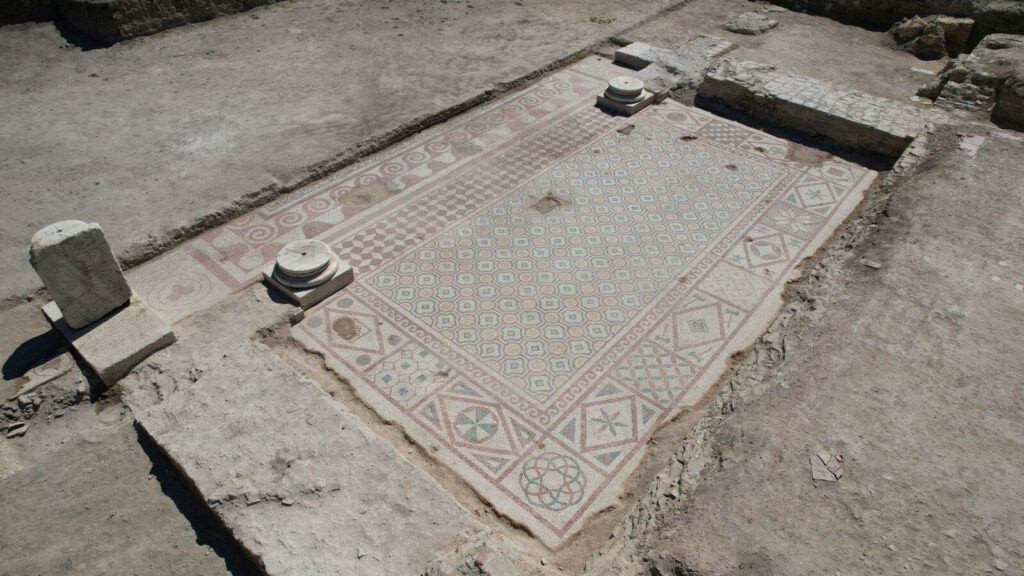
Without the unexcavated sections, however, the relationship between these panels remains uncertain. Archaeologists cannot yet know whether the surviving area belongs to a symmetrical design organized around the center of the nave or whether the patterns changed across different parts of the building.
The missing sections may also contain architectural interruptions, repairs or entirely different compositions. A doorway, partition or change in floor level could explain why one group of patterns ends and another begins.
The discovery therefore cannot be evaluated by size alone. The arrangement of the completed floor may eventually help researchers understand how decorative emphasis was distributed across the interior.
The Excavated Area Is Not the Ancient Boundary
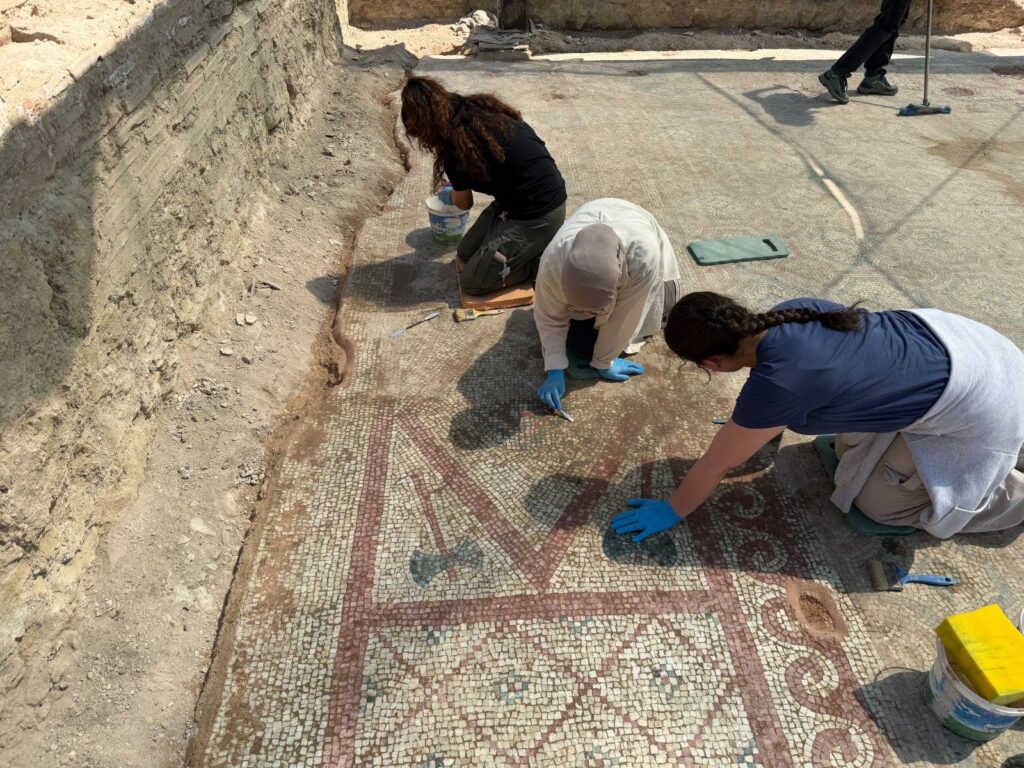
The visible edge of the pavement currently follows the progress of the excavation rather than the original limits of the mosaic. Archaeologists have simply not completed work across the entire central nave.
As excavation advances, newly exposed sections will need to be documented and compared with the panels already visible. This may allow researchers to produce a complete plan and determine whether the pavement was laid during a single construction campaign.
Differences in technique, material or alignment could reveal more than one phase of work. Repairs may also identify areas that experienced heavier use or remained exposed for longer periods.
The final dimensions could therefore tell only part of the story. How the patterns connect—and where they stop in relation to the surrounding architecture—may provide more useful evidence for dating the floor and understanding the building’s internal arrangement.
The Mosaic Is Younger Than the Building Beneath It
The pavement dates to the fourth century AD, but the basilica itself was first constructed considerably earlier. Architectural characteristics, archaeological layers and associated finds place its initial phase in the second half of the second century AD, probably around AD 160–180.
This chronological difference means the mosaic was not part of the building’s original floor. It was installed approximately two centuries after the earliest phase, when the structure was already an established feature of Pompeiopolis.
Nor can the pavement yet be labelled conclusively as a Christian church mosaic. Excavation director Associate Professor Mevlüt Eliüşük has stated that the Roman public basilica was later converted into a Christian church after Pompeiopolis became an episcopal center, but the precise relationship between that conversion and the fourth-century floor has not been established.
The mosaic may have accompanied a major reorganization of the building, or it may belong to an earlier renovation completed before its Christian arrangement took shape. Connections between the pavement, walls and subsequent architectural additions will be necessary to clarify that sequence.
A Separate Discovery from the 2026 Season
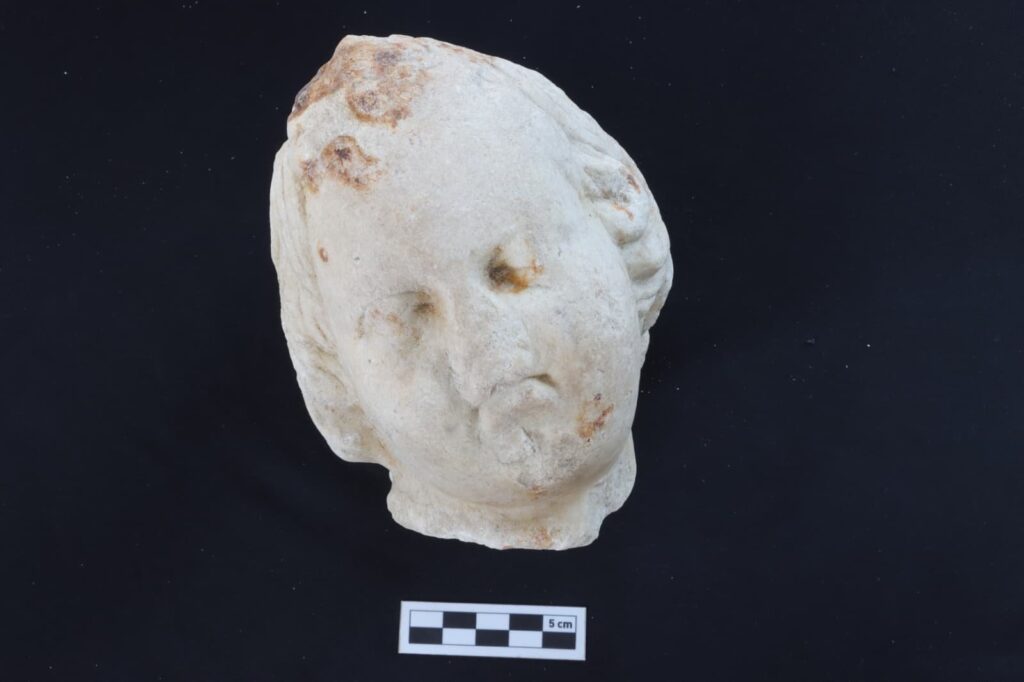
The excavation also produced a head of Eros dated to the second half of the second century AD. It was recovered from the pastophorion, a side chamber associated with the building’s later Christian layout.
The sculpture adds an important object to the 2026 excavation record, but it does not explain the mosaic and should not be treated as part of the same decorative program. Approximately two centuries separate the creation of the head and the installation of the pavement.
Its discovery in a room belonging to the later church arrangement does not show that an image of Eros was displayed there during Christian worship. The head may have been displaced when the building was remodeled, incorporated into reused material or deposited after it was damaged.
Further examination of its archaeological context may establish whether the sculpture originally belonged to the Roman basilica or reached the complex from another part of Pompeiopolis.
Why a Mosaic of This Scale Fits Pompeiopolis
Pompeiopolis was founded by Pompey the Great in 65–64 BC during Rome’s reorganization of northern Anatolia after the defeat of Mithridates VI. Its position beside the ancient Amnias River, now the Gökırmak, connected the city with routes running between inland Anatolia and the Black Sea.
The settlement became a leading center of Paphlagonia and held the title of metropolis during part of the Roman Imperial period. Archaeological research at Pompeiopolis has identified a city containing theaters, monumental public buildings, residential quarters and streets extending beneath Zımbıllı Hill.
This urban background places the mosaic in a clearer context. A pavement covering more than 105 square meters required large quantities of prepared tesserae, specialist labor and sufficient resources to renovate a major interior long after the building was first constructed.
Systematic excavations at Pompeiopolis began in 2006, but work on this basilica opened only in 2025. The following season brought archaeologists into the central nave, where they encountered one of the largest decorated surfaces yet exposed at the site.
Until the remaining nave is excavated, the 105-square-meter mosaic must be treated as an incomplete discovery. Its final scale, full design and relationship to the building’s later history may all change as additional sections emerge.
Cover Image: Conservators work across the still-partially exposed fourth-century mosaic at Pompeiopolis in northern Anatolia. Credit: Republic of Türkiye Ministry of Culture and Tourism