
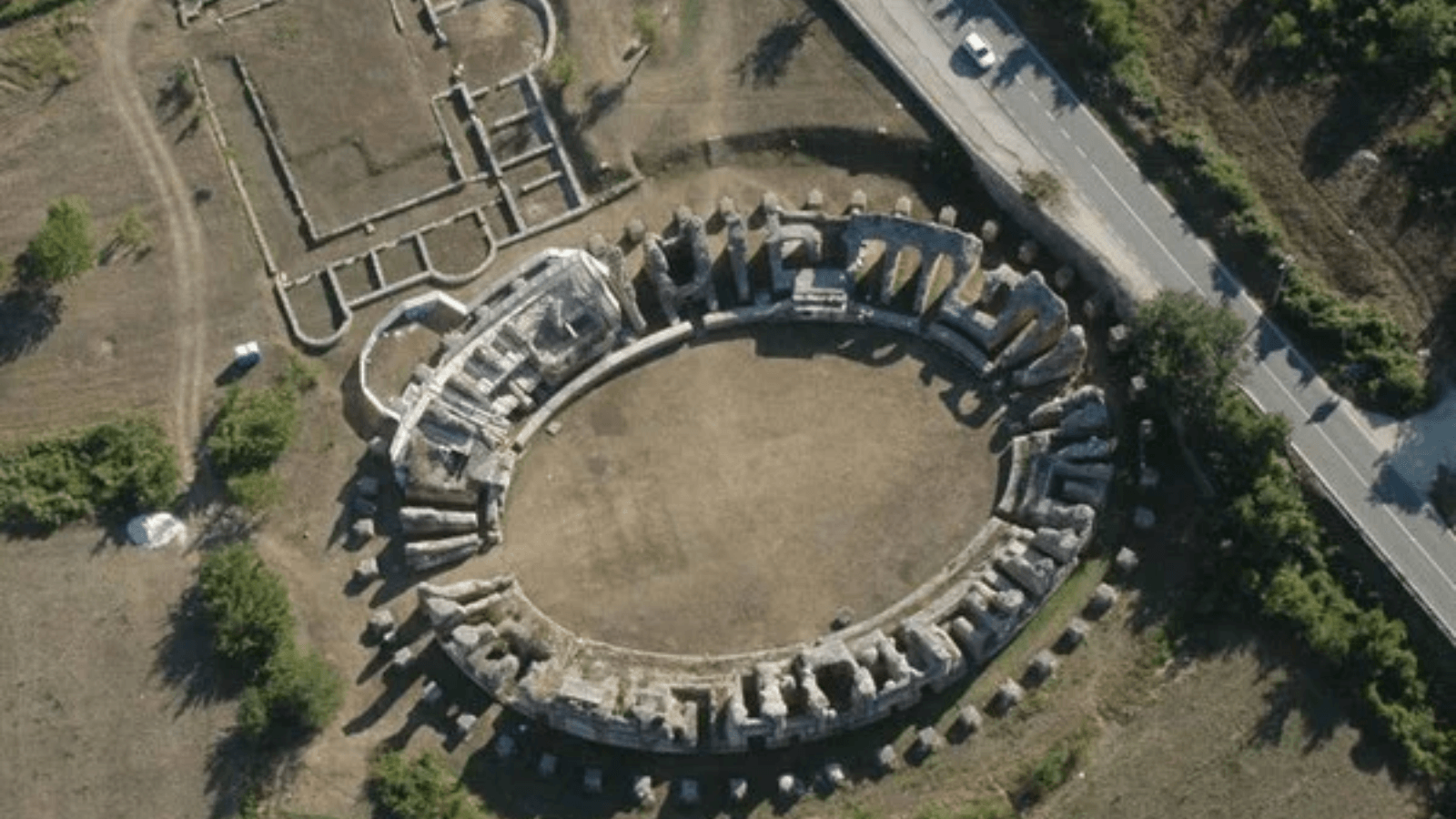
Ancient DNA recovered from 16 burials in central Italy reveals a striking genetic difference between the Roman Imperial period and the early Middle Ages. The research also identifies three children who were probably brothers, offering new evidence of migration, family relationships, and burial traditions in post-Roman Italy.
At the ancient city of Amiternum, near L’Aquila in Italy’s Abruzzo region, scientists have reconstructed part of the genetic history of a community that lived through centuries of political and cultural transformation. Their findings suggest that population movements from Central and Northern Europe contributed to the ancestry of medieval inhabitants while earlier Mediterranean genetic components remained present.
The study, conducted by researchers from the Universities of Pavia and L’Aquila and published in iScience, examined remains recovered from Santa Maria in Civitate, a cathedral complex built over earlier Roman structures. By combining ancient DNA with archaeological evidence, the team traced differences between people buried centuries apart at the same site.
A Roman Burial with a Different Genetic History
Amiternum was founded by the Sabines around the ninth or eighth century BCE and came under Roman control in 290 BCE. The settlement later developed into an important urban center, while its religious landscape gradually changed with the spread of Christianity.
Researchers collected petrous bones from 16 individuals, successfully obtaining ancient DNA from all of them. Fourteen yielded genomic data suitable for further analysis, including three close relatives; the principal population comparisons therefore used 12 unrelated individuals.
The earliest burial belonged to a man approximately 35–50 years old, radiocarbon dated to between AD 241 and 347. Unlike the medieval individuals buried within the cathedral complex, he was interred in a masonry structure outside the later church.
His genetic profile resembled those of other people living in Imperial Italy, showing substantial ancestry associated with the Near East. Such genetic patterns reflect the movement of people across the interconnected territories of the Roman Empire.
The burial itself was also unusual. Archaeologists found it beside a building tentatively interpreted as an early Christian oratory, raising the possibility that the man occupied a distinctive position within the emerging religious community. However, the researchers emphasize that neither his social standing nor his religious identity can be established conclusively.
Medieval DNA Points to Population Mixing
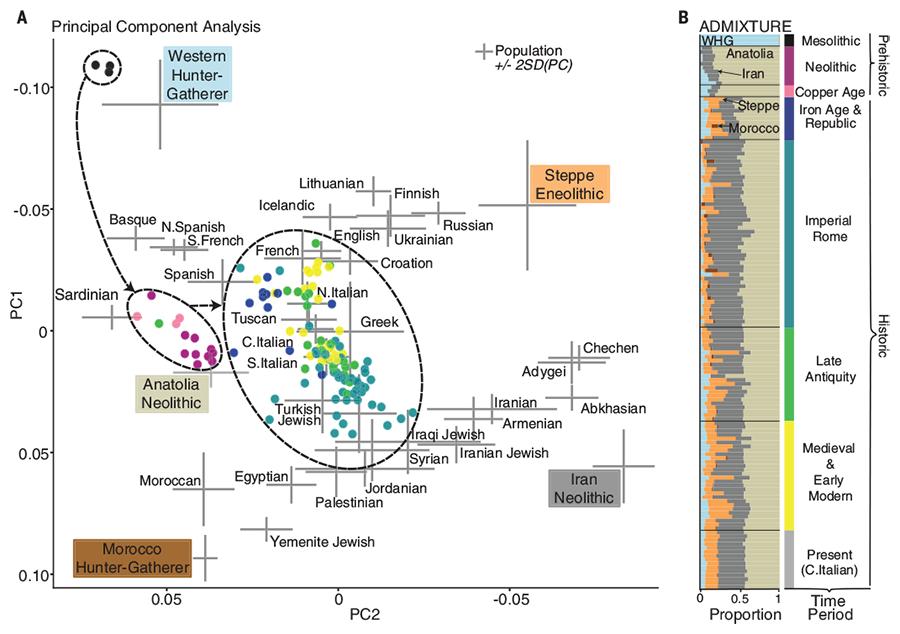
The remaining 15 individuals belonged mainly to the early medieval period, with one burial dating to the eleventh or twelfth century. Their genetic profiles differed from that of the Roman-period man and showed stronger affinities with populations from Central and Northern Europe.
The researchers examined these differences using several genetic models, which support a mixture of ancestry already present in Roman Italy and additional contributions associated with populations north of the Alps. The results are consistent with migrations following the decline of Western Roman authority, including movements associated with the Lombards.
The Lombards entered Italy in AD 568 and subsequently extended their control into Abruzzo. Nevertheless, the medieval inhabitants of Amiternum were not genetically identical to Lombard populations previously studied in northern Italy, indicating a more complicated history of population mixing.
Significantly, the medieval genomes also resembled those of present-day populations in Abruzzo and other parts of Central and Southern Italy. This suggests that important elements of the region’s modern genetic structure had already developed during the Middle Ages.
Three Brothers Buried Near One Another
The study also revealed a personal dimension of Amiternum’s medieval history. DNA analysis identified three young males with first-degree biological relationships, most likely brothers, whose remains were recovered from neighboring graves.
Two children were buried together, while the third rested in a nearby grave alongside an unrelated young individual. The discovery suggests that family relationships may have influenced how burial spaces were organized within the cathedral’s funerary chapel.
Thirteen of the individuals examined were recovered from a relatively small funerary area associated with the religious complex. Grave goods were almost entirely absent, apart from a simple two-handled ceramic vessel accompanying one double burial.
The researchers suggest that privileged burial locations, rather than valuable objects, may have expressed social standing and preserved family memory. Such practices could reflect changes in funerary traditions during the transition from Lombard to Carolingian rule.
Although the genetic contrast is striking, the study includes only one Roman Imperial individual. Consequently, the findings cannot establish the full genetic diversity of Roman Amiternum or demonstrate a complete population replacement.
Instead, the research offers a more nuanced picture of post-Roman Italy, where migration, local continuity, and changing burial customs shaped communities over several centuries. The evidence from Amiternum adds an important regional perspective to the genetic history of the Italian peninsula.
Cover Image: Aerial view of the Roman amphitheater at Amiternum in central Italy, where ancient DNA research has revealed genetic differences between Roman and medieval populations. Credit: University of Cologne, Institute of Archaeology.