
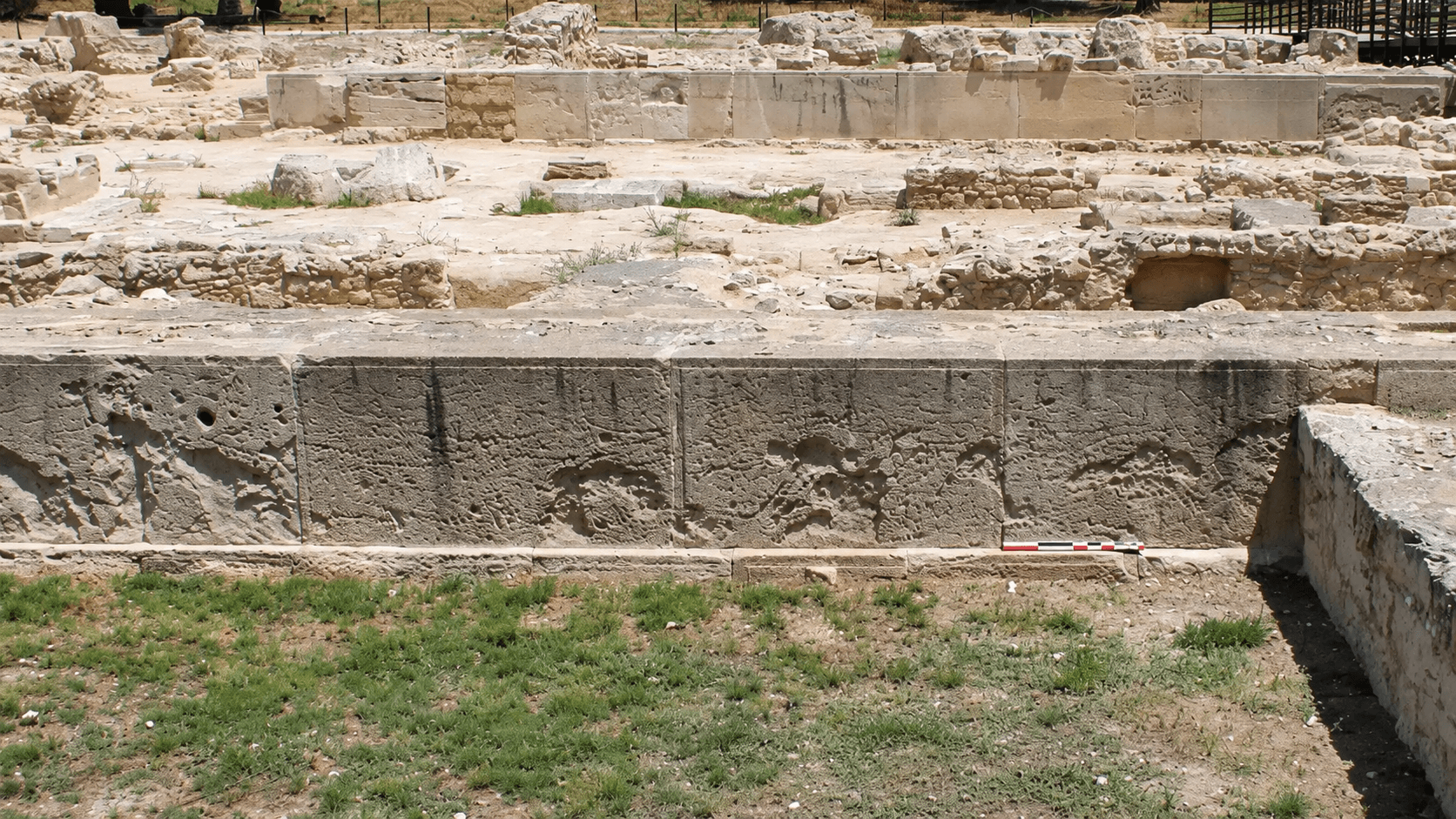
Dozens of ancient ship carvings appear to sail across the weathered sandstone blocks of a monumental temple in Cyprus. Some consist of little more than a hull, while others preserve masts, rigging, oars and distinctive projections at the bow.
These images at Kition Kathari in modern Larnaka were already known to archaeologists. A new study shows that they should not be understood as a single composition created during the Late Bronze Age. The temple wall accumulated maritime images over an extended period that may have lasted as long as 300 years.
The carvings at Kition Kathari in modern Larnaka were already known to archaeologists. A new study shows that they should not be understood as a single composition created during the Late Bronze Age. The temple wall accumulated maritime images over an extended period that may have lasted as long as 300 years.
High-resolution laser scanning and photogrammetry have revealed previously overlooked ships, subtle changes made to an older carving and rows of deliberately cut dots that may represent the surface of the sea. Together, these details suggest that later artists worked in the presence of images left by earlier generations and sometimes responded directly to them.
A temple wall filled with ships
Kition emerged as an urban center on the southern coast of Cyprus around 1300 BCE. Its position in Larnaka Bay connected the settlement with maritime networks extending toward the Levant, Egypt and the Aegean, while copper production and overseas exchange contributed to its growing importance.
Most of the ship carvings appear on large stone slabs forming the southern façade of Temple 1. Two further examples were incised on an altar in Temple 4. Their concentration within a monumental sacred complex has long raised questions about who made them and why ships were chosen.
The images may have been created by people familiar with Kition’s harbor and its vessels, but no inscriptions identify the carvers or explain their purpose. Their possible religious or commemorative significance consequently remains uncertain. What can be reconstructed with greater confidence is the changing history of the wall on which they worked.
Twenty-three potential ships emerge from the stone
Nineteen ships on Temple 1 had been published during the 1980s. When researchers returned to the façade with modern recording equipment in 2024, they detected 23 additional forms that might also represent vessels. A digital 3D model of the entire wall now allows its faint carvings to be examined within their original architectural arrangement.
The team placed nine of the newly identified images in its highest confidence category. Six were considered probable, while eight remain uncertain because fractures, erosion and other forms of surface damage can resemble human-made lines.
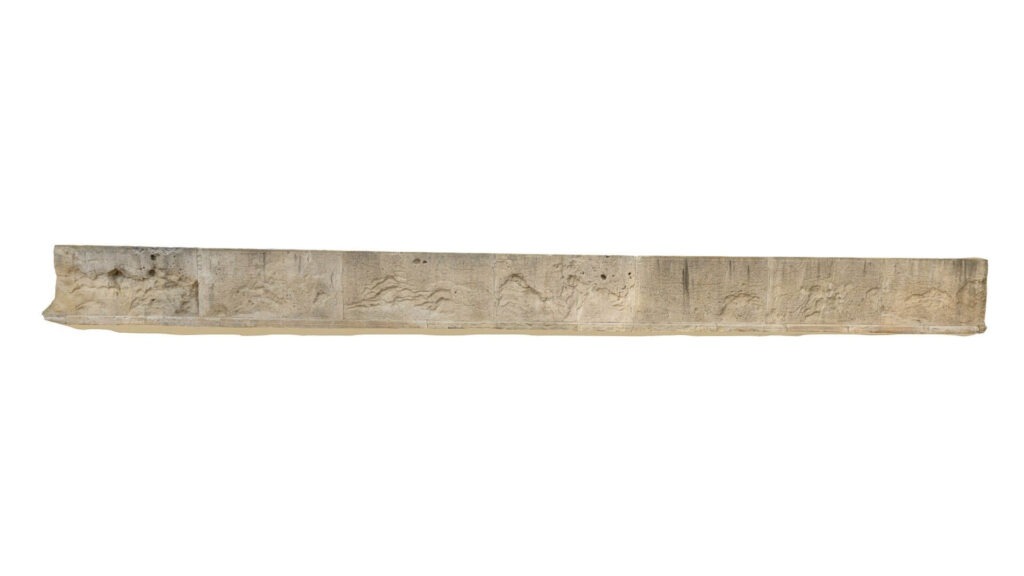
Digital enhancement can make faint marks visible, but it cannot automatically establish that every irregularity was intentionally carved as part of a ship. The researchers compared incision patterns, their relationship with surrounding features and the shapes of known ancient vessels before assigning confidence levels.
The resulting catalogue divides most of the ships into six broad morphological groups, although several unusual examples resist classification. Some resemble rounded cargo vessels, while others have the long, narrow profiles associated with oared galleys. A number appear to combine characteristics commonly divided between merchant ships and fighting vessels.
These carvings were not technical plans, and their makers could simplify, exaggerate or omit features according to the available space. Even so, details such as masts, yards, rigging, oars and bow structures preserve evidence of how ships were observed and represented at one of ancient Cyprus’s principal coastal centers.
One repaired block changed the chronology
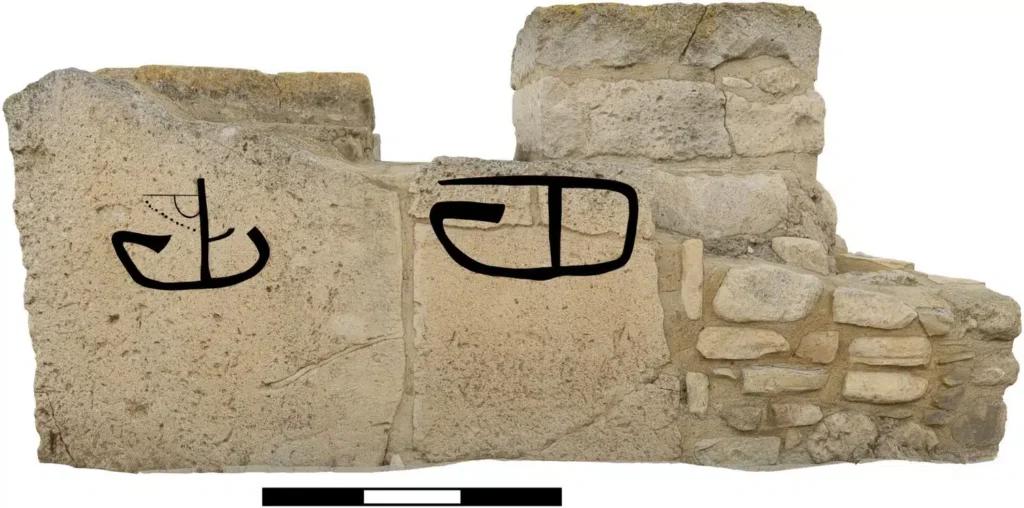
The clearest evidence that the maritime scene developed over time comes from a sandstone repair block beside the southeastern entrance to Temple 1. At least one and possibly two ships were carved on its surface.
The block was installed approximately 150 years after the original façade. Any ships incised upon it must therefore belong to a later phase of the building, demonstrating that the collection was not produced as a single Late Bronze Age composition.
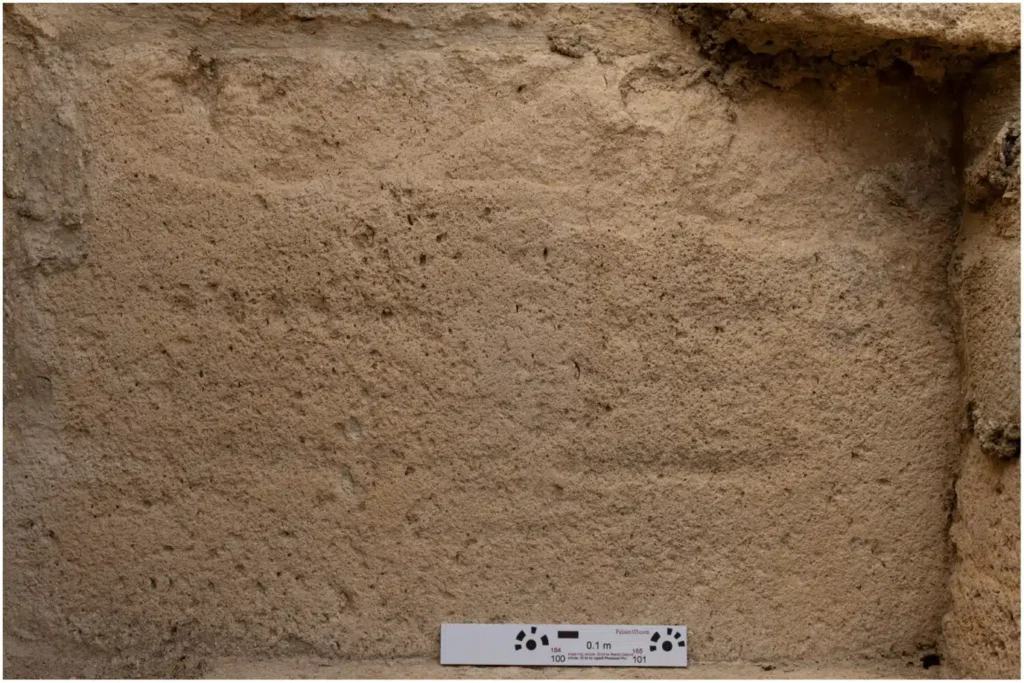
By combining this architectural sequence with comparisons drawn from other examples of ancient ship imagery, researchers concluded that carving probably continued from around 1200 BCE into at least the mid-11th century BCE. Other evidence could extend the practice further, producing a possible chronological span of up to three centuries.
The façade was therefore not simply a surviving picture of Bronze Age maritime activity. Ships continued to be added as Kition passed through the upheavals separating the Late Bronze and Early Iron Ages.
An older ship may have received a new bow
One vessel is particularly revealing because parts of it may have been reworked after the original carving was completed. Researchers detected what appear to be two phases, including a possible later alteration to the bow.
The modification could reflect the changing form of a projecting bow structure that eventually developed into the effective ram associated with ancient galleys. The interpretation remains a hypothesis, but it suggests that an existing ship was adapted rather than erased.
If correct, the alteration may preserve a rare moment when an inherited ship image was adjusted according to a newer visual convention. The older vessel remained recognizable, while its bow was brought closer to a form familiar during the Early Iron Age.
The collection also reflects connections in several directions. Some ships find their closest comparisons in Levantine imagery, while others recall Aegean traditions. Distinctive Cypriot features appear beside both, indicating a local maritime culture capable of adopting outside ideas while developing its own forms.
Did the carved dots represent sunlight on water?
Ships were not the only marks repeatedly added to the Temple 1 façade. The new analysis identified at least 11 rows of small, deeply incised dots distributed across the stones.
Many occur just below the keels of the vessels. Although their meaning cannot be established with certainty, their position suggests they were not scattered randomly.
Researchers propose that the dots may evoke waves, rippling water or sunlight reflected on the sea. Dotted backgrounds occur in other ancient maritime images, including a Late Bronze Age Cypriot cylinder seal, although none provides an exact explanation for the Kition examples.
The dots on the later repair block appear to repeat a pattern already present on the older façade. Either the new carver copied the earlier marks, or some dots were added retrospectively to connect different parts of the scene. Both possibilities indicate that at least some contributors paid attention to the wider arrangement rather than cutting isolated ships wherever space was available.
Maritime knowledge survived a changing world
The centuries around 1200 BCE brought the collapse or transformation of major political systems across the eastern Mediterranean. Palatial centers disappeared, settlements were abandoned or rebuilt, and established networks of trade and power were reorganized.
Kition’s ships provide a different kind of evidence for this turbulent period. Their continued production points to the endurance of maritime knowledge and visual traditions across the conventional boundary separating the Bronze and Iron Ages.
The findings do not prove that the population of Kition remained unchanged or that every ship carried the same meaning. They show that later inhabitants continued to engage with a monumental sacred space and its earlier imagery rather than treating the carvings as remnants of a forgotten past.
The sandstone blocks have suffered decades of exposure, making some lines increasingly difficult to distinguish. Digital recording is preserving details that may eventually disappear while helping researchers separate faint carvings from cracks and weathering.
A virtual reconstruction supported by the Honor Frost Foundation will return the carvings to their architectural setting. The latest study has already established that the ships did not belong to one moment: the scene developed as Kition itself moved from the Late Bronze Age into the Iron Age.
The peer-reviewed research was published online on August 18, 2026, in the International Journal of Nautical Archaeology. It was conducted by Graham C. Braun of the University of Cincinnati, Caroline Barnes of the University of British Columbia and Tzveta V. Manolova of Ludwig-Maximilians-Universität Munich.
Cover Image: The southern façade of Temple 1 at Kition Kathari, where ship carvings accumulated over several generations. Credit: Graham C. Braun et al. (2026) / International Journal of Nautical Archaeology.