
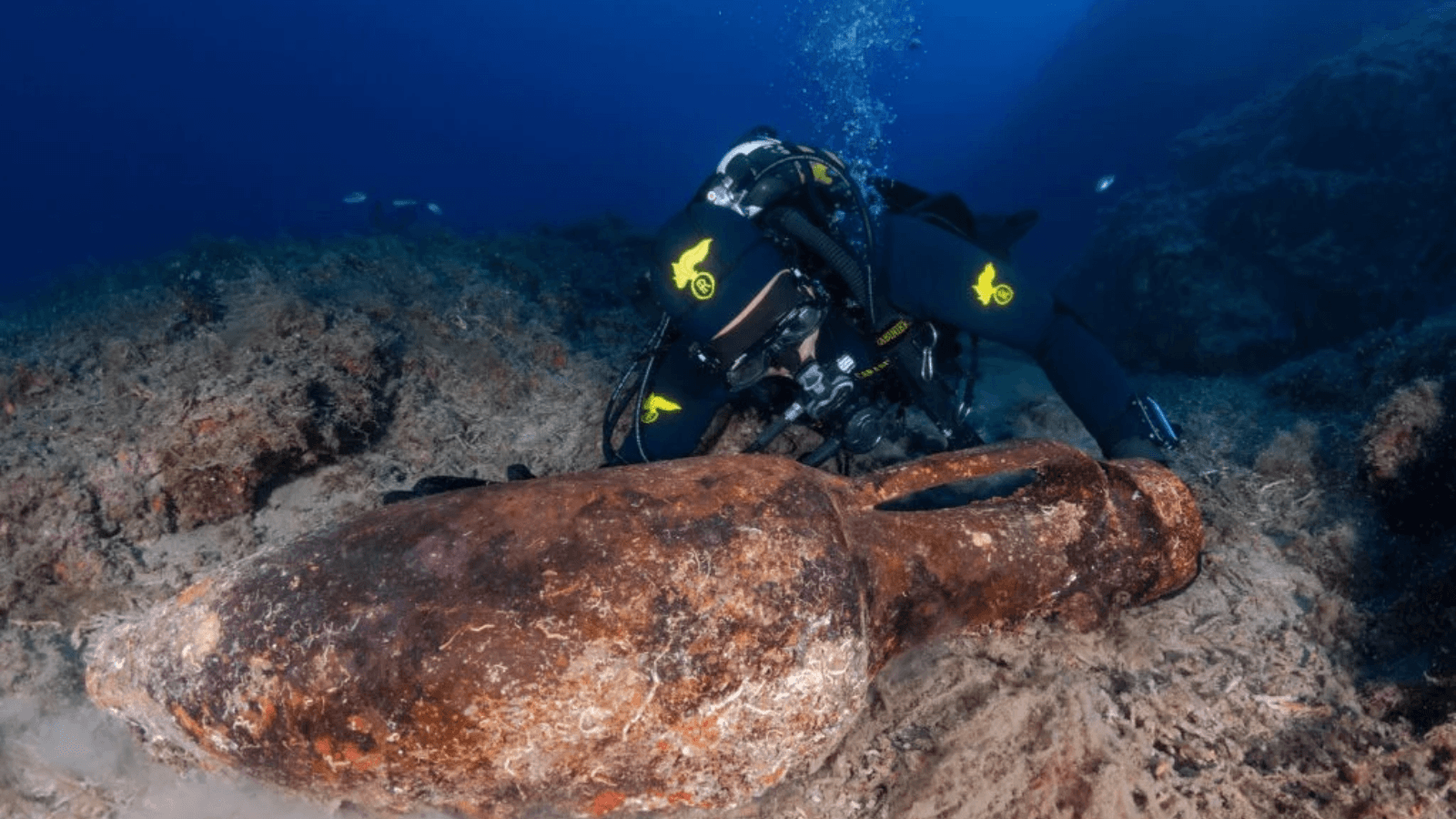
Nine Roman wine amphorae found off Italy’s Ligurian coast have led archaeologists back to an underwater site first documented in 1959. The discovery revives an investigation into a possible merchant vessel whose cargo had eluded divers for more than six decades.
In May 1960, divers returned to a rocky stretch of seabed off Italy’s Ligurian coast hoping to investigate a concentration of Roman amphorae recorded months earlier. The suspected deposit was nowhere to be found, while one vessel discovered nearby was attached to a thin rope, raising fears of looting. More than six decades later, an unexpected discovery during a Carabinieri training dive has brought archaeologists back to the same waters, reopening a mystery from the earliest days of Italian underwater archaeology.
Ancient Amphorae Hidden Among the Rocks
The rediscovery began when members of the Carabinieri Diving Unit from Genoa encountered an intact Roman amphora more than 40 meters beneath the surface near Punta Chiappa, off the coastal town of Camogli. The vessel, identified as belonging to the Dressel 1 type, lay among the rocks within the Portofino Marine Protected Area. Its discovery prompted a more extensive archaeological investigation of the surrounding seabed.
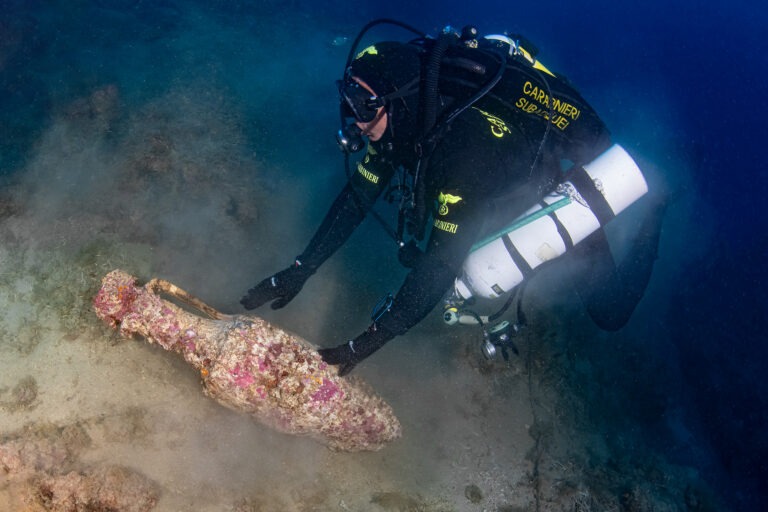
Working with Liguria’s Soprintendenza Archeologia, Belle Arti e Paesaggio and its Technical Service for Underwater Archaeology (S.T.A.S.), divers identified nine amphorae concentrated within a relatively small area. Most were lodged in crevices along a steep underwater cliff, their surfaces covered with marine concretions that had effectively fused them to the rocky seabed. These conditions helped conceal the pottery even though the surrounding waters are regularly explored by recreational divers.
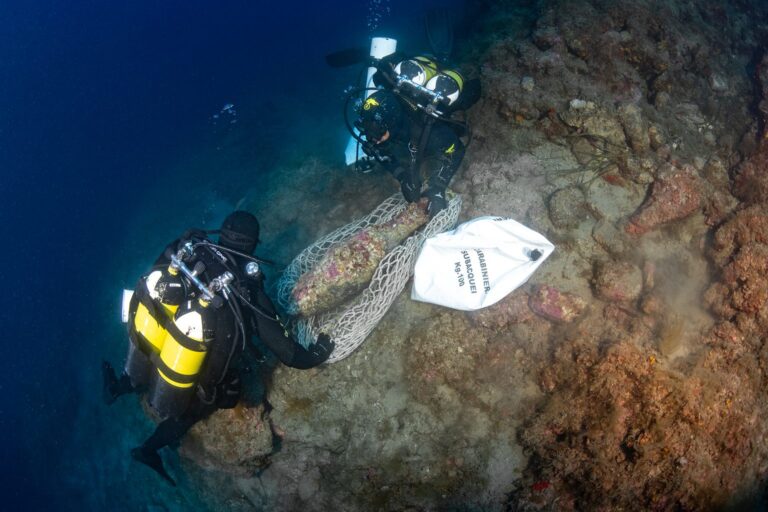
Two amphorae were recovered because their exposed positions made them particularly vulnerable to unauthorized removal. The concentration of vessels suggests the presence of an ancient shipwreck, although archaeologists have yet to establish whether any structural remains of the ship survive. The objects themselves have already provided an important connection to an archaeological investigation that began nearly seven decades earlier.
The Shipwreck That Vanished in the 1960s
The original discovery dates to November 1959, when Italian diving pioneer Duilio Marcante explored the waters around Punta Chiappa alongside Carabinieri divers. He encountered two amphorae firmly embedded among the rocks and noticed additional pottery nearby. At the base of the underwater cliff, he also suspected the presence of a larger accumulation of objects concealed beneath muddy sediment.
Marcante and his team recovered two intact amphorae and reported their findings to the regional antiquities authorities and the Experimental Center for Underwater Archaeology in Albenga. The discovery attracted the attention of archaeologists working to develop systematic methods for investigating submerged ancient sites. However, difficult diving conditions prevented a thorough examination of the suspected deposit.
When Marcante returned in May 1960 with Gianni Roghi and the Carabinieri, the investigation took a troubling turn. The larger concentration of pottery could no longer be located, although the divers encountered three fragmentary amphorae and another vessel attached to a thin rope. The latter raised suspicions that someone might have attempted to recover archaeological material without authorization.
The case was subsequently documented by Nino Lamboglia, one of the founders of modern Italian underwater archaeology, in the proceedings of an international conference held in Barcelona in 1961. He acknowledged that the site’s considerable depth and steep terrain had complicated further exploration, while also expressing concern about possible looting. Without a securely established location for the suspected cargo deposit, the investigation remained unresolved for decades.
A Cargo from the Late Roman Republic
The newly identified amphorae offer evidence of Mediterranean commerce during the final centuries of the Roman Republic. According to underwater archaeologist Simon Luca Trigona, head of S.T.A.S. Liguria, preliminary analysis indicates a relatively uniform cargo of Dressel 1A wine amphorae manufactured in the Tyrrhenian region. Their typology suggests a date between the late second century BC and the first decade of the first century BC.
These vessels belonged to a widespread transport system that carried Italian wine across the Mediterranean. Their presence off Liguria reflects the maritime connections developing as Rome consolidated its influence in the western Mediterranean, particularly following the conquest of southern Gaul. Genoa and other Ligurian ports occupied strategically important positions within these commercial networks.
The identification also connects Punta Chiappa with another unresolved underwater discovery near Pegli, west of Genoa, where a Roman wreck was reported during the early 1950s but has never been relocated. Both sites belong to a period when Italian merchants were expanding their commercial activities along the northern Mediterranean coast. Their archaeological remains may eventually provide a clearer picture of how these maritime routes operated.
An Archaeological Investigation Reopened
For the archaeologists involved, the rediscovery is significant not simply because ancient pottery has been found, but because its location can now be connected with a documented episode in the history of underwater exploration. Trigona considers the identification with Marcante’s original site secure, although more extensive investigations will be needed to determine the size of the vessel and establish whether additional cargo survives beneath the sediment.
The Soprintendenza plans to continue studying the area while introducing appropriate monitoring and protection measures. Despite their considerable depth, the amphorae remain exposed to potential disturbance in a popular diving area. Their preservation will depend on balancing archaeological research with the management of underwater access.
The renewed investigation also brings together two generations of Italian underwater archaeology, from Marcante and Lamboglia to the modern Carabinieri diving teams and heritage specialists working along the Ligurian coast. The 1959 discovery never disappeared from the historical record, but its precise location had remained elusive. Now that the amphorae have been identified again, archaeologists can return to the questions that the original expedition was unable to answer.
Cover Image: A Carabinieri diver examines a Roman wine amphora on the seabed near Punta Chiappa, Italy, where an archaeological site first recorded in 1959 has been rediscovered. Credit: Alessandro Grasso.