
An unusual 2,700-year-old burial in Armenia has revealed a woman laid to rest with a cylinder seal associated with the kingdom of Urartu. A new study suggests she may have grown up elsewhere, while the location of her grave raises questions about her place in the ancient community.
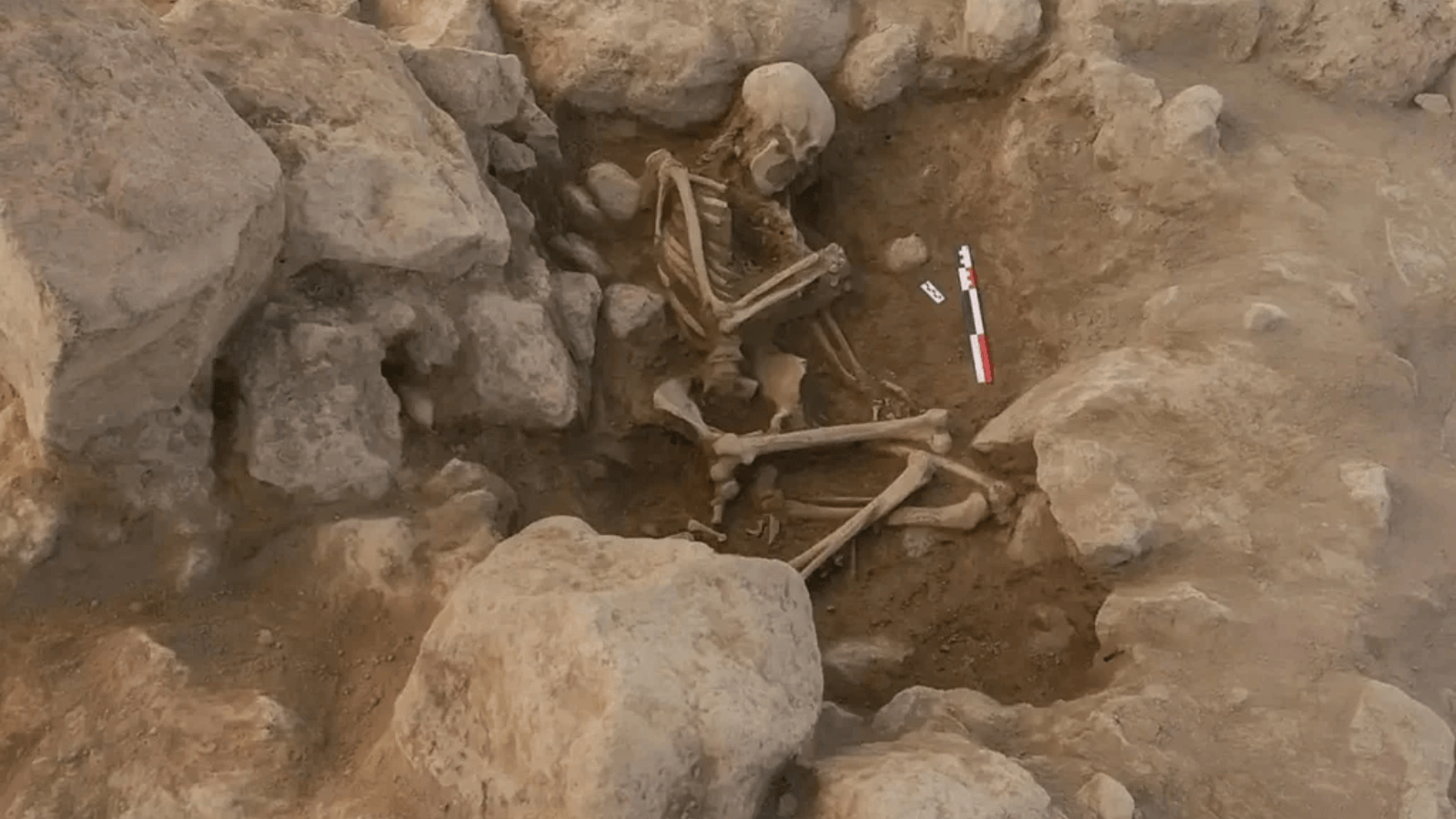
Around 2,700 years ago, a woman was buried in the courtyard of a house at Metsamor, in present-day Armenia. Her body was placed in a tightly contracted position, accompanied by a cylinder seal and small bronze objects. What makes the burial particularly unusual is that the house appears to have remained in use when she was laid to rest.
The grave, excavated in 2019, has now been examined in a study by archaeologists Krzysztof Jakubiak and Arkadiusz Sołtysiak. Their findings offer a closer look at the woman’s life, her possible origins, and the significance of an object that may have distinguished her from other members of the community.
An Unusual Grave Inside an Ancient Home
Metsamor lies in Armenia’s Ararat Valley, approximately 30 kilometers west of Yerevan. During the Bronze and Iron Ages, it developed into a fortified settlement with residential buildings, workshops, and an imposing citadel. The community experienced major political changes as the kingdom of Urartu expanded its influence across the Armenian Highlands.
The woman’s grave, designated Burial 11, was discovered in the courtyard of House II, a building associated with the late eighth and early seventh centuries BC. Other burials in this part of the settlement largely belong to later periods, when abandoned buildings were reused as burial places. In this case, however, the grave appears to have been inserted into the courtyard floor while domestic activity continued.
Archaeologists found the woman lying on her left side, with her arms and legs drawn tightly toward her body. Although ancient looters had disturbed the grave, enough evidence survived to establish its unusual character and identify several objects buried alongside her.
A Small Seal with an Uncertain Meaning
The most intriguing object recovered from the burial is a cylinder seal associated with Urartian traditions. These small engraved objects were widely used across the ancient Near East, where rolling them across clay produced impressions that could identify individuals, mark ownership, or authenticate administrative transactions.
Similar seals have been found at sites across the Armenian Highlands and neighboring regions. The Metsamor example belongs to this wider cultural tradition, although its precise function remains uncertain.
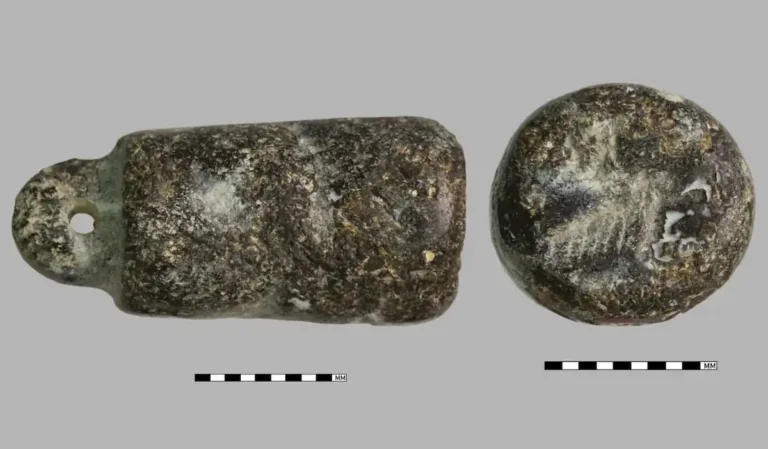
Its presence in a woman’s grave is especially interesting because the social and institutional roles of women in Urartian society are still poorly understood. Religious imagery indicates that women participated in ceremonial activities, but archaeological evidence rarely allows researchers to determine their exact responsibilities.
Jakubiak and Sołtysiak caution against identifying the Metsamor woman as a priestess, administrator, or member of an elite institution solely because she possessed a seal. It may have been a personal belonging, an object carrying symbolic meaning, or something connected with her activities during life. The surviving evidence cannot establish which interpretation is correct.
Her Teeth Reveal Clues About Her Childhood
Analysis of the skeletal remains suggests that the woman was probably over 40 when she died. Her bones showed degenerative changes in the knee joints, while her teeth displayed considerable decay. Researchers also identified defects in tooth enamel that indicate episodes of physiological stress during childhood, potentially associated with illness or nutritional difficulties.
Another examination produced a more unexpected finding. Strontium isotope analysis of her tooth enamel suggests that she may not have grown up in the immediate surroundings of Metsamor.
The chemical composition of tooth enamel can preserve information about the geological environment in which a person spent their early years. In this case, the woman’s strontium measurements fell slightly outside the currently established local range.
The difference is small, and the researchers emphasize that the regional reference data remain limited. Nevertheless, the result raises the possibility that she arrived at Metsamor from another community, perhaps through marriage, family movement, or other social connections. Her birthplace and the circumstances of any relocation remain unknown.
A Rare Glimpse into Life Under Urartian Influence
The kingdom of Urartu was a major power in the Armenian Highlands during the first millennium BC, controlling fortresses, settlements, and important routes through the region. Its surviving inscriptions and monumental architecture reveal much about kings and military campaigns, but considerably less about the everyday lives of women.
To place the Metsamor discovery in context, Jakubiak and Sołtysiak examined comparable female burials from the South Caucasus, northern Iran, and the Van region of eastern Türkiye. Some share characteristics with the Metsamor grave, including contracted body positions and the presence of seals or small metal objects.
These comparisons indicate that the burial was unusual but not entirely without parallels. They do not, however, establish a single funerary tradition or demonstrate that the women involved held similar positions in society.
The Metsamor woman stands out because several unusual details converge in one grave: her burial within a domestic courtyard, the Urartian-style seal, and the possibility that she spent her childhood somewhere else. Although her identity remains unknown, the findings offer a more personal perspective on a period usually understood through fortresses, royal inscriptions, and political history.
Cover Image: The remains of a woman buried in a contracted position at Metsamor, Armenia, approximately 2,700 years ago. Credit: © Krzysztof Jakubiak and Arkadiusz Sołtysiak, 2026.