
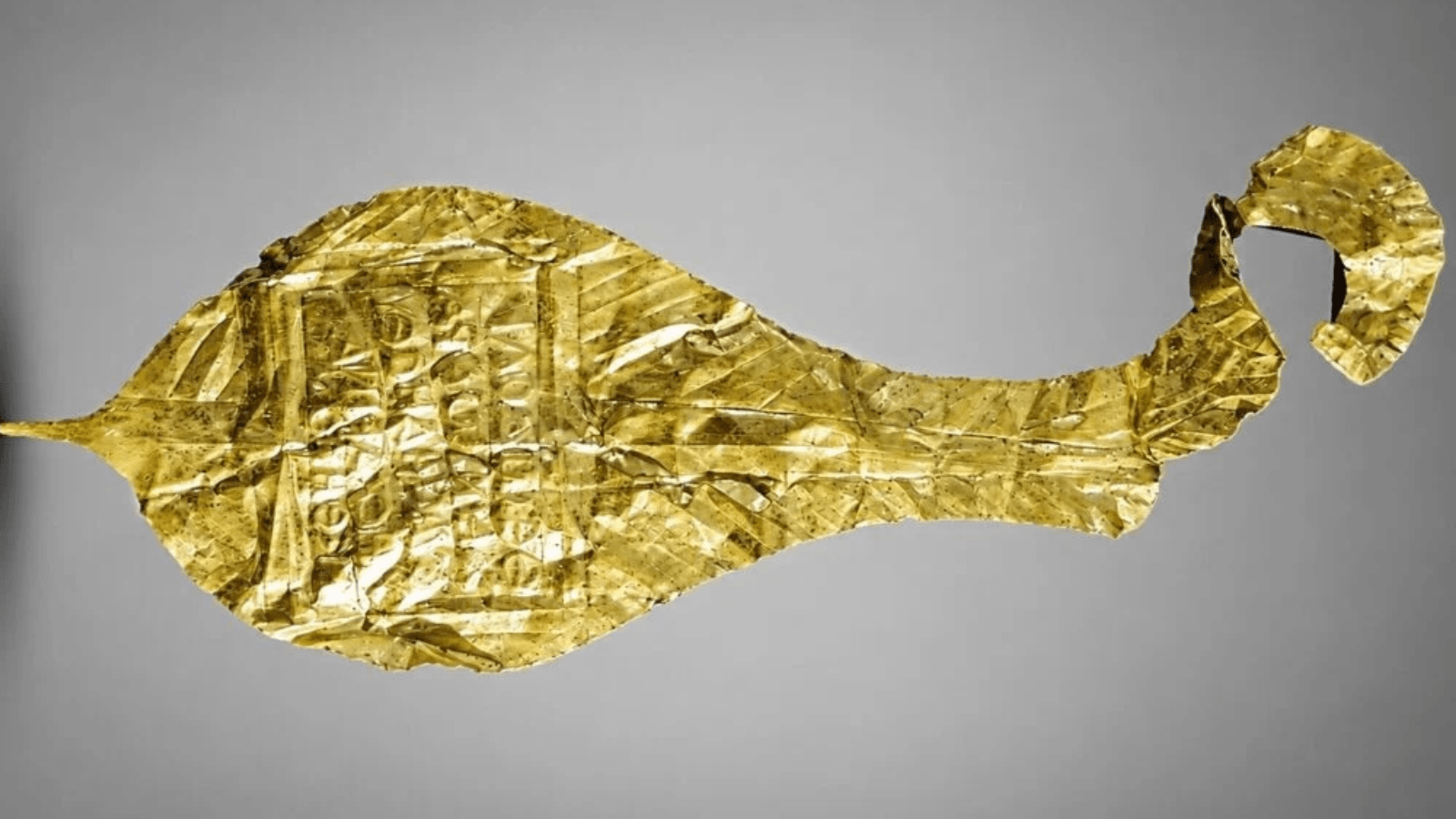
A gold offering discovered at a Roman fortress in Georgia has revealed the name of a mysterious donor who may have been a wealthy merchant supplying the empire’s army nearly 2,000 years ago. The inscription also provides the first direct written evidence for the worship of Jupiter Dolichenus at the fortress, offering a glimpse into the connections between soldiers, traders and religious traditions around the ancient Black Sea.
The small gold plaque was recovered in 2024 at Apsaros, a Roman fort near modern-day Batumi on Georgia’s Black Sea coast. Its Greek inscription, examined by a Polish-Georgian research team, records a dedication to the “Dolichenian God” and identifies the donor as Thrasymedes. The findings were published in 2026 in Zeitschrift für Papyrologie und Epigraphik.
The name has attracted particular interest because inscriptions from ancient Chersonesus in Crimea mention a wealthy merchant named Thrasymedes. Researchers believe the two individuals may have been the same person, potentially connecting the Georgian fortress with commercial networks operating across the Black Sea.
A Merchant Connected to Rome’s Legions?
The Thrasymedes known from Chersonesus enjoyed significant commercial privileges. Inscriptions record that the city’s authorities exempted him from customs duties and certain taxes on maritime trade, suggesting that he occupied an influential position in the local economy.
Radosław Karasiewicz-Szczypiorski of the University of Warsaw has proposed that the merchant may have supplied Roman military units, particularly those associated with Legio V Macedonica, the Fifth Macedonian Legion.
The connection is supported by the legion’s presence at both locations. Its soldiers served at Chersonesus, while stamped roof tiles discovered at Apsaros confirm that detachments were stationed at the Georgian fortress during the 130s AD.
If the two inscriptions refer to the same individual, Thrasymedes may have followed military movements or maintained commercial relationships with Roman garrisons across the region.
However, the gold inscription does not identify his occupation, and the proposed connection remains a hypothesis rather than an established fact.
Evidence of an Early Military Cult
Beyond the possible merchant connection, the plaque provides important evidence for the worship of Jupiter Dolichenus, a deity whose cult originated in Doliche, in what is now southeastern Türkiye.
The god became particularly popular among Roman soldiers and was commonly depicted standing on a bull, carrying a thunderbolt and a double-headed axe.
At Apsaros, archaeologists also discovered a bronze figurine depicting an eagle perched on a bull, imagery closely associated with Jupiter Dolichenus. Together with the inscribed gold offering, the object suggests that a sanctuary dedicated to the deity may once have existed within the fortress.
Although no such sanctuary has been conclusively identified, the inscription provides the first direct written confirmation of the cult at Apsaros.
The discovery is particularly significant because the evidence dates to the early second century AD, before the worship of Jupiter Dolichenus reached its greatest popularity across the Roman Empire in the later second and early third centuries.
Apsaros and the Spread of Religious Traditions
The fortress occupied an important position along the eastern Black Sea, relatively close to the regions where the cult originated. Its location raises the possibility that Roman military communities in this area played an early role in spreading the worship of Jupiter Dolichenus throughout the empire.
Karasiewicz-Szczypiorski suggests that the movement of soldiers may have helped transmit these religious traditions westward, connecting distant garrisons through shared beliefs and practices.
The gold plaque therefore offers more than a record of an individual religious dedication. Its inscription establishes the presence of an early military cult at Apsaros, while the name Thrasymedes points to a possible connection with the commercial networks that supported Roman forces along the Black Sea frontier.
Cover Image: The inscribed gold votive plaque discovered at the Roman fort of Apsaros in Georgia. The Greek inscription records a dedication to Jupiter Dolichenus by a man named Thrasymedes. Credit: Polish-Georgian Archaeological Expedition, PCMA University of Warsaw.