
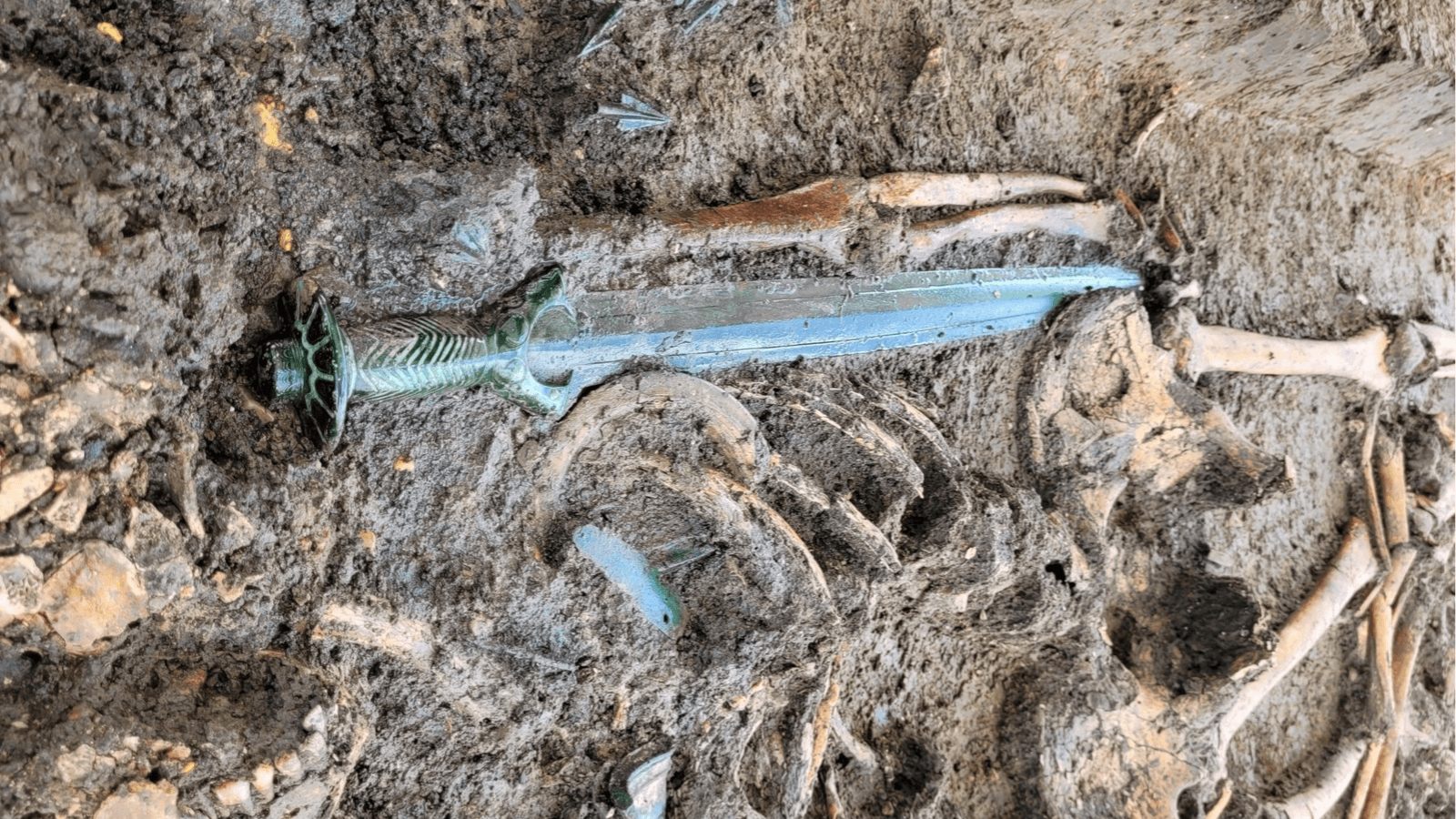
A 3,400-year-old bronze sword discovered in southern Germany still shines in places, with an almost sharp blade and intricate decorations preserved on its handle. Archaeologists found the weapon in a grave containing three people in 2023. Now, scientists examining its construction have identified an unexpected detail: the decorative patterns on its hilt were made with carefully arranged copper wires rather than the softer metal researchers had anticipated.
The findings, announced by Helmholtz-Zentrum Berlin in February 2026, offer new evidence of the skills employed by Bronze Age metalworkers. Using advanced X-ray techniques, researchers have examined how the blade and handle were joined and how an ancient craftsman created the weapon’s elaborate decoration.
A Remarkably Preserved Sword from a Bronze Age Grave
Archaeologists discovered the sword during excavations in Nördlingen, Bavaria, in 2023. It lay in a grave containing a man, a woman, and a young person, buried within a relatively short period and accompanied by valuable bronze objects. Whether the three individuals were related remains unknown.
The Bavarian State Office for the Preservation of Historical Monuments initially dated the weapon to the end of the 14th century BCE, placing it in the Middle Bronze Age. Swords from this period rarely survive in such excellent condition, particularly in graves that archaeologists can investigate using modern excavation methods.
The weapon belongs to a group known as octagonal-hilt swords, named for their distinctive eight-sided bronze handles. Producing these swords required considerable skill because metalworkers cast the hilt around an extension of the blade, securing the two components together.
The Nördlingen example also features intricate geometric decorations on its pommel and the plate beneath it. These surviving details have now become central to understanding how its maker worked more than three millennia ago.
Advanced X-Rays Expose Ancient Metalworking Techniques
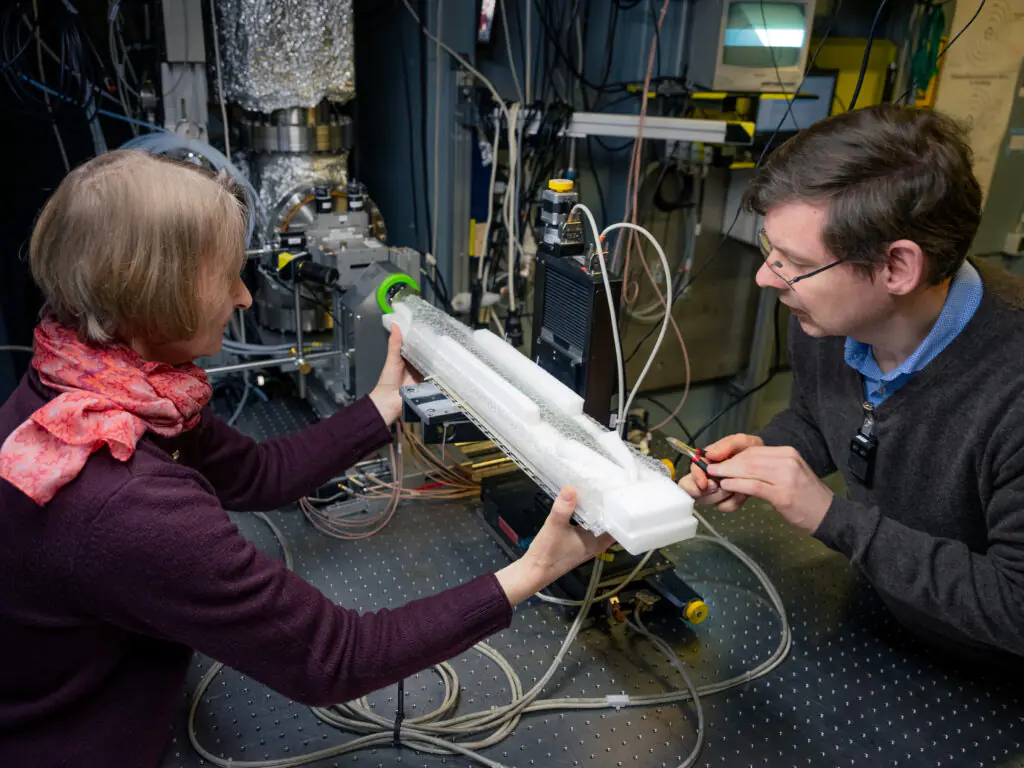
To examine the sword without damaging it, archaeologist Johann-Friedrich Tolksdorf and conservator Beate Herbold of the Bavarian heritage authority brought it to Helmholtz-Zentrum Berlin.
There, researchers used three-dimensional computed tomography to investigate its internal structure. The scans confirmed that the blade extended into the hollow bronze hilt, where it was secured with rivets. Earlier examinations had identified two functional rivets and another pair represented only in the decoration.
The team also used X-ray fluorescence spectroscopy at the BESSY II synchrotron facility, working with specialists from Germany’s Federal Institute for Materials Research and Testing (BAM). This technique allowed scientists to identify the chemical elements present in the decorative inlays.
The results revealed something that surprised even the specialists studying the weapon.
Copper Wires Hidden in the Sword’s Decorations
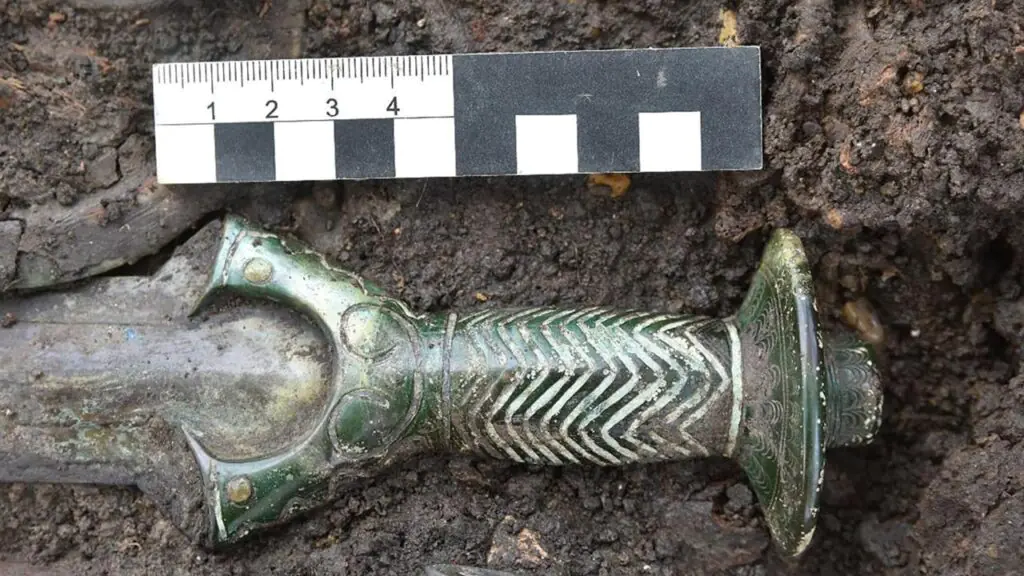
Deep grooves on the pommel and pommel plate form carefully arranged geometric patterns. Researchers had noticed that these grooves contained a material different from the surrounding bronze, but its composition remained uncertain.
Herbold initially suspected tin, a relatively soft metal that would have been easier to shape and press into the narrow channels. Instead, the analysis showed that the ancient craftsman had used thin pieces of copper wire joined together to create the designs.
The discovery indicates that the swordmaker chose a more demanding technique than researchers had expected. Similar copper inlays are known from other Bronze Age objects, while a 3,000-year-old bronze hoard discovered in Scotland also provides evidence of sophisticated metalworking. The identification of copper inlays on the Nördlingen sword adds to our understanding of Bronze Age craftsmanship.
The decorative patterns may also have looked different when the weapon was new. Researchers suggest that the reddish copper could have been chemically darkened to create a stronger contrast with the golden-colored bronze. Substances such as urine may have served this purpose, although no direct evidence establishes that the sword underwent such treatment.
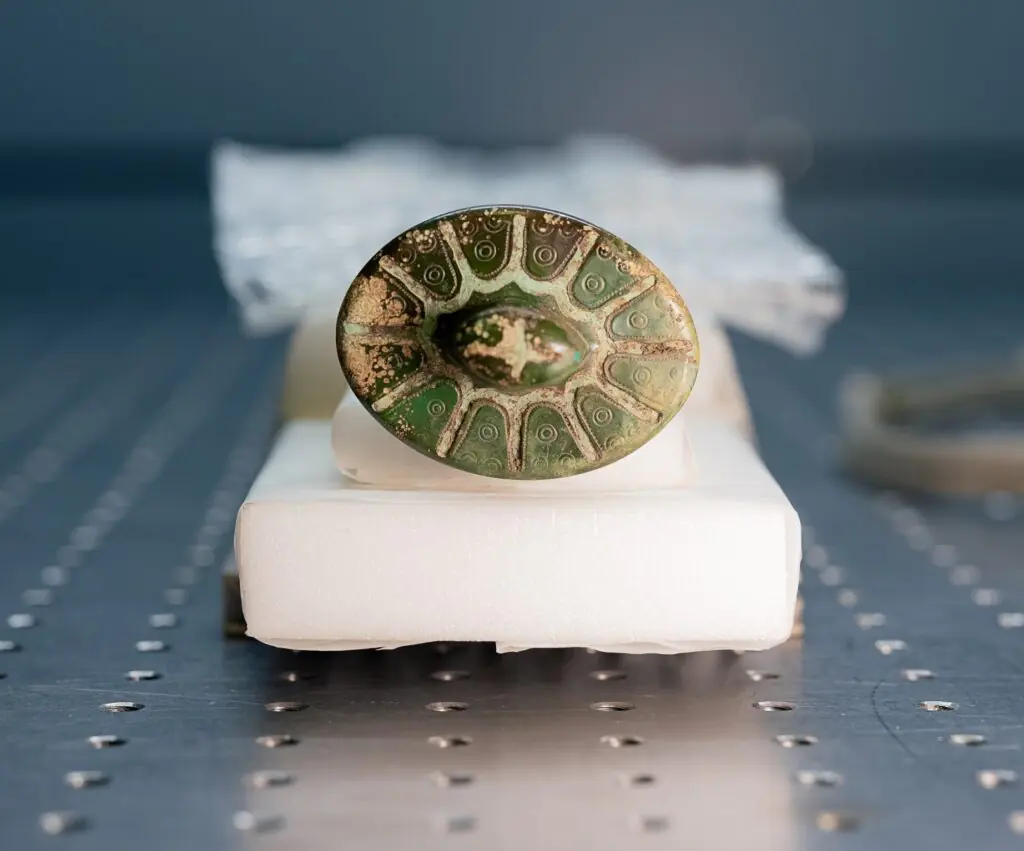
If the copper was originally blackened, the hilt would have displayed dark geometric patterns against a brighter bronze surface. For its maker, the appearance of the weapon may have mattered almost as much as its construction.
A Functional Weapon with an Unknown Maker
Despite its elaborate decoration, archaeologists consider the Nördlingen sword a functional weapon rather than a purely ceremonial object. Its center of gravity lies toward the front of the blade, making it suitable for cutting blows. The absence of visible impact marks does not establish whether anyone ever carried it into battle.
Octagonal-hilt swords occur in two main regions of Bronze Age Europe: southern Germany and an area encompassing northern Germany and Denmark. Comparisons of casting techniques and decoration suggest that some northern examples copied southern designs, while others may have traveled through exchange networks or with skilled metalworkers.
The Nördlingen sword probably originated in southern Germany, but researchers have not identified its workshop. Scientists are examining internal stresses in the bronze to investigate how the metal responded to casting, heating, cooling, and hammering. A detailed analysis of the measurements and a scientific publication were still pending when the team announced its initial findings in February 2026.
The sword’s extraordinary condition first drew attention to the discovery. Its latest examination has shifted that attention to the person who made it. The copper wires, carefully constructed hilt, and decorative details preserve evidence of deliberate choices made by a skilled metalworker more than 3,400 years ago.
Cover Image: The remarkably preserved 3,400-year-old bronze sword at its original burial site in Nördlingen, Bavaria, Germany. Credit: Archäologie-Büro Dr. Woidich / Sergiu Tifui.