
In AD 43, Roman soldiers preparing to invade Britain refused to cross the English Channel. According to the historian Cassius Dio, the troops even mocked an imperial official sent to address them before eventually agreeing to join the campaign. Yet the political events that brought Rome to Britain’s shores had begun years earlier.
Among those involved was a British ruler who had lost power and sought refuge with Emperor Claudius. Dio called the exile Bericus, a figure historians have long associated with the Iron Age ruler Verica. Now, a new interpretation of ancient coins is challenging a familiar account of this ruler’s identity.
Rome’s British Connections Began Long Before the Conquest
The political relationship between Rome and southern Britain can be traced back to Julius Caesar. In 55 BC, while preparing his first expedition across the Channel, Caesar sent Commius, a leader of the Atrebates in Gaul, to negotiate with British communities.
In his Commentaries on the Gallic War, Caesar described Commius as a ruler he had appointed and trusted. The alliance eventually collapsed, and Commius is thought to have settled in southern Britain, where his people maintained connections with continental Europe.
Archaeologists have identified one possible centre of Atrebates power at Calleva, near modern Silchester in Hampshire. Excavations reveal that the settlement had already developed considerably before the Roman conquest.
According to Historic England, its earliest inhabitants occupied timber roundhouses during the first century BC. Later, more formally arranged streets and rectangular buildings appeared. Imported amphorae and fine pottery show that the settlement participated in trading networks extending across the Channel.
The rulers of Calleva also produced their own coinage. Silver and gold issues associated with Commius’s successors provide some of the clearest surviving evidence for the political succession, while coins bearing the name of Eppillus include CALLE or CALLEV, probably identifying the place where they were minted.
Among the rulers associated with this political world was Verica, whose name appears on numerous coins dated to the early first century AD.
The Coins That Complicate Verica’s Identity
A silver coin recovered during excavations by the University of Reading at Silchester measures just eight millimetres across. Known as a minim, it carries the letters CF, which the university’s archaeological project identifies as an abbreviation of Commii Filius, meaning “son of Commius.”
That interpretation reflects the traditional understanding of Verica as a male ruler descended from the Atrebates leader. Yet the letters themselves have become central to a different explanation proposed by archaeologist Miles Russell of Bournemouth University.
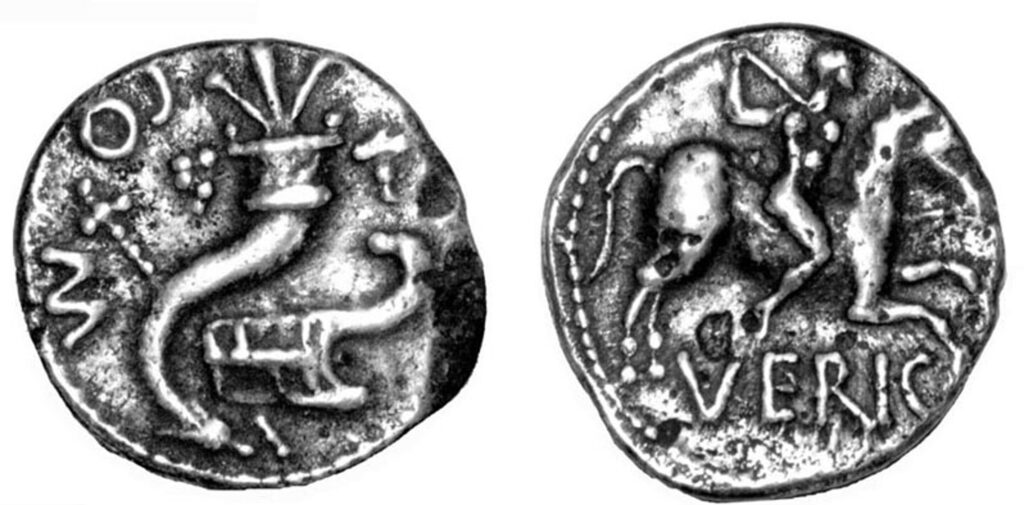
Russell argues that the abbreviated inscription could also represent Commii Filia, meaning “daughter of Commius.” If correct, a small detail on the coinage would challenge a long-established assumption about one of southern Britain’s most influential rulers.
The range of surviving coins makes the problem more complicated than a single inscription. Oxford University’s Celtic Coin Index records a silver unit found at Silchester that carries COM[I]F and depicts a boar beneath a star. Another coin in the Ashmolean Museum’s collection, also eight millimetres across, bears Verica’s name alongside a frontal mythical face, possibly based on Medusa.
These examples differ from the horse-and-spear designs that feature prominently in Russell’s interpretation. They demonstrate the variety of imagery associated with Verica’s coinage and the difficulty of assuming that every figure represents the issuing ruler.
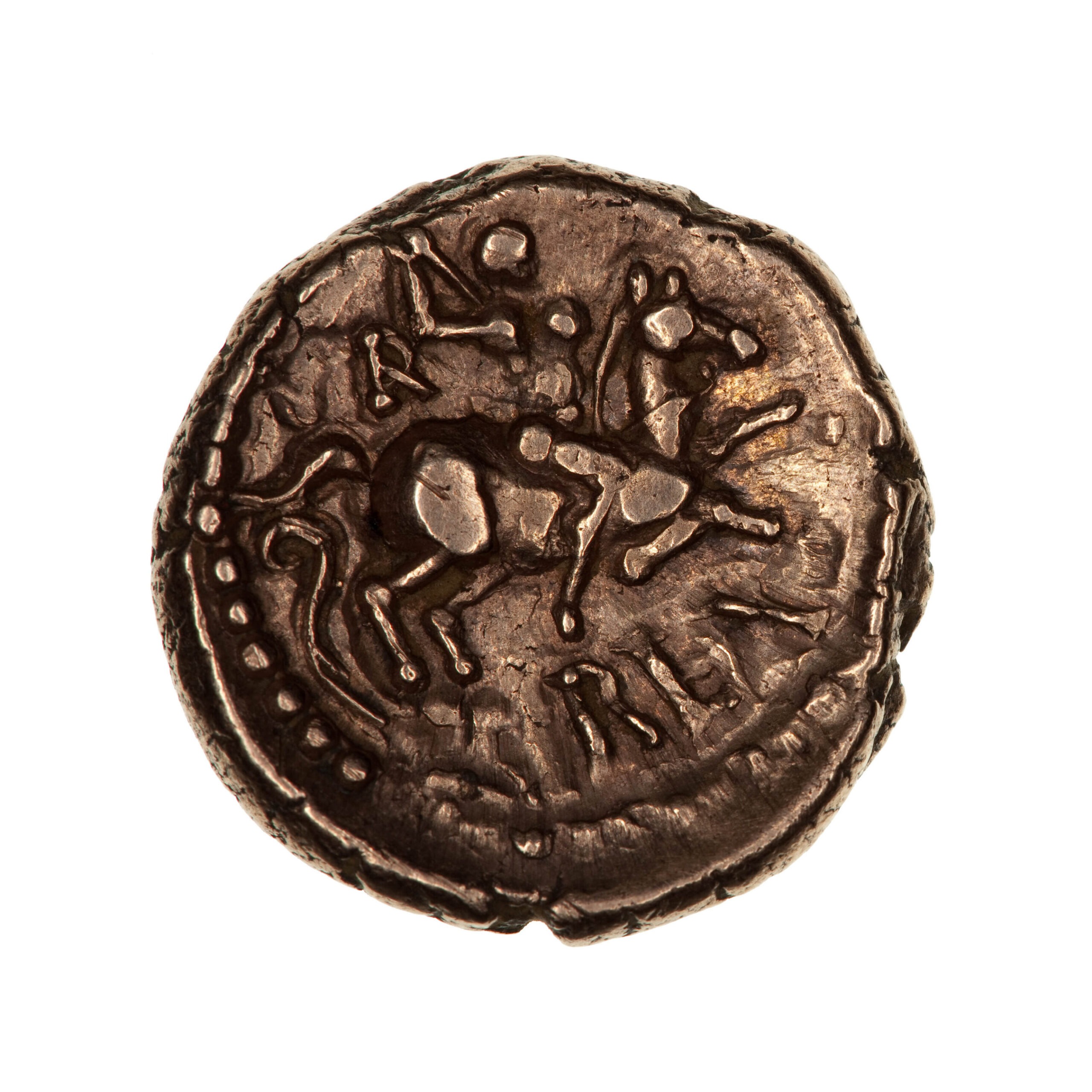
In a statement released by Bournemouth University on 5 November 2026, Russell argued that some mounted warriors on Verica’s coins have distinctly feminine features. He also pointed to the ruler’s name ending in -a and questioned whether the title REX, conventionally translated as “king,” necessarily established the sex of its holder.
Taken together, Russell believes these details indicate that Verica was a woman. His argument, however, remains contested, particularly because the imagery and terminology can admit interpretations other than those he proposes.
An Earlier Royal Exile Recorded in Türkiye
Verica’s reported appeal to Rome also belongs to a much longer history of British rulers seeking imperial protection.
An inscription preserved at the Temple of Augustus and Rome in Ankara, Türkiye, records two British rulers who sought refuge with Emperor Augustus decades before Claudius invaded the island.
The inscription contains a copy of the Res Gestae Divi Augusti, the emperor’s account of his achievements. In section 32, Augustus names Dumnobellaunus among foreign kings who came to him as supplicants. The name of a second British ruler survives only partially and is commonly reconstructed as Tincomarus.
The passage does not explain what drove these rulers to seek imperial assistance. Nevertheless, it establishes that British political disputes had already brought local leaders into direct contact with Rome well before AD 43.
This earlier evidence provides an important context for Verica’s exile. Appealing to an emperor was not an entirely new political strategy, and Rome had already become a potential source of protection for rulers facing difficulties at home.
The Exile Who Helped Open the Way for Rome
By the late AD 30s, Verica’s position had come under pressure from the expanding Catuvellauni, another powerful political group in southern Britain. Caratacus, a son of their ruler Cunobelinus, became associated with the struggle for territory and later emerged as a leading opponent of the Roman invasion.
Around AD 40, Verica lost power and sought refuge with Emperor Claudius. Cassius Dio, writing in the early third century, claimed that an exile named Bericus persuaded the emperor to send an army to Britain.
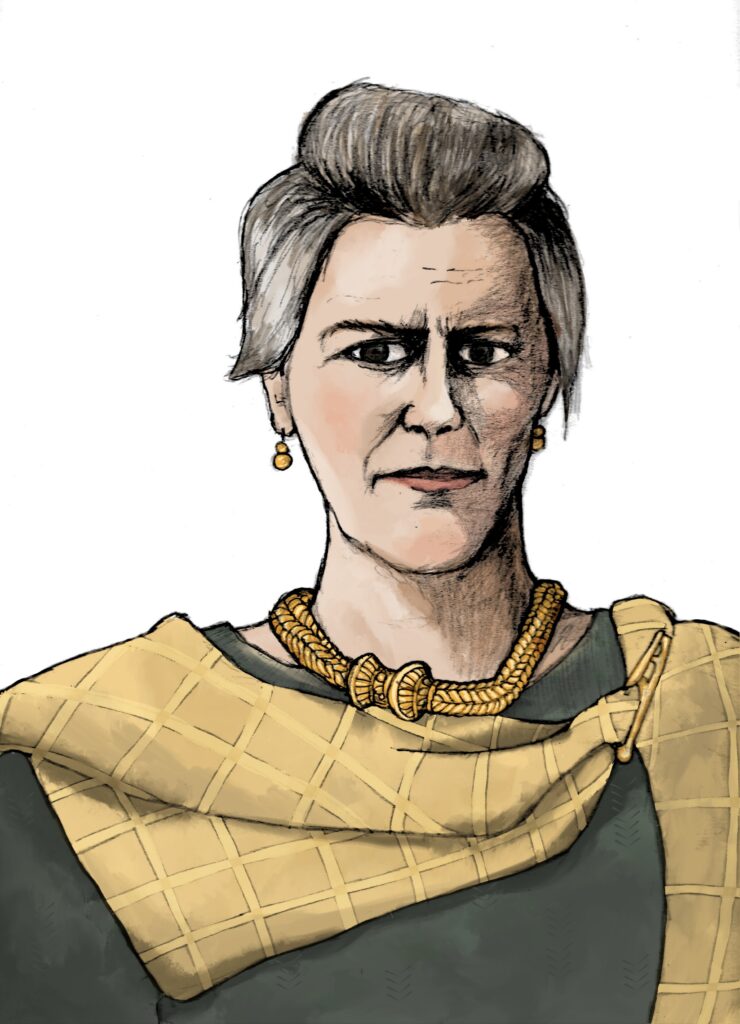
Although historians generally identify Bericus with Verica, the surviving text does not use the name found on the coins. This difference matters because Dio wrote long after the events he described, drawing on earlier accounts that have not survived in full.
For Claudius, the political crisis offered an opportunity to intervene in Britain while pursuing the military prestige that a major conquest could provide. Verica’s exile was therefore part of a broader struggle between rival British rulers and an expanding empire, rather than the sole explanation for the invasion.
Russell’s proposal raises the possibility that the individual involved in these events was a woman. However, the surviving coins and historical records do not yet provide conclusive evidence to establish Verica’s sex.
The difficulty lies in interpreting the coins themselves. Abbreviated inscriptions allow different readings, while the mounted figures cannot be securely identified as portraits of Verica. The title REX also provides no independent confirmation of the ruler’s sex, leaving the proposed female identity open to debate.
The University of Cambridge’s Celtic Personal Names of Roman Britain database continues to classify Verica as male. Its catalogue contains numerous variations of the name and associated inscriptions, including forms longer than the abbreviated CF, all of which must be considered when assessing the new proposal.
Russell presents his interpretation in the November 2026 issue of Current Archaeology. He also addresses the period in his forthcoming book, Caratacus: Great King of Britain, scheduled for publication by Bloomsbury in January 2027.
The argument rests on a reassessment of existing archaeological and historical evidence, rather than a newly discovered burial or genetic identification.
The Roman soldiers who hesitated to leave Gaul eventually crossed the Channel, beginning a conquest that transformed Britain. Their campaign is well documented, but the British exile who helped provide its justification remains more difficult to identify. Verica’s coins preserve a name, titles and images; whether they also reveal a forgotten female ruler is still an open question.
Cover Image: Gold coin of Verica depicting a naked, spear-bearing rider alongside the inscriptions VIR (Verica) and REX. Archaeologist Miles Russell interprets the rider as female. Credit: Museums Victoria Collections / CC BY 4.0.