
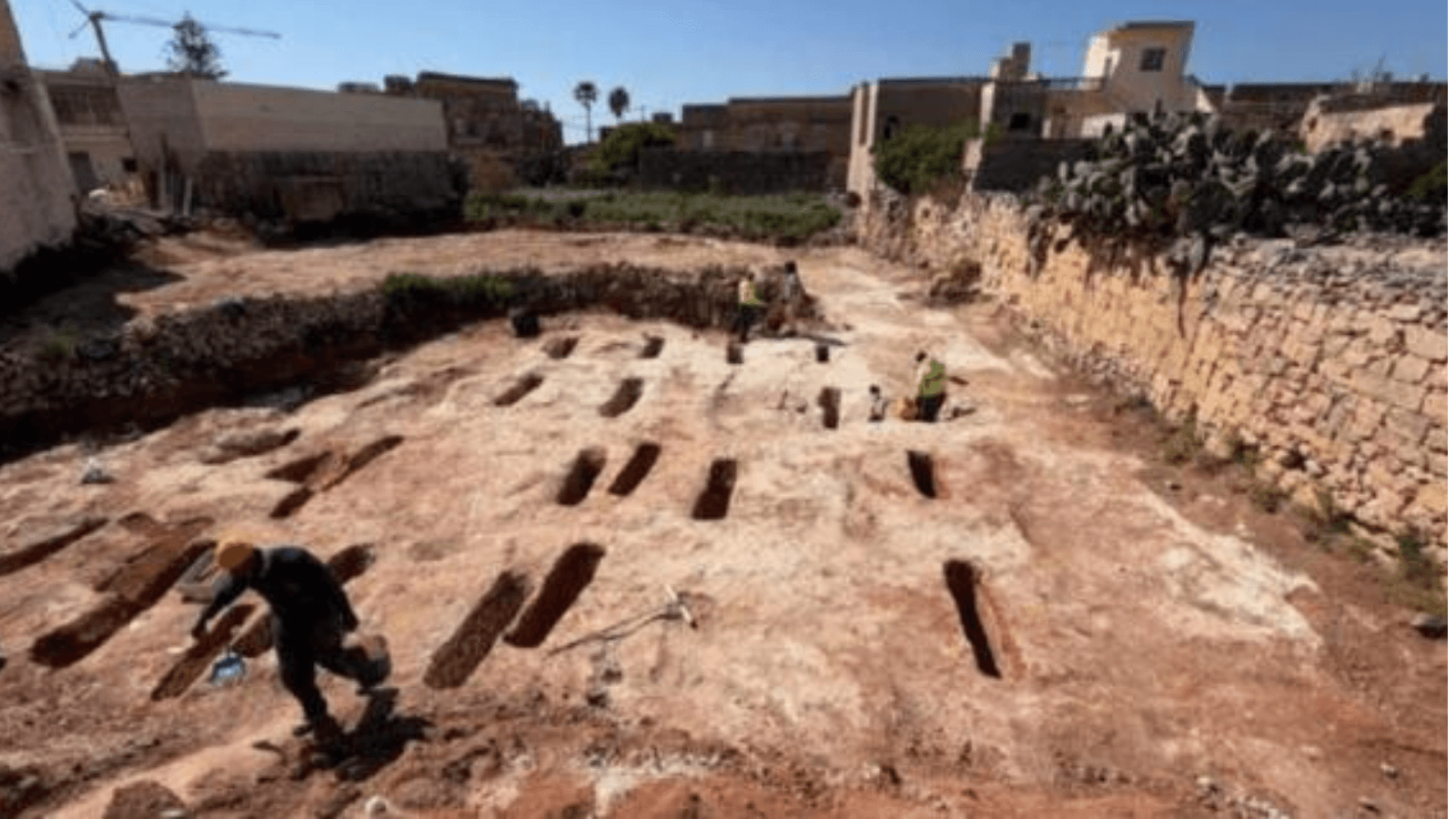
A prehistoric cemetery in Xagħra, on the Maltese island of Gozo, has yielded at least eight tombs containing human remains and pottery dating back around 6,000 years.
The cemetery belongs to the Żebbuġ Phase, approximately 4100–3800 BC. That places it at the beginning of Malta’s Temple Period, before the construction of the monumental stone buildings for which the islands later became famous.
The discovery was made at Triq il-Ġdida fi Pjazza Sant’ Anton. Malta’s Planning Authority has now issued an Emergency Conservation Order preventing development or other work from damaging the site while archaeologists assess its extent and importance.
Eight prehistoric tombs found in Xagħra
Investigations uncovered human remains, pottery fragments and intact ceramic vessels. Authorities say the evidence points to a cemetery containing at least eight tombs, making it an unusually substantial discovery from this early stage of Maltese prehistory.
The condition of the deposits may prove as important as the number of graves. Many prehistoric burial sites in Malta were opened or disturbed before modern excavation methods were introduced. At Xagħra, some vessels and their archaeological contexts appear to have survived intact. Similar traditions of creating enduring places for the dead appeared elsewhere in Neolithic Europe, including a 5,500-year-old monumental tomb recently identified beneath a Polish forest.
Further work could establish how the tombs were arranged, whether they were reused and how many people were buried there. Authorities have not yet announced whether the human remains have been directly radiocarbon dated, so the present chronology appears to rely mainly on the associated pottery.
The Żebbuġ Phase represents the earliest part of Malta’s Temple Period. Its communities buried their dead in rock-cut tombs and produced distinctive ceramics, but the islands’ great megalithic temples had not yet been built.
The new cemetery therefore offers evidence from the generations that lived in Gozo before monumental temple construction began.
Part of Xagħra’s prehistoric landscape
Xagħra is already known for two of Malta’s most important prehistoric sites. The nearby Ġgantija complex, built during the fourth millennium BC, contains some of the world’s oldest surviving free-standing stone monuments. The Xagħra Circle, also known as the Brochtorff Circle, served as a major prehistoric burial complex.
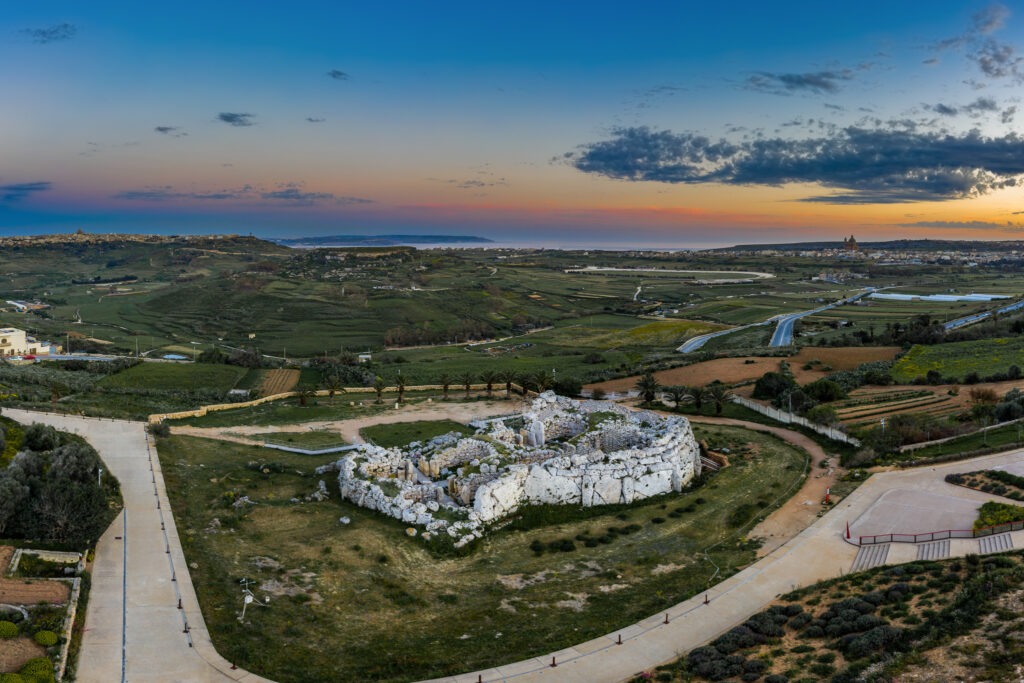
Excavations at the Xagħra Circle between 1987 and 1994 recovered around 220,000 human bones, together with animal remains, figurines and other objects. The scale of those finds showed that burial activity formed a major part of life in prehistoric Gozo.
The newly discovered cemetery lies within the same archaeologically sensitive landscape, but authorities have not yet established whether it was connected to the Xagħra Circle or developed independently. Its earlier dating makes that relationship especially worth investigating.
Site placed under emergency protection
The Planning Authority issued the Emergency Conservation Order at the request of Malta’s Superintendence of Cultural Heritage. The measure treats the location as “heritage at risk” and gives it temporary protection equivalent to a Class A scheduled site.
No excavation, construction or intervention can take place without authorization from the Planning Authority in consultation with the Superintendence.
The order will remain in force for 12 months after its publication in the Government Gazette. During that period, specialists will study the remains and decide what long-term protection is required.
Several basic details remain unknown, including the number of individuals represented, the construction of the tombs and whether all eight belong to the same phase. Even so, the discovery already adds a rare early chapter to Xagħra’s archaeological record: a cemetery used before Gozo’s first great stone temples were built.
Cover Image: Archaeological investigations at Xagħra uncovered at least eight prehistoric tombs containing human remains and pottery dating to approximately 4100–3800 BC. Credit: Planning Authority of Malta