
A small metal object found beside two Bronze Age axes in Norfolk may look like a button, but archaeologists cannot yet say whether it ever fastened clothing. Its discovery raises a broader question: why were two usable axes deposited alongside such an unusual object around 3,000 years ago?
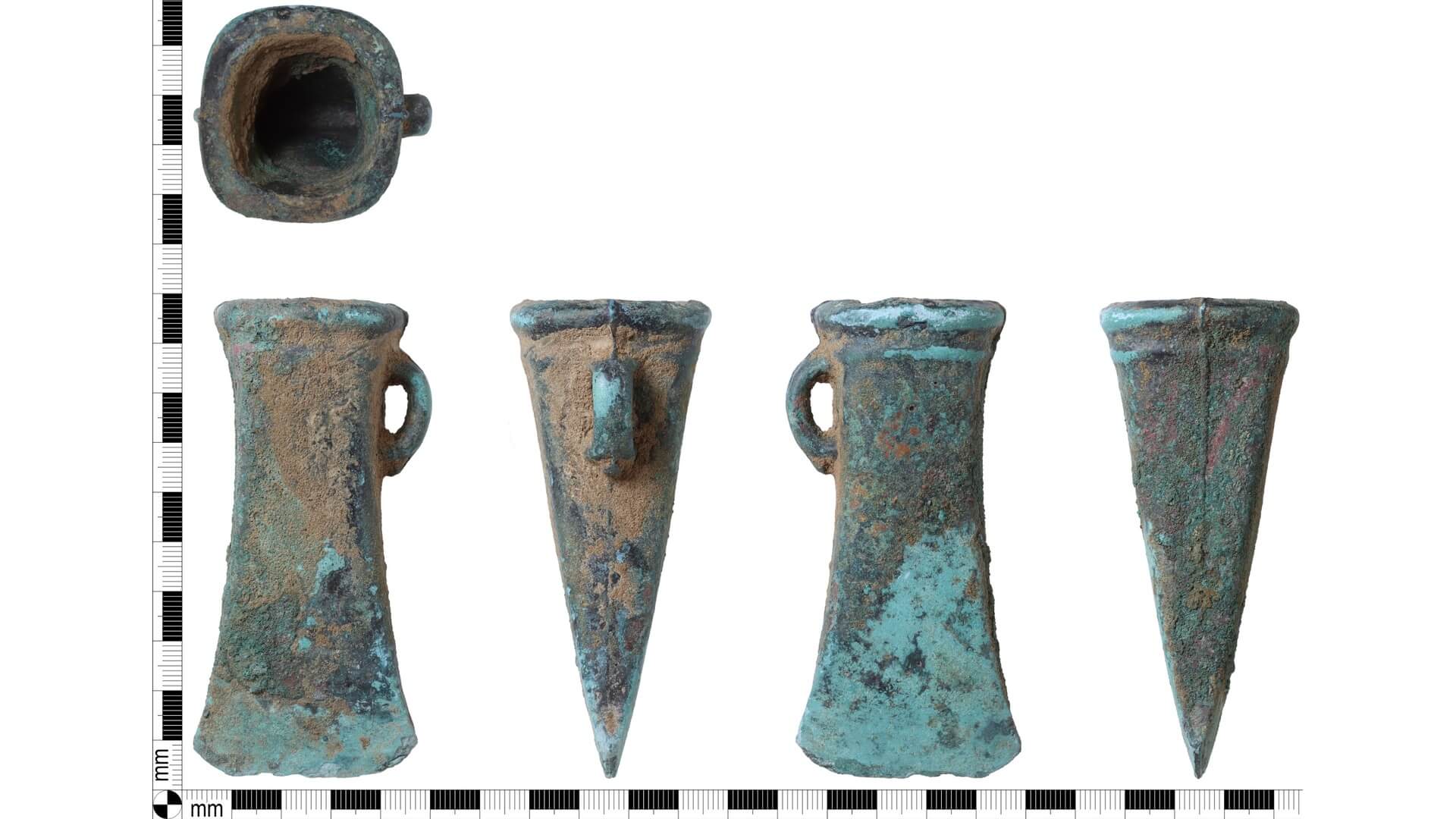
Metal detectorists discovered the objects near Barton Turf, on the northern edge of the Norfolk Broads. The first socketed axe was found in March 2021. A second axe and the circular copper-alloy object emerged from the same site in 2023.
Experts believe the three objects formed a single deposit dating to between 1000 and 700 BC, during the final centuries of the Bronze Age and the transition toward the Iron Age. The find has been declared treasure, and Norwich Castle Museum hopes to acquire it.
The axes belong to a familiar category of Late Bronze Age metalwork. The third object is far more difficult to interpret.
A “button” unlike any other in the PAS database
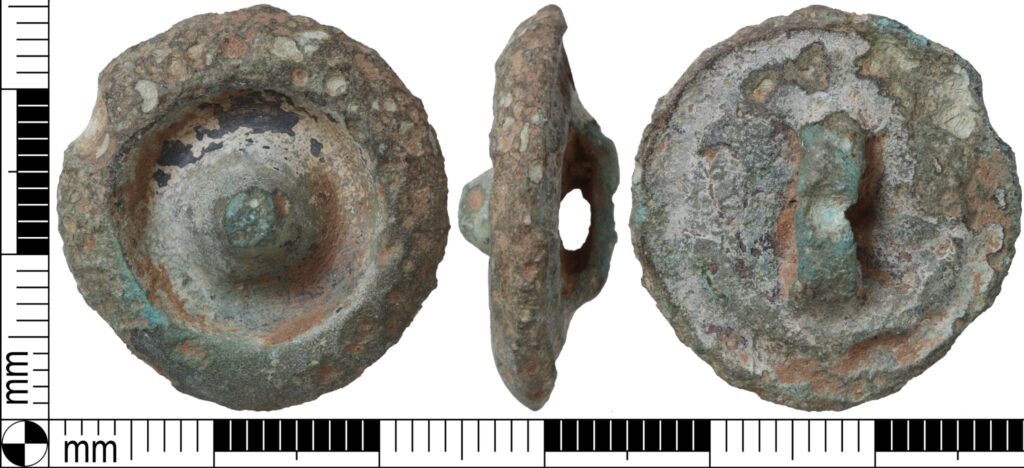
Measuring approximately 2.4 centimetres across, the circular fitting has a deep concave field bordered by a thick outer rim. A conical boss rises from its centre. Its tip is now missing, probably because of corrosion rather than breakage.
On the back is a short rectangular loop that allowed the object to be attached to something. What it was attached to remains unknown.
Only 19 Bronze Age objects classified as buttons have been recorded by the Portable Antiquities Scheme, and the Barton Turf example is just the third reported in Norfolk. According to specialists, it is the only one among those 19 examples with a central conical boss.
Calling it a button, however, risks creating a misleadingly modern image. No comparable object found in Britain has survived in a context that clearly shows how it was used. It may have secured or decorated clothing, but it could also have formed part of a horse harness or another item made from leather, textile or wood.
A few similar fittings have been recovered from graves in northwestern Europe, although their original positions have not resolved the question. Even in a burial, an object found near the body was not necessarily attached to clothing. It could have belonged to a belt, a container, riding equipment or another object that later decayed.
The rear loop provides evidence for attachment, but not for function. Archaeologists can see how the fitting was secured, yet they still cannot identify what carried it.
Why bury axes that could still be used?
The association with two complete socketed axes makes the discovery more significant. Both axes remained usable when they entered the ground, suggesting they were not simply discarded as worn-out tools.
Bronze was a valuable and recyclable material. Broken tools, weapons and casting waste could be melted down and made into new objects, leading some researchers to interpret metalwork hoards as reserves hidden by metalworkers or traders.
That explanation is possible at Barton Turf, but it is not the only one. If the objects were stored for later recovery, their owner never returned. They may instead have been deposited as an offering or as part of a practice whose meaning is no longer recoverable from the archaeological evidence.
Dr Ed Caswell, Oxfordshire’s finds liaison officer and a specialist in Bronze Age small finds, said the presence of the rare fitting with perfectly usable axeheads points to deliberate deposition. Archaeologists continue to debate whether such hoards were intended for recycling, buried for safekeeping or placed in the ground for ritual reasons.
The evidence does not currently allow one explanation to be preferred with confidence. Nor does the absence of an excavated context make the objects accidental: their shared date and recovery from the same site strongly suggest that they belonged together.
Part of a wider surge in Bronze Age hoarding
Norfolk lies within one of Britain’s richest regions for Late Bronze Age metalwork. Research published in the Proceedings of the Prehistoric Society examined 385 hoards containing 7,210 objects reported between 1997 and 2021. It found that the deposition of metalwork increased sharply toward the end of the Bronze Age, with hoards becoming both more numerous and, in many cases, larger.
Axes were among the most frequently selected objects. They appeared so often that axe hoards accounted for 34 percent of the Late Bronze Age deposits included in the study.
The Barton Turf group is unusually small, but its contents make it difficult to classify. The two axes could represent stored metal, tools, valuable possessions or offerings. The circular fitting introduces an object that may have belonged to clothing, personal display or horse equipment.
Its discovery also shows how much remains unknown about even seemingly familiar objects. Modern observers call it a button because of its shape and rear loop, but without a surviving garment or an undisturbed burial context, that name remains an archaeological convenience rather than a confirmed identification.
For now, the Barton Turf hoard offers no definitive answer about why the objects were buried. What it does preserve is a rare association: two functional axes placed in the ground with an enigmatic fitting unlike any other Bronze Age “button” recorded by the Portable Antiquities Scheme.