
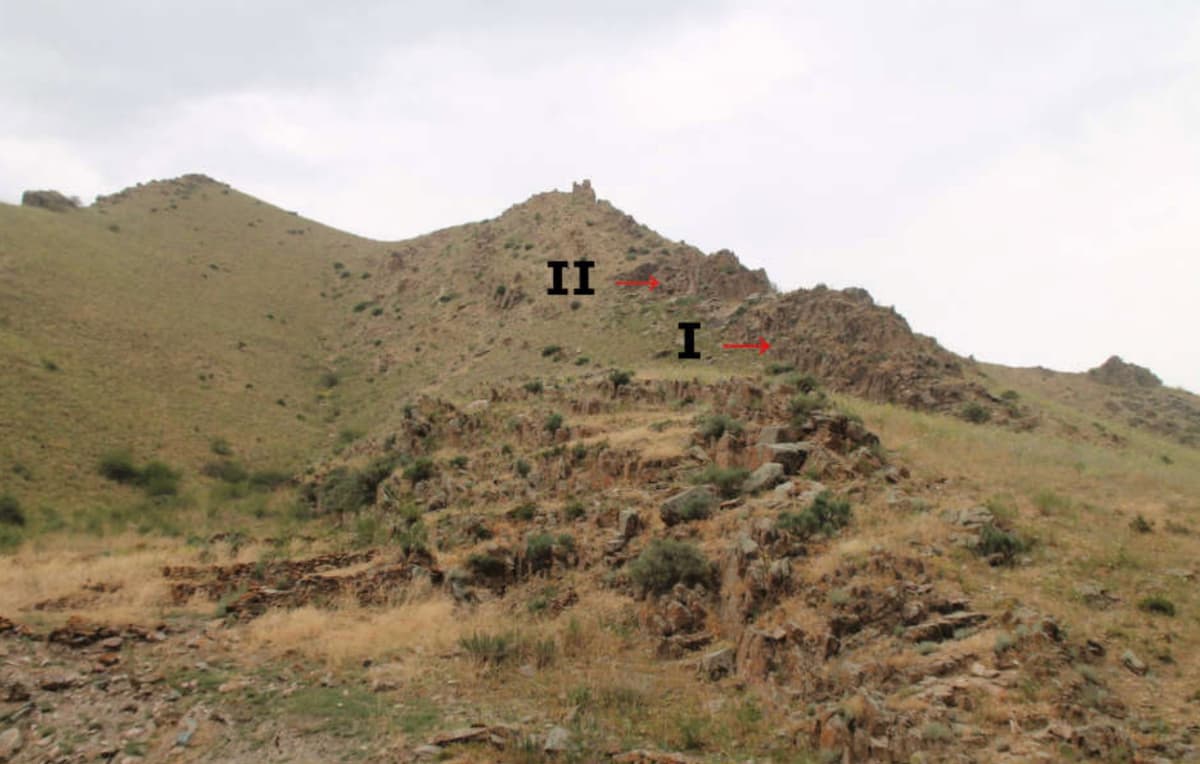
Nearly 600 petroglyphs, rare clan tamgas, and two previously unknown Sogdian texts emerge from a remote mountain valley
The high ridges of western Talas have long guarded their secrets. Now, a small rocky valley near the village of Bakaiyr has yielded one of the most consequential archaeological surprises of recent years: Durdana, a newly documented rock-art site containing almost 600 petroglyphs, ten clan tamgas, and two Sogdian inscriptions that bring us face-to-face with a military commander who lived more than a thousand years ago.
At first glance, Durdana seems modest—just 77 engraved boulders scattered between 1,760 and 1,970 meters. But once researchers began mapping the site in 2024, its significance became unmistakable. The field survey, led by Belgian researcher Luc Hermann in collaboration with the environmental foundation Eco-AYAN and the Manas Ordo memorial complex, revealed a rare convergence of Bronze Age imagery, medieval symbols of power, and direct written testimony from the Silk Road world.

A landscape shaped by herders, warriors, and travelers
Located 66 km southwest of the city of Talas, the valley’s springs and pasturelands made it a natural waypoint for ancient communities. Over centuries, herders left images of wild goats, horses, camels, dogs, deer—and, occasionally, themselves. Of the 593 petroglyphs recorded, 369 depict wild goats, far outnumbering any other animal, a pattern consistent with broader Central Asian rock-art traditions.
The earliest layers belong to the Bronze Age, with 91 engravings. Another 56 date to the Iron Age, but it is the medieval period (9th–11th centuries) that dominates: 283 petroglyphs, many of them executed as tiny, razor-thin graffiti just a few centimeters long. Seven of the site’s ten tamgas—clan symbols marking identity or inheritance—also belong to this horizon.
Later centuries left their traces as well. The Kyrgyz period (17th–19th centuries) contributed 35 petroglyphs and three more tamgas. The modern era added 59 Cyrillic inscriptions, sketched yurts, cars, flowers, and even a Soviet star—stark reminders that carved stone is a living archive.
The breakthrough: two new Sogdian inscriptions

The most remarkable finds sit quietly on two separate rock faces: vertical inscriptions in Sogdian, an Eastern Iranian language once spoken by merchants who knit together the Silk Road. Deciphered by epigraphist Pavel Lurje, the texts preserve the name and rank of a high-status figure.
One inscription, arranged in three lines, reads:
“Mrty ‘yl yk-‘n srð’nk” — “Man El Yegän, commander.”
The presence of a distinctive Uighur-style letter allows archaeologists to date it between the 9th and early 11th centuries. Sixty meters away, a second inscription repeats only the name El Yegän—likely carved by the same individual.
What elevates these texts from curiosity to historical milestone is the title they preserve: sarθang, meaning “commander” or “general.” Known from Manichaean, Buddhist, and Christian manuscripts but never before attested in a secular inscription, the term suggests El Yegän held a senior military position—possibly second in command—within a culturally mixed Turko-Sogdian society.
For researchers of medieval Inner Asia, this is rare, direct evidence of how political authority was expressed in multilingual frontier zones.
Tamgas that tie clans to the land
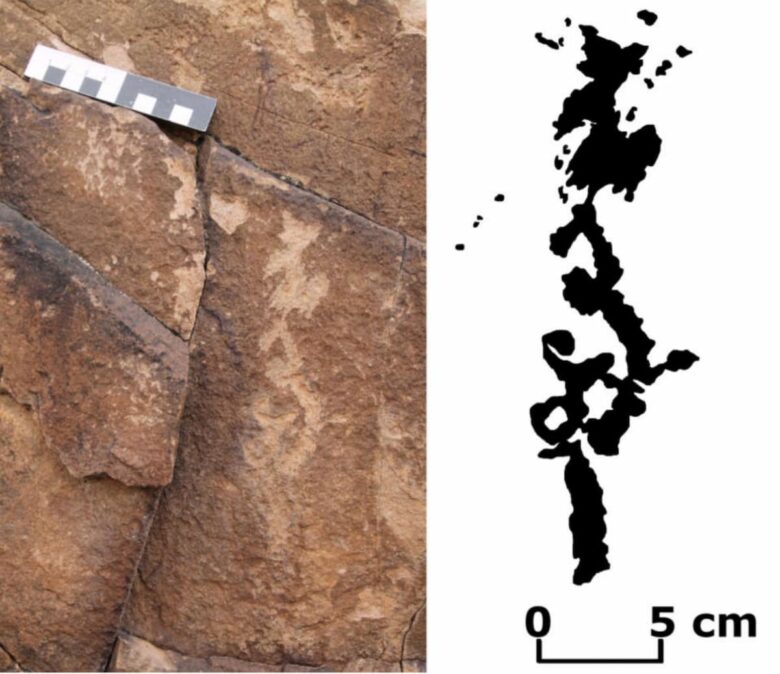
Alongside the Sogdian texts, Durdana yielded ten tamgas representing eight distinct types. Three of these types have never before been recorded in the Talas region. Six symbols were found near the remains of ancient settlements, strengthening the idea that tamgas functioned not only as abstract emblems but as markers of physical territory and family identity.
Although the total number of petroglyphs is smaller than at larger Talas sites, the concentration of tamgas combined with the two Sogdian texts makes Durdana a rare nexus of clan symbolism, personal authorship, and military history.
A new chapter for Kyrgyz rock art
Before this discovery, only one Sogdian inscription was known near Bakaiyr and three more north of Talas. Durdana effectively doubles the corpus and extends the known typology of tamgas in the valley. Supported by a Horizon 2020 grant from the European Union, the project lays the groundwork for further surveys in the region, where researchers expect to find additional clusters of rock art.
The voice of El Yegän, etched into the mountain centuries ago, now joins this expanding archive—a rare moment where the anonymity of rock art gives way to a named individual of high rank, revealing the layered social world that once animated these remote highlands.
Luc Hermann, Pavel Lurje, Gamal Soronkulov, Laurence Delwiche, Azamat Asein Uulu, The new rock art site of Durdana (Talas region) in Kyrgyzstan with tamgas and two new sogdian inscriptions. Maiask, 20 (2025), doi.org/10.53737/2713-2021.2025.87.92.003
Cover Photo: Main ridge of the Durdana site showing the locations of Sogdian Inscriptions I and II. Credit: Luc Hermann.